
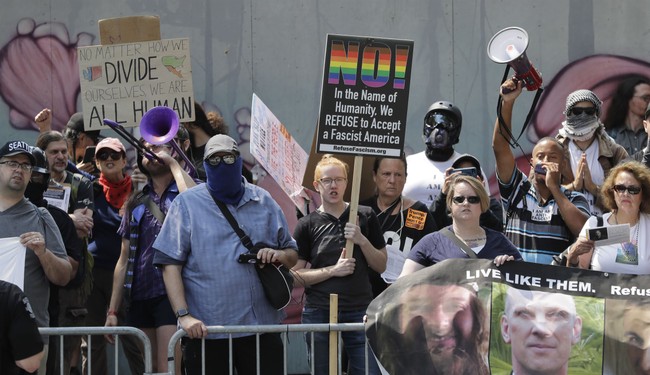
This article examines media treatment of a July 4th public appearance by Patriot Front in Washington, D.C., critiques the surface-level coverage and unanswered questions about the group’s origins and connections, highlights how social media filled reporting gaps, and lays out the tangled history tying Vanguard America, Thomas Rousseau, and allegations involving paid informants and the Southern Poverty Law Center.
The coverage of the Patriot Front sighting during Independence Day events leaned hard on spectacle and outrage while giving readers very little concrete information about who these people actually are. Reporters framed the images and moments as inherently newsworthy, yet often skipped the deeper context readers need to understand the group’s history and structure. The result is visual shock with thin explanatory reporting, which leaves plenty of room for speculation and rumor to take hold.
Photographs of members in matching attire and staged postures dominated the narrative, but the reporting around those images raised as many questions as it answered. How was the photo op arranged, and why were news photographers seemingly in the right place at the right time to capture it? The curious details around masks, timing, and the composition of the scenes were rarely explored, even though those elements could reveal whether the moment was spontaneous or produced for attention.
Social media users supplied some of the missing color and background that mainstream outlets omitted, including details about individuals photographed during the scene. One image featured a homeless woman who appeared to be a repeat presence on the subway, a fact that social posts quickly highlighted to push back on the narrative that the interaction was purely symbolic. That kind of crowd-sourced context matters when the press leaves gaps; it helps explain real dynamics instead of relying solely on performative outrage.
The broader problem is how journalists repeatedly treat groups like Patriot Front as lightning rods to signal the political moment without tracing their lineage or intentions. Commentary often defaults to attributing the group’s existence to contemporary political figures or movements, rather than mapping its actual organizational roots. When coverage leans on tired tropes instead of investigation, readers get a caricature instead of clarity.
The history connecting Patriot Front to earlier extremist formations is essential to understanding why their appearances matter and how they evolve. After the unrest in Charlottesville and the fallout around Vanguard America, a leadership shift produced a splinter that rebranded as Patriot Front. That transition wasn’t simply cosmetic; it changed who led the group and how they presented themselves to the public. These are not idle details; they point to continuity and adaptation that reporters should chronicle.
Questions around accountability and outside influence also deserve attention, especially given recent legal developments involving activist watchdog organizations and federal inquiries. Reports and court filings have suggested payments to informants and the transfer of information about extremist actors to authorities, which complicates the familiar story about who is responsible for exposing or enabling these movements. Those procedural aspects offer insight into how law enforcement and civil society interact with fringe groups.
It is worth noting how individuals navigated the post-Charlottesville environment to reposition themselves and their followers. The leadership move that birthed Patriot Front consolidated much of Vanguard America’s membership under a new banner while leaving some hardline elements behind. That consolidation reshaped the scene and made subsequent appearances less about spontaneous protest and more about organized, image-driven demonstrations designed to attract attention.
Even when mainstream pundits weighed in, their critiques often felt incomplete, stopping short of the full paper trail and internal dynamics that would tell the complete story. Public commentary often pointed to surface associations and symbolic acts without tracing the funding, recruitment patterns, or legal entanglements that matter. A fuller account would examine not only the optics but also who benefits from the spectacle and what networks support it behind the scenes.
https://x.com/jaketapper/status/2073902170550734980
Two passages quoted in previous reporting capture the sense of coordination that made Charlottesville notable:
A gathering of groups in Charlottesville, Virginia, over the weekend showed a new level of cooperation between a wide range of white supremacist factions. The list includes names like Identity Evropa, League of the South, The Daily Stormer and The Right Stuff. It also included Vanguard America.
Another court document summarized how informant programs intersected with law enforcement efforts around individuals tied to extremist groups:
During the April 6 (2026) meeting, defense counsel presented documents and information relating to Individual A, a member of Vanguard America (a well-known extremist group) who sought a national security clearance as part of Individual A’s work at the Philadelphia Navy Yard in 2018. The specific documents counsel provided to the prosecutors showed how and when the informant program gathered and passed information about Individual A to law enforcement.
Those excerpts show why shallow coverage is a problem: they hint at connections and mechanisms that deserve fuller reporting. Journalists who want to serve readers should dig into timelines, leadership changes, and any institutional interactions that help explain why these groups keep reappearing. The public deserves that level of rigor rather than repeated cycles of alarm without depth.
Ultimately, the scene in D.C. was a reminder that image-driven events can obscure more than they reveal when media coverage prioritizes theatrics over investigation. If the point of reporting is to illuminate, then following the money, leadership moves, and legal records is how we get there. Until that happens more consistently, these public appearances will remain headline fodder with too many unanswered questions.
Jake Tapper’s commentary offered a public-facing critique that captured attention but did not exhaust the story, leaving several legal and organizational threads untouched. That gap shows how even prominent voices can frame and then leave essential facts unexplored, which keeps significant questions about origins and influence afloat for readers. A responsible account would follow those threads through to the court filings and organizational histories that connect past events to present appearances.


Add comment