
Checklist: Call for an inquiry into Patriot Front; contrast media and Democratic response with Republican action; note the group’s July 4 march, size, and conduct; point out legal and investigative jurisdiction issues; underline free speech protections and political double standards.
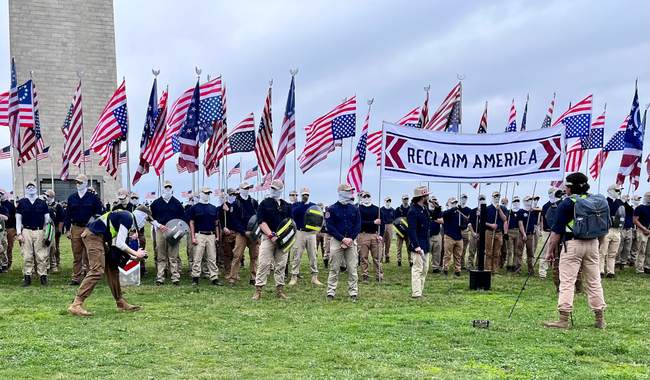
Republican Representative Anna Paulina Luna has urged House Oversight to investigate Patriot Front after its Independence Day march in Washington, D.C., arguing the group’s funding and organization deserve scrutiny. The group drew attention for a 400-person turnout, masks, uniforms, and flags during the demonstration. Luna highlighted what she sees as selective enforcement and a lack of past investigation under the Biden administration. Her push raises questions about whether Congress or federal law enforcement should take the lead now.
For years Patriot Front has been visible for its coordinated street actions and flash demonstrations, and it now finds itself at the center of a partisan argument over who noticed it and when. Many on the right have long complained that certain extremist groups received more attention when it suited political narratives, while others were left alone. Luna’s statement reflects that broader frustration: the sense that investigations follow political winds rather than consistent criteria. That perception fuels calls for a formal, transparent review by congressional oversight.
Rep. Anna Paulina Luna (R-Fla.) on Monday called for an investigation into the Patriot Front white nationalist group after its Independence Day rally and march across Washington, D.C.
“What I find odd about Patriot Front is how under Biden they were never investigated. Well funded. Never investigated,” Luna on the social platform X.
https://x.com/realannapaulina/status/2073992813453135986
“FBI under Biden looked into Catholics instead. So, looks like @GOPoversight should do some digging,” she added, referring to the House Oversight and Government Reform Committee.
How federal investigations proceed is shaped by who controls the executive branch, and Republicans argue the likelihood of action shifts with administrations. The FBI sits in the executive branch, so congressional referrals and public pressure can influence priorities but do not guarantee investigative outcomes. Luna’s call is as much political signaling as a procedural request because Congress can subpoena, hold hearings, and press agencies for records. That process would put the group’s finances and networks under a public microscope.
The Patriot Front march was lawful in the sense that participants did not, by most accounts, engage in violence or property destruction during the demonstration. Observers noted masked, uniformed marchers and some upside-down flags, creating a striking visual but not an immediate law-and-order crisis. Conservatives who defend robust free speech point out that distasteful or extreme political views are still protected under the First Amendment unless they cross into illegal actions. That constitutional protection complicates calls for criminal probes unless evidence of criminal behavior emerges.
Even so, public officials have a duty to investigate groups that organize at scale when questions about funding, outside influence, or coordinated illegal activity arise. A committee investigation could clarify whether domestic or foreign money, organized networks, or hate group affiliations are involved. Transparent oversight would provide voters with facts and undercut partisan speculation. Republicans argue that if serious financing or illicit coordination is found, it would justify a broader federal response regardless of political affiliation.
There’s also a political contrast at play: critics on the right ask why similar visibility in past years did not prompt the same level of scrutiny from Democrats or the media. That perceived asymmetry fuels distrust in public institutions and in the press. From a Republican standpoint, consistent application of investigative resources should not depend on which party or president is in power. Luna’s move seeks to force that consistency by putting the question into the public record.
Talking about extremist groups also requires careful language. Labeling an entire movement without evidence of crimes risks exaggerating threats and diluting focus from acts of real violence. Yet lawmakers must weigh the seriousness of organized, uniformed demonstrations advocating exclusionary ideologies and decide whether oversight is warranted. A congressional probe would test the facts: funding trails, organizational structures, and any ties to criminal acts. That fact-finding route is preferable to speculation and selective outrage.
Whether the FBI or the House Oversight Committee takes primary action, the debate highlights broader tensions over political priorities, media coverage, and how Americans perceive threats from the extremes. Republicans like Luna see this moment as an opportunity to demand answers and to press for uniform standards in investigating domestic extremist movements. The outcome will hinge on what investigators find and how both branches of government choose to respond.


Add comment