
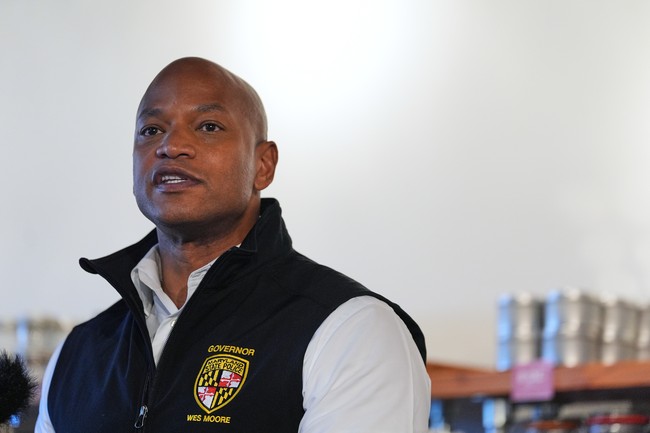
Maryland’s political theater moved from headline to hazard when Governor Wes Moore blocked local cooperation with federal immigration enforcement, prompting a blistering response from the White House press secretary and raising real questions about public safety, law enforcement coordination, and political priorities in a deeply blue state.
Maryland has been reliably Democratic for decades, and that political landscape shapes how officials act and how voters react. Longstanding local customs and party dominance mean statewide choices often reflect partisan signaling as much as practical governance. When a governor with national ambitions takes a high-profile posture against federal authorities, the consequences ripple through communities and police departments.
The controversy centers on Governor Wes Moore forbidding state and local law enforcement from assisting federal immigration agents, a move denounced by the White House press secretary as deliberately political and dangerous. That rebuke landed in public briefings and social channels and was quickly seized by critics who argue the policy sacrifices safety for headlines. The debate now revolves around whether the decision protects civil liberties or hampers basic law-and-order cooperation.
Local sheriffs and police chiefs generally value the ability to coordinate with federal partners because joint efforts can reduce risk and streamline arrests. When that cooperation is cut off, federal agents say they face higher danger and more complicated operations. Those claims resonate with voters who prioritize safety and expect pragmatic partnerships between jurisdictions rather than ideological stand-offs.
Here is how the Press Secretary responded to a question on the topic:
First of all, it’s another despicable action by Governor Wes Moore. Why would you prevent your state and local law enforcement from cooperating with federal law enforcement? If you just ask them, to your point, you ask sheriffs across the country if they want to have that level of cooperation and coordination with the federal government, of course, they do. It makes their jobs easier, it keeps them out of hostile and dangerous environments, it allows them to detain illegal alien criminals who have committed heinous crimes in our country with, with, the most safe circumstances possible. So the president, of course, continues to always stand on the side of law enforcement, and this is another, just horrible and frankly political action taken by Governor Wes Moore, and unfortunately, the people of his state are going to reap the consequences of it.
The press office framed the move as political theater aimed at score-settling rather than measured policy making, and that reading is hard to ignore given the timing and the national context. Conservatives see the governor’s choice as an example of virtue signaling that puts officers and citizens at risk. They argue that public safety should not be traded for political optics, especially when coordination can prevent violent offenders from remaining free to reoffend.
Critics compare reactions to federal immigration efforts under different administrations and accuse Democratic leaders of hypocrisy when their priorities flip based on who holds the White House. From this viewpoint, when Democrats control federal power they demand enforcement, and when Republicans lead, some Democratic governors refuse to cooperate. That selective approach fuels distrust and makes meaningful enforcement inconsistent across state lines.
The practical fallout is not abstract: it affects patrol officers, federal agents, and residents who expect their leaders to put safety first. Law enforcement professionals say the ability to hand off detained suspects or to rely on shared intelligence reduces the risks of arrests and keeps dangerous people off the streets. When that mechanism is blocked, operations become messier and potentially more hazardous for everyone involved.
There’s also a political calculation in play. Governors who take symbolic stands often expect applause from their base and national visibility, but those gambits can wear thin when public safety incidents make the headlines. Opponents argue that short-term applause does not excuse long-term public risk, and they warn that voters will notice which officials protect neighborhoods and which prioritize messaging.
Beyond immediate law-enforcement effects, the policy raises questions about democratic accountability in states where one party dominates. When the party in power effectively controls access to civic participation, dissenting voices and policy alternatives struggle to gain traction. That concentration encourages political posturing because there are fewer institutional checks on dramatic executive choices.
Residents and local leaders who are focused on daily safety now face a choice between civic patience and political pressure. Some will press lawmakers to restore interagency cooperation; others will double down on sanctuary-style policies. Either way, the issue has transformed from an administrative directive into a test of priorities for Marylanders and for the broader debate over immigration and enforcement nationwide.
Commentary and accusations will continue, and legal and operational consequences may unfold in courtrooms and on busy streets. The practical implications for law enforcement coordination will be tracked closely, and the political fallout could influence electoral dynamics in the state and beyond as voters evaluate which leaders they trust to keep communities secure.
Public voices from both sides will keep this story alive, but the central fact remains: a governor’s decision to bar cooperation with federal immigration agents has opened a sharp dispute over safety, strategy, and the role of partisan theater in governing. Those stakes are what make this episode more than a headline and why officials across the spectrum are watching the outcomes closely.


Add comment