
This article reviews the conviction of Karmelo Anthony for the 2025 stabbing of 17-year-old Austin Metcalf at a high school track meet, examines the contested “sudden passion” claim being argued during sentencing, lists key questions about how and why the incident happened, and includes exact testimony and jury instruction text relevant to how jurors will decide punishment. It lays out the facts and the doubts without adding outside links or commentary beyond the available record.
Could Convicted Murderer Karmelo Anthony Get Off Easy? Jury Contemplates ‘Sudden Passion’ Defense
The jury found Karmelo Anthony guilty of murder in the fatal stabbing of Austin Metcalf at a Frisco, Texas, high school event. Prosecutors say Anthony brought a knife to the track meet, sat in a rival school’s tent, and stabbed Metcalf after a confrontation. He now faces a wide sentencing range, depending on whether jurors accept the “sudden passion” defense presented by his lawyers during the sentencing phase.
The “sudden passion” theory argues the killing happened under an immediate emotional influence that could reduce the sentence dramatically. If jurors unanimously decide the killing occurred under sudden passion, the instructions allow a sentence of no less than two years and no more than 20 years. If they conclude the opposite, the possible punishment jumps to life or between five and 99 years, with fines and parole rules also described in the jury instructions.
The official jury language included the following: “Jury instructions included the issue of ‘sudden passion.’ If the jury unanimously finds that the defendant caused the death under the immediate influence of ‘sudden passion,’ he may be sentenced for no more than 20 years and no less than 2 years. If the jury unanimously finds that the defendant did not cause death under the immediate influence of ‘sudden passion,’ he may be sentenced to life imprisonment, or no more than 99 years, or no less than 5 years. In either case, a fine not to exceed $10,000 may also be imposed. The sentence may also be reduced by parole; however, the defendant is not eligible for parole until the time served equals half of the sentence imposed or 30 years, whichever is less. The verdict must be unanimous.”
There are major issues with the sudden passion claim in this case, starting with why a teenager would bring a knife to a school sporting event where weapons are forbidden. Observers and witnesses reported that Anthony went to a rival tent and stayed even after being told to leave, and multiple classmates said he appeared to be looking for trouble. Those facts feed the prosecution argument that the violence was not an impulsive reaction but a foreseeable escalation.
Defense strategy focuses on a narrow window of emotional heat that could reframe the act from first-degree murder to a lesser offense for sentencing purposes. That legal nuance matters a lot: the difference between two years and 99 years is not academic to the victim’s family. Jurors must decide if a shove or an insult triggered an uncontrollable, immediate reaction or if the defendant made a choice that led to a preventable death.
Eyewitness testimony included direct confrontation and threats before the stabbing took place. One account quotes Anthony as saying, “F— y’all. I’m not going to leave. Y’all are a bunch of pu–ies. Y’all not going to do anything.” The same testimony claimed he threatened, “Touch me and see what happens.” Metcalf reportedly replied, “I’m not going to fight you.” Those words are part of the factual record jurors will weigh against the sudden passion claim.
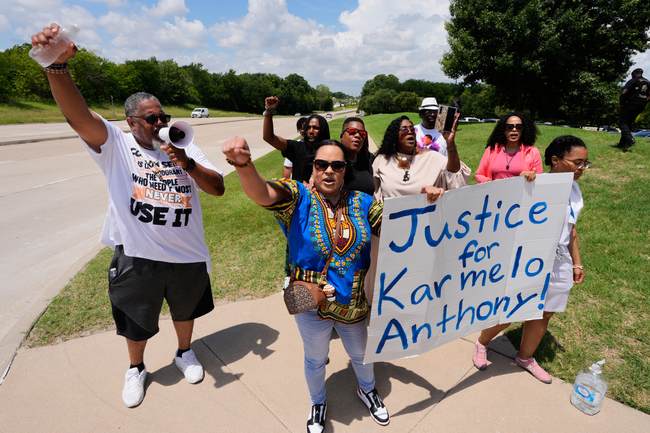
Closing statements and reactions outside the courtroom underscored how polarized feelings run when a young life is taken in a public, preventable setting. Supporters of strict accountability argue that forgiving violent acts because of youthful emotion erodes public safety and justice. Others push for mercy when a defendant is young, citing rehabilitation and the possibility of remorse, which keeps the debate over punishment alive in the jury room.
The community impact is plain: a promising teenager is dead, a family is grieving, and a separate life now faces decades behind bars depending on the jury’s interpretation. The case raises questions about personal responsibility, juvenile behavior, and how criminal law treats heat-of-the-moment violence. Those tensions are exactly what jurors must resolve as they consider both the facts and the law laid out in court.
https://x.com/Brooketaylortv/status/2064459385359802586?ref_src=twsrc%5Etfw
Ultimately, the sentencing phase turns on whether jurors find sudden passion present and unanimous agreement on that finding. The instruction that the verdict must be unanimous raises the stakes and ensures that a single holdout could steer the outcome toward a harsher sentence. Whatever the result, this case will linger as a reminder of how one violent decision can forever change multiple lives.



Add comment