
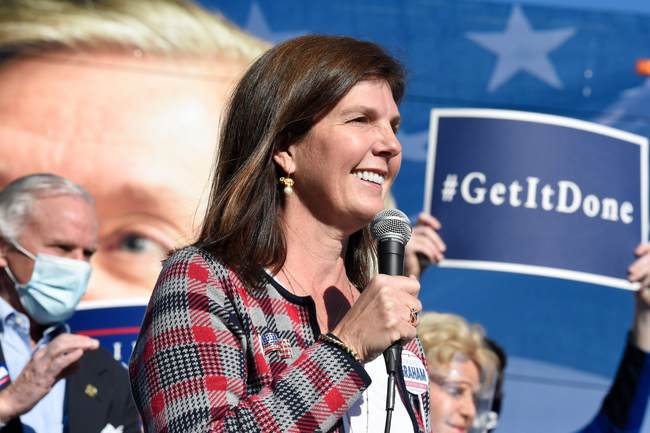
The South Carolina Republican governor’s primary is headed to a runoff between Lt. Gov. Pam Evette and Attorney General Alan Wilson after no candidate cleared the 50 percent mark, with former Congresswoman Nancy Mace falling well short despite expectations and a contentious endorsement battle. With roughly 60 percent of precincts reporting, Evette led with about 29 percent and Wilson followed with roughly 26 percent, setting up a June 23 rematch that will shape the GOP’s direction in the Palmetto State.
The contest revealed how endorsements and perceived loyalty to President Trump still carry real weight in Republican primaries. President Trump formally backed Pam Evette on May 29, two weeks before the primary, a move that bypassed Nancy Mace and reshaped expectations. Mace had been confident she would receive the endorsement and blamed her outspokenness on certain national issues for costing her that backing.
https://x.com/DecisionDeskHQ/status/2064505105697669179
Pam Evette positioned herself as a proven administrator who could translate private sector experience into effective state leadership. She stressed her business background and experience in state government while aligning closely with conservative priorities and President Trump’s agenda. That alignment seemed to pay off in a crowded field where unity with the national GOP base matters to primary voters.
Alan Wilson ran as the steady, law-and-order candidate rooted in state institutions and conservative governance. His message focused on affordability, public safety, and job creation along with efforts to bridge political divides within the state. Wilson’s second-place finish reflects a durable base of support among voters who prioritize experience in statewide office and practical solutions to everyday problems.
Nancy Mace’s decision to leave Congress and run for governor was a high-risk play that did not pay off this cycle. Mace claimed that her defense of Epstein victims and her calls for transparency around the “so-called Epstein files” cost her President Trump’s endorsement. She finished fifth, which means she will be out of elected office when her current term ends in January 2027, at least for now.
The runoff is now a straightforward head-to-head between Evette and Wilson, forcing Republican voters to choose between a Trump-backed outsider-with-government-credentials and a longtime statewide official. The dynamic will sharpen the contrast between a candidate running partly on national alignment and a candidate emphasizing state-level experience and continuity. That contrast should drive voter turnout and messaging over the next few weeks.
Both campaigns have signaled a willingness to debate before the June 23 runoff, which will give voters a clearer look at policy specifics and leadership styles. Expect debate talking points to rotate around crime, taxes, public education, and how to handle the economic pressures families face today. Each candidate will try to frame the other as less able to defend conservative priorities while promising practical results.
Republican activists and local leaders will be key in swinging the runoff, especially since several candidates who finished behind Evans and Wilson together attracted a sizable portion of the vote. Those supporters will be courted aggressively, and endorsements from local sheriffs, mayors, and state legislators could decide the outcome. Grassroots organizing and the ability to turn supporters out on June 23 will likely be decisive.
The South Carolina race also highlights a broader lesson for GOP hopefuls nationwide: a strong national brand helps, but it does not guarantee victory without a compelling local case. Evette’s Trump endorsement gave her momentum, but she still fell well short of an outright majority. Wilson’s solid showing shows voters can reward steady conservative stewardship even when a high-profile endorsement reshuffles the deck.
Campaign resources and messaging tactics will intensify as the runoff approaches, and outside groups will probably weigh in to protect or challenge the candidates. Evette’s alignment with the former president will likely attract national attention and fundraising, while Wilson’s record as Attorney General will give him concrete talking points on law, order, and state governance. Both paths offer a plausible route to victory depending on turnout patterns.
For South Carolina Republicans, the runoff is a moment to decide whether the state’s next governor will be the candidate most closely tied to the national MAGA movement or the candidate grounded in statewide executive experience. That choice will shape policy priorities and political dynamics in Columbia for years to come, and it will send a signal to other Republican primaries about the balance between national endorsements and local credibility.



Add comment