
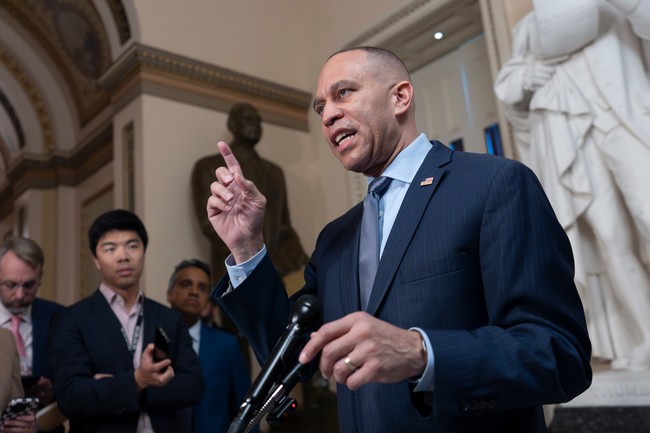
The House Democratic leader Hakeem Jeffries launched a fierce public attack on the Supreme Court after the Court’s ruling in Louisiana v. Callais, and his comments have raised questions about tone, intent, and respect for institutional norms in the wake of a high-stakes legal decision. This piece examines Jeffries’ remarks, the political context around the Voting Rights Act case, and why such rhetoric matters for public confidence in the judiciary and the rule of law.
The Supreme Court’s decision in the Louisiana voting case is the spark that set off this firestorm, and Democrats see the ruling as a threat to their prospects in future redistricting fights. From a Republican viewpoint, the ruling reflects a judicial check that can change political maps and election dynamics, which naturally alarms the party that benefits from the current balance. That makes sharp responses from political leaders predictable, but predictability does not excuse incendiary language aimed at the Court itself.
After the decision, Jeffries used language that many found alarming, arguing that the outcome reflected a “corrupt MAGA majority” issuing political opinions. Those words were not uttered in a private briefing; they were public, forceful, and personal. When party leaders describe the Court in those terms, it corrodes the usual deference toward judicial outcomes and invites a cycle of escalating political retaliation.
“Everything is on the table – everything – to deal with this corrupt MAGA majority that is issuing political opinions that are designed to bolster the prospects of the Republican Party, and we will not allow them to succeed.”
Those quoted words deserve scrutiny because they move beyond disagreement into the realm of action-oriented promise. “Everything is on the table” can be read broadly: court packing, legislative retaliation, or other institutional maneuvers aimed at reshaping judicial outcomes. From a conservative vantage, that phrasing sounds like a direct challenge to the independence of the judiciary and a bid to tilt it toward partisan preferences.
Politicians are supposed to work within the constitutional framework when they disagree with judicial rulings, even deeply. The normal playbook is to seek legislative fixes, pursue new cases, or respond at the ballot box; none of those moves require labeling the Court corrupt. Calling the Court corrupt without presenting evidence undermines trust in both branches and gives opponents cover to question motives when judges apply law rather than politics.
It’s also worth noting the optics of timing and tone. The country is still processing other high-profile events tied to the nation’s political theater, including a violent episode that drew national attention at a recent political dinner. In that climate, leaders’ words carry extra weight and can inflame supporters or antagonists alike. For stability, public officials should avoid rhetoric that could be seen as baiting conflict or encouraging extra-legal responses.
Critics of the Court often accuse justices of issuing “political opinions,” but the counterargument is straightforward: judges interpret law and Constitution, not campaign strategy. If a party disagrees with the judicial interpretation, the remedy is democratic—change the law through elected representatives or elect different representatives who will pass new statutes. Court packing or similar structural interventions are a blunt instrument that risks long-term damage to institutional neutrality.
Jeffries’ remarks also suggest a strategic calculation: when a party faces an adverse ruling, mobilize outrage to drive turnout and pressure sympathetic constituencies. From a Republican perspective, that strategy should be met with clear-eyed rebuttal rather than alarmist surrender. Voters want leaders who respect institutions and lay out legal and political options without resorting to personal attacks on judges or threats against the judicial process.
There is a real debate to be had about voting rights, fair maps, and how the law should treat racial considerations in districting. That debate is essential and healthy for a functioning democracy, and it should be waged with facts, precedent, and respect for judicial roles. Turning the dispute into a crusade against a Court perceived as hostile risks transforming legitimate policy disagreement into institutional warfare.
At the end of the day, political leaders can challenge decisions through legislation, fresh litigation, or mobilizing voters, but they should not undermine the judiciary by implying corruption without evidence. Respect for the rule of law means engaging the system even under unfavorable rulings, not threatening its foundations. The tone Jeffries used does not help persuade skeptical voters that his aims are purely legal or constitutional rather than raw partisan advantage.
Add comment