
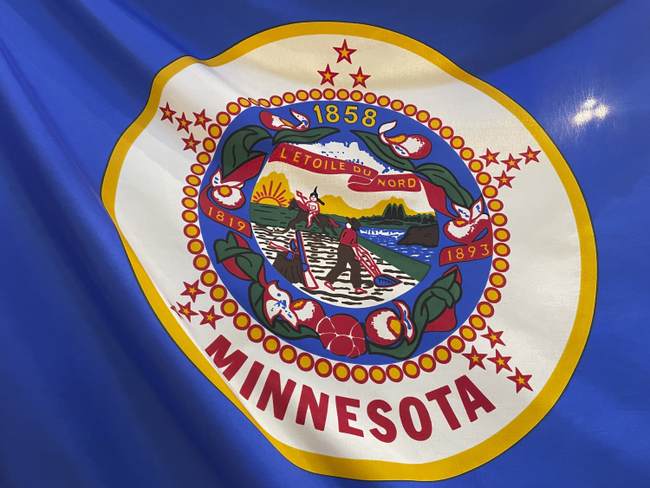
The Minnesota flag fight has become another example of politics trumping common sense: state Democrats pushed a bill to cut aid from cities or counties flying the old flag, critics say the new design is unimpressive and politically motivated, and the controversy sits on top of a massive fraud scandal that has left citizens furious and communities worried about lost services.
The story starts with revelations about widespread fraud in Minnesota that exposed troubling oversight and suggestions that top Democrats were aware of problems and failed to act. That scandal has polarized the state and sharpened scrutiny on decisions that look like political favors rather than governance. Into that tense environment came a new flashpoint: a redesigned state flag adopted in 2023 that some communities rejected and returned to the original banner. The reaction from the DFL was swift and punitive.
On the Minnesota House floor, lawmakers introduced legislation aimed at penalizing cities and counties that fly any flag other than the redesign certified by the State Emblems Redesign Commission. The proposal would reduce state aid to jurisdictions that use the older flag, with the penalty set to take effect in 2027 if the bill becomes law. Critics argued the move was less about flags and more about forcing compliance with a political decision that lacked broad local support.
The timing and tone of the measure struck many as petty. Cities like Inver Grove Heights, Elk River, Champlin, Zumbrota, and Plainview chose to hoist the historic flag, claiming it reflects local heritage or simply better imagery. Those actions were described by local officials as civic choices, not provocations, yet the state-level response treated them like acts of defiance that should be punished with less funding for essential services. That raised immediate concerns for smaller towns that depend on state dollars to fund police, fire, and other critical services.
The argument used to justify the new flag hinged on claims the 1893 design carried racist imagery, and official commentary pointed to a seal showing a Native American riding into the sunset while a White settler plows a field. That interpretation has been widely reported and quoted in debates over the flag. Opponents counter that the criticism is an overreach of woke interpretation and that replacing the historic flag is an unnecessary rewrite of local symbols.
“The seal depicts a Native American riding off into the sunset while a White settler plows his field with his rifle leaning on a nearby stump. The imagery suggests to many that the Indigenous people were defeated and going away, while Whites won and were staying.”
The replacement adopted in 2023 features an eight-pointed star on a navy background beside a light-blue field meant to represent water, with a shape intended to echo the state outline. Skeptics called the design bland and said it lacks the resonance of the old flag. Some critics even pointed out a similarity to the Somali national flag, which added an awkward visual comparison that critics used to underscore their point about poor design choices.
Meanwhile, the backdrop to this dispute is the staggering scale of uncovered fraud in Minnesota, estimated at roughly $9 billion. Reports indicate a high percentage of those charged were of Somali descent, and those facts have fed a furious debate about enforcement, oversight, and political priorities in the state. For many Republicans and conservatives, the federal and state response to the fraud has been far too lenient and politically tilted, especially when immigrant political blocs are implicated.
Critics accuse state Democrats of prioritizing political alliances over accountability, suggesting that pandering to certain voting blocs has produced a blind spot that allowed fraud to flourish. The flag fight, from this perspective, looks like a distraction aimed at shaming local officials who refused to fall in line with the party’s cultural rebrand. That kind of political posture, critics say, risks harming small communities that rely on stable funding rather than partisan grandstanding.
Smaller towns with populations under 25,000 face particular vulnerability if aid is cut, since even modest reductions can force layoffs or cuts to emergency services. Local leaders warn that the threat of reduced funding creates real-world consequences beyond symbolic culture wars. Lawmakers on the other side insist the redesign is the official state symbol and deserves uniform use, but opponents see enforcement as heavy-handed and unnecessary.
Republican leadership in the Minnesota House pushed back publicly, arguing the bill would not survive and that diverting funds from police and fire to punish towns is a reckless priority. “That bill is dead on arrival. There is no way this bill is moving through. To know that Democrats are trying to take funding away from our police and fire, from our cities, it’s ridiculous. We have real work that could help Minnesotans.”
The flag dispute has become a proxy for larger complaints about governance, accountability, and political tone in Minnesota. Citizens and officials on both sides are dug in, and the debate over symbols now runs alongside urgent questions about fraud, public safety funding, and whether state government is listening to the communities it serves. The outcome will tell a lot about which priorities win in Minnesota politics this year.



Add comment