
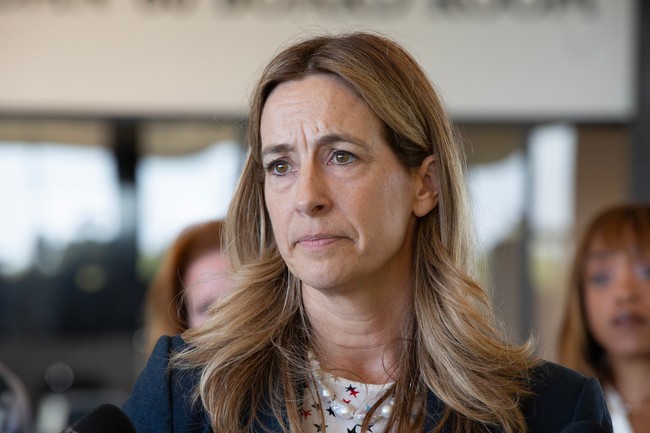
The piece examines Rep. Mikie Sherrill’s response to sustained anti-ICE demonstrations at Delaney Hall in Newark, criticizes her past alignment with protesters, and highlights calls from former ICE leadership that her late pivot to manage protests is political damage control rather than real leadership.
Elected officials should be judged by actions, not just statements, and hindsight matters when public safety and federal law enforcement are involved. In Newark, a pattern of protests at Delaney Hall has repeatedly tested the balance between civil demonstration and direct confrontations with federal agents. Local decisions about how to respond have consequences for the safety of officers, detainees, and nearby families.
These anti-ICE demonstrations have at times crossed into violence and dangerous clashes, creating situations where federal officers try to carry out removals while facing aggressive obstruction. The protests have been described by critics as driven by incendiary rhetoric and have sometimes led to arrests and physical altercations. Observers warn that tolerating that escalation invites more disorder and undermines the rule of law.
Newark’s sanctuary policies and the political posture of state and local leaders have complicated the response. When local law enforcement is ordered to stand down, federal officers are left to manage high-tension operations with fewer resources and less coordination. Some Democratic officials have made public appearances at these protests, framing their presence as advocacy for humane treatment while downplaying the risk to officers on the ground.
Rep. Mikie Sherrill showed up at Delaney Hall on Memorial Day to voice concerns about conditions and to demand access for oversight, saying, “I went to Delaney Hall after reports of unsafe and unconstitutional conditions inside, and what I heard from families and advocates was heartbreaking. The people being held there are fathers, mothers, sons, and daughters who deserve to be treated with dignity.” Her request for entry was denied, and she vowed to press for answers.
That statement, however sincere it may read, came amid demonstrations that critics say deliberately provoked ICE agents and threatened their families. Those critics argue that Sherrill’s initial public posture condemned enforcement but did not address the growing public-safety threats posed by some protesters. The situation escalated for days, and only afterward did she announce a managed protest zone to try to contain the unrest.
The timing of that announcement drew sharp rebukes from former ICE leadership and conservative commentators who see it as political theater. Former ICE Deputy NYC Field Office Director Scott Mechkowski noted the delay and framed the move as after-the-fact damage control, arguing authorities should have enforced order and protected federal operations from the start.
I went to Delaney Hall after reports of unsafe and unconstitutional conditions inside, and what I heard from families and advocates was heartbreaking. The people being held there are fathers, mothers, sons, and daughters who deserve to be treated with dignity.
My request to access the facility was denied this morning, raising even more questions about what they are trying to hide from public view. I’ll keep fighting for answers and to hold ICE accountable.
Mechkowski and others pressed the point that leadership means preventing small fires from becoming large ones, not stepping in for photo ops once a crisis has peaked. He described the late designation of a protest zone as insufficient when the situation had already produced repeated clashes and use of chemical agents. The message from those critics is that protecting law enforcement and enforcing the law should have been priorities from day one.
https://x.com/GovSherrillNJ/status/2059056021545324882
From a Republican viewpoint, the broader pattern is clear: permissive local policies combined with performative political gestures create openings for disorder to fester. When politicians prioritize optics over operational solutions, federal officers and local residents bear the cost. That dynamic also fuels an electoral narrative in which Democrats appear to side with activists even when public safety is at risk.
Advocates for tougher enforcement argue that legitimate oversight and humane treatment of detainees are important, but those goals cannot come at the expense of allowing dangerous confrontations to continue unchecked. The debate over Delaney Hall shows how complex these situations are and how quickly they can deteriorate when political signaling replaces coordinated, practical responses.
What remains under debate is whether the newly announced measures will meaningfully restore order or simply serve as a pause button until political heat dies down. Residents, officers, and detainees need consistent, enforceable policies and clear coordination between federal, state, and local officials. Without that, cycles of protest and confrontation are likely to repeat, and the communities on all sides will keep paying the price.
Add comment