
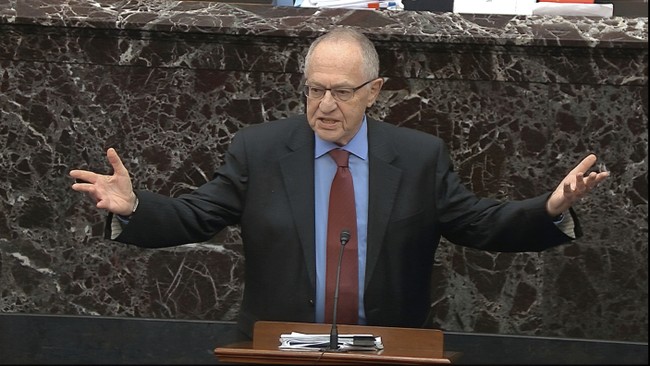
Alan Dershowitz, long a Democratic stalwart, has officially re-registered as a Republican, citing a shift in the Democratic Party’s stance on Israel and a broader move away from the center; he says he will work, donate, campaign, and vote to keep Republicans in control of Congress and urges fellow pro-Israel Americans to consider changing their affiliation or at least voting against Democratic candidates.
Alan Dershowitz’s party switch is newsworthy because he spent most of his life tied to the Democratic Party and only recently left to register as an independent before becoming a Republican. The announcement surfaced on a national morning cable program and in his own public statement, and it has already sparked debate about the broader realignment of senior legal minds and pro-Israel constituencies. For many conservatives, his decision feels like confirmation that the Democratic Party has drifted from positions once regarded as mainstream.
He made his change public with strong language about the Democratic Party’s direction, pointing squarely at what he says is increasing hostility toward Israel and a shift toward radicalism. That concern is not abstract; Dershowitz cites recent Senate votes and the rise of specific Democratic primary contenders as evidence of a serious policy and ideological turn. His move is framed as both principled and practical: he intends to back Republican candidates financially and politically to block Democratic control of Congress.
The announcement was broadcast on the Fox News morning program, . In his longer commentary he set out his reasoning about party priorities and foreign policy, insisting the Democratic Party has shifted from the center at a time when steady support for key allies matters. For observers on the right, that shift confirms a narrative about the Democratic Party embracing positions that alienate traditional supporters and donors.
DERSHOWITZ DEPARTS: Legal legend Alan Dershowitz is officially ditching the Democratic Party. The lifelong liberal is registering as a Republican, citing the Democratic Party’s “hostility” toward Israel and a radical shift that he warns is “bad for America.” “I intend to work hard to prevent the Democrats from gaining control of the House… and Senate, and I urge those who share my concerns about the increasing influence of radicalisms in the Democratic Party to vote, campaign and contribute for continued Republican control of Congress.”
He expanded on that theme in an op-ed, where he described recent Senate actions and primary campaigns as evidence the anti-Israel wing of the left has moved from the margins to the center. He emphasized polls showing younger voters trending against Israel and noted that the problem may no longer be generational but generational plus party-wide. In his view, the Republican Party still contains an antisemitic fringe, but that element remains marginal compared with what he sees on the Democratic side.
The Democratic Party has become the most anti-Israel party in U.S. history. Last week all but seven Senate Democrats voted for an arms embargo against the Jewish state, and an avowed enemy of Israel, Abdul El-Sayed, is gaining ground in the Democratic campaign for U.S. senator from Michigan.
There is no denying that the hard left, anti-Israel wing of the Democratic Party has moved from the fringe to the mainstream. Until recently there was an age gap, with younger voters more strongly opposing Israel, but recent polls suggest that the trend now includes Democrats of all ages. Republicans have their own antisemitic fringe, but for now it remains a fringe.
Dershowitz makes explicit how he plans to act on his decision. He vows to donate to Republican campaigns, to appear at Republican events, and to urge pro-Israel Americans to alter their political behavior in response. He says this is not a mere symbolic gesture but a campaign-level intervention aimed at preserving congressional control aligned with his foreign-policy priorities. That kind of public realignment from a high-profile legal scholar carries weight beyond a simple registration form.
I believe that the Democratic Party’s hostility to Israel represents a deeper and more dangerous shift away from the center and toward a radical approach that is bad for America and the free world. So I intend to work hard to prevent the Democrats from gaining control of the House and Senate, and I urge those who share my concerns about the increasing influence of radicalism in the Democratic Party to vote, campaign and contribute for continued Republican control of Congress. I will contribute money to Republican candidates, campaign for them, make speeches at Republican events, and urge pro-Israel Americans to change party affiliation or at least vote against Democrats. Until something changes, I will vote Republican for representative, senator and president.
Beyond the politics, Dershowitz’s background explains why his voice carries attention: Yale Law School graduate, early Harvard law professor, and a defense attorney for high-profile cases spanning decades. His résumé includes clients and cases that kept him in the public eye and positioned him as a staunch defender of free speech principles, even for speech he found objectionable. Given that history, his decision to change party affiliation underscores how strongly he now perceives the risk posed by the Democratic Party’s ideological trajectory.
This move will be debated on media platforms and among voters who watched his career unfold over decades. For conservatives, Dershowitz’s switch is an emblem of a bigger story: longstanding institutions and figures reassessing where their interests and values fit in today’s partisan landscape. As he actively supports Republican candidates and urges others to follow suit, his next steps will test whether public influence from a single, prominent defection can shift broader political alliances.



Add comment