
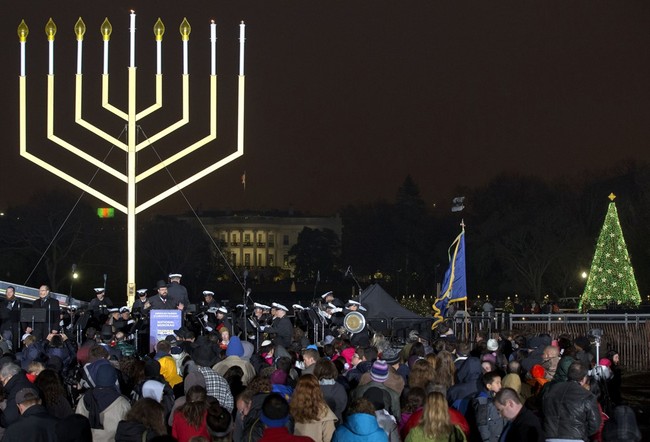
On the first night of Hanukkah, Washington, D.C. held its annual menorah lighting on the Ellipse despite recent international attacks and cold weather, bringing people together to honor tradition, mourn losses, and show resilience.
Crowds gathered in freezing air on the Ellipse to mark the holiday’s opening night, refusing to let fear push public observance into the shadows. Organizers and worshippers treated the ceremony as both a celebration and an act of communal defiance after violent incidents overseas and at home. The event’s tone moved between solemn remembrance and determined resolve to keep public Jewish life visible and secure.
Rabbi Levi Shemtov, Executive Vice President of American Friends of Lubavitch (Chabad), opened the evening by asking for prayers for Ahmed al Ahmed, the Bondi Beach shop owner who confronted an attacker in Australia. He highlighted the courage of bystanders who stepped in during the Bondi Beach massacre and asked attendees to observe a moment of silence for the victims. The request set a serious, unified note for the ceremony that followed.
After the moment of silence, Rabbi Shemtov emphasized Chabad Lubavitch’s choice to continue public Hanukkah programming around the world despite the recent violence. He put the decision in the context of thousands of events across the United States and over a hundred countries, framing public celebrations as an answer to terror. The goal, he said, was to replace the darkness brought by attacks with visible light and steadfastness.
Now obviously this event is the most prominent celebration of Hanukkah if not the most widely publicized Jewish event anywhere in the world. I join with over 5,000 of my colleagues in all 50 states and over 110 countries who are organizing some 15,000 public Hanukkah events. The decision was made by the central organizational leadership of the international Chabad Lubavitch movement to continue with our public celebrations of Hanukkah, obviously with increased security measures as you’re very easily able to see today. So that the darkness that came over our colleagues and across the greater Jewish community as a result, will be answered with strength, light, and resistance.
Security was visibly heightened for the Ellipse event, reflecting both real threats and the determination to keep public worship safe. Law enforcement and private security worked together, and organizers made clear that public Jewish life would not retreat behind closed doors. Attendees responded with applause and a palpable sense of solidarity.
Among the attendees were public figures and diplomats who underscored the political and cultural weight of the gathering. Remarks at the menorah lighting connected the ancient festival’s message of light and perseverance to current events and to the broader fight against antisemitism. Leaders used the platform to stress unity with Jewish communities at home and abroad.
WATCH:
United States Secretary of Commerce Howard Lutnick and Ambassador Stuart Eizenstat joined other officials at the ceremony, lending official recognition to the night’s message. During his remarks, Lutnick praised the administration’s support for Jewish Americans and noted efforts to secure and free hostages. He echoed a call to public pride in faith, quoting, “We should celebrate proudly, we should celebrate loudly, we should celebrate being Jews.”
WATCH:
The weekend before the lighting had been marred by multiple violent incidents that amplified concern among Jewish communities and allied groups. Internationally, Australia suffered a brutal antisemitic attack at Bondi Beach, and domestically there were alarming episodes tied to religious displays and campus violence. Organizers and attendees repeatedly returned to the point that maintaining public observance in the face of danger is itself a statement of resilience.
Ceremonies like the Ellipse menorah lighting aim to balance remembrance with the public practice of faith and culture, refusing fear as the default response. For many who attended, showing up was an intentional act: a refusal to hand public spaces over to intimidation. The evening’s mix of grief, gratitude, and defiance reflected a community determined to protect ritual and memory while pushing for safer conditions.
Speakers called for vigilance, mutual support, and continued public presence as practical responses to threats. They also emphasized solidarity across communities and the need for clear leadership when tensions rise. The night ended with the menorah’s lights burning as a visible sign that the community seeks neither retreat nor surrender to violence.

Add comment