
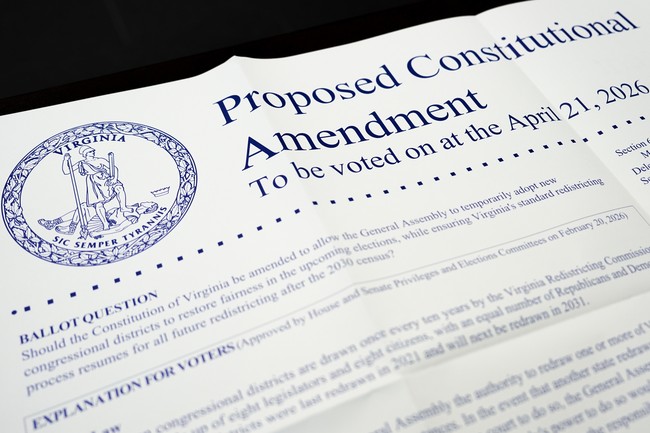
The Virginia Supreme Court struck down a Democratic effort to redraw maps for political gain, and state Democrats have filed a motion seeking to delay the court’s mandate while they pursue an emergency appeal to the U.S. Supreme Court; this article lays out the ruling, the appeal attempt, the legal posture, and reactions from conservative lawyers and commentators.
The Virginia Supreme Court issued a ruling that tossed the Democrats’ proposed maps, finding the plan ran afoul of the Commonwealth’s rules. That decision arrived on May 8, 2026, and it immediately triggered a response from party leaders who moved to stall the mandate. The motion seeks to invoke Rule 5:39 so Democrats can file an emergency petition to the United States Supreme Court.
The Commonwealth of Virginia and Appellants Don Scott, Scott Surovell, and L. Louise Lucas, by counsel, move this Honorable Court pursuant to Rule 5:39 to delay issuing its mandate in the above-captioned matter. The Commonwealth has informed counsel for all parties of its intent to file this motion. Rule 5:4(a)(1).
Rule 5:39 provides that this court may defer the issuance of its mandate if a party intends to file an appeal with the Supreme Court of the United States. On May 8, 2026, this Court issued its decision in this case. Appellants and the Commonwealth intend to file an Emergency Petition to the Supreme Court of the United States. This motion is timely because it is filed within 15 days of this Court’s order. Rule 5:39.
State Democrats are clearly trying to buy time, but the legal landscape is not on their side. The Virginia Supreme Court was explicit in its holding, and under state constitutional law the court is the ultimate interpreter of the Commonwealth’s constitution. That reality limits the avenues for a federal court to override a state court’s final decision about state constitutional issues.
The motion to delay shows they intend to take the matter uphill to the U.S. Supreme Court, yet that route is narrow when the state court’s judgment rests on state constitutional grounds. The U.S. Supreme Court generally avoids becoming a second-guessing body for state courts interpreting their own constitutions unless a federal question is squarely presented. That makes the prospects of a successful federal appeal slim in many cases.
Conservative legal voices wasted no time weighing in and pointing out the practical endgame. Former Virginia attorney general Ken Cuccinelli and other Republican-aligned lawyers stressed that the state Supreme Court is the final arbiter on state constitutional issues. From their perspective, the Democrats’ motion is more about optics and fundraising than about a realistic path to reversal.
WATCH:
The social media reaction has been loud and mocking in many right-leaning circles, and some posts framed the appeal motion as evidence that Democrats are out of legal options. One quoted post declared, “This is the end, folks!” and mocked national Democrats who pledged to try and overturn the state court’s work. Those reactions reflect the relief among Republicans that the maps will not stand as drawn by the majority party.
JUST IN: Former VA AG @KenCuccinelli CONFIRMS Democrats have NO PATH to appeal the Virginia Supreme Court’s decision today, throwing their maps out
“This is the end, folks!”
This has been an AWFUL day for Hakeem Jeffries 🤣
Temu Obama whined and pledged to find a way to overturn this decision, but there’s literally nobody to appeal it to.
VA Supreme Court has the ultimate say on the state constitution!
Other attorneys familiar with constitutional law echoed the conclusion that the Democrats face a steep climb. Those conservative commentators argue that the right result came from a court that enforced the state’s rules and checked an obvious attempt to tilt elections. The emphasis from this side is that safeguards against gerrymandering matter and that courts must enforce neutral rules.
Republicans see this decision as a win for fair maps and for the rule of law in Virginia. They argue the move to appeal was predictable but ultimately unlikely to succeed, and they say the party in power should not be allowed to manipulate lines for short-term political gain. In the weeks ahead, legal filings will reveal just how far Democrats intend to push this, but for now the state court’s ruling stands as a significant check on partisan mapmaking.



Add comment