
The U.S. Navy’s recent actions against Iranian-flagged tankers in the Gulf of Oman show a clear, forceful approach to enforcing a maritime blockade and choking off revenue to Tehran, with several vessels disabled after attempts to evade the interdiction and multiple statements from CENTCOM confirming the operation’s impact.
Iran continues to test the blockade despite knowing the risks and consequences. Forces observed two Iranian-flagged unladen oil tankers, the M/T Sea Star III and the M/T Sevda, attempting to slip past the blockade toward an Iranian port in the Gulf of Oman. The U.S. responded decisively, demonstrating that efforts to run the line would not go unanswered.
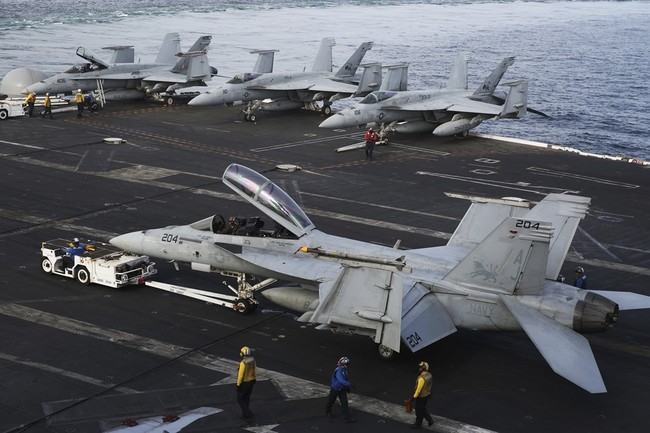
In a precise action, a U.S. Navy F/A-18 Super Hornet from USS George H.W. Bush (CVN 77) engaged the vessels and disabled them by striking their smokestacks with precision munitions. That action left both ships unable to proceed and effectively prevented them from entering Iranian waters. The report of that engagement was presented in a direct, no-nonsense tone reflecting the military objective to stop any non-compliant transit.
The incidents did not stop there. On May 6, U.S. forces disabled a third Iranian-flagged tanker, the M/T Hasna, as it tried to reach an Iranian port in the Gulf of Oman. An F/A-18 Super Hornet from USS Abraham Lincoln (CVN 72) targeted the Hasna’s rudder, firing several rounds from a 20mm cannon and leaving the unladen oil tanker unable to maneuver. That hit made clear the blockade’s enforcement tools include both precision munitions and direct, kinetic measures to stop non-compliant vessels.
A U.S. Navy F/A-18 Super Hornet from USS George H.W. Bush (CVN 77) disabled both tankers after firing precision munitions into their smokestacks, preventing the non-compliant ships from entering Iran.
U.S. forces also disabled Iranian-flagged M/T Hasna, May 6, as it attempted to sail to an Iranian port in the Gulf of Oman. An F/A-18 Super Hornet from USS Abraham Lincoln (CVN 72) disabled the unladen oil tanker’s rudder by firing several rounds from a 20mm cannon gun.
“All three vessels are no longer transiting to Iran,” CENTCOM noted, underscoring the operational success. That statement was straightforward and factual, aimed at making the scope of enforcement and outcome clear to both regional actors and international observers. The message to any would-be violator was simple: attempts to breach the interdiction risk definitive military action.
CENTCOM further emphasized the scale of disruption being imposed on Iran’s maritime commerce. In a separate post, CENTCOM stated: “There are currently more than 70 tankers that US forces are preventing from entering or leaving Iranian ports. These commercial ships have the capacity to transport over 166 million barrels of Iranian oil worth an estimated $13 billion-plus.” That calculation paints a vivid picture of how much revenue Tehran is being denied.
Strangling that revenue stream hits the regime where it matters most. Iran’s economy has been under pressure for years, and taking billions out of the system intensifies the financial squeeze on the ruling elite. Freezing assets, tracking overseas accounts, and targeting revenue sources combine to push Tehran toward a strategic reckoning about continued aggression and regional behavior.
Beyond the ships and the dollars, the U.S. military also made a point after more aggressive Iranian actions earlier in the week. When Iranian forces fired on U.S. ships, the response was not muted; U.S. strikes targeted locations onshore that were tied to attacks against American vessels. That kind of proportional, targeted retaliation reinforces deterrence and makes clear the cost of escalatory behavior.
Political leaders reinforced the operational message with blunt rhetoric. One public figure framed the consequence plainly: if Iran fires on U.S. forces, the reply will not be diplomatic niceties but decisive military action. That line communicates to Tehran that ambiguity and brinksmanship are no longer safe options and that the costs of miscalculation are high.
From a practical standpoint, the blockade and its enforcement are designed to force Iran into a decision point. Tehran can either present meaningful compromises to avoid further economic pain and isolation, or watch its economy and strategic options deteriorate further. The ongoing interdictions, paired with other financial pressure campaigns, narrow the regime’s breathing room.
It remains to be seen whether Iran will change tactics and seek a political exit from this standoff, or continue risking vessels, crews, and assets in attempts to move product and cash. For now, the U.S. posture in the Gulf of Oman and the Strait of Hormuz is active and clearly communicated, and the recent disabling of multiple tankers is a tangible demonstration of that posture.
Editor’s Note: For decades, former presidents have been all talk and no action. Now, Donald Trump is eliminating the threat from Iran once and for all.
Help us report the truth about the Trump administration’s decisive actions to keep Americans safe and bring peace to the world. Join RedState VIP and use promo code FIGHT to get 60% off your VIP membership.


Add comment