
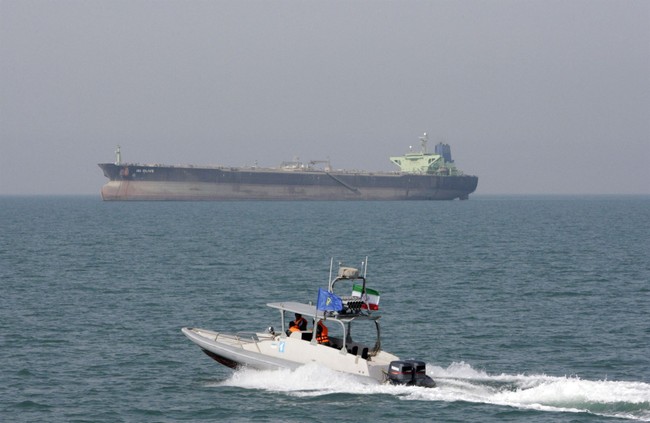
I will explain why Iran’s recent seizure of a tanker looks self-defeating, outline the strange overlap with reports of a major oil spill near Kharg Island, detail expert warnings about Iran’s oil infrastructure, and show how these events may expose Tehran’s operational weaknesses.
Iran Seizes a Tanker and Suffers New Problem – What’s Hilarious Is Who That Cargo Belongs To
Iran announced it detained a tanker this past Friday, claiming the vessel threatened the nation’s oil exports and interests, a move that left observers baffled. State media reported the seizure as a “special operation,” and described the ship as trying to “disrupt oil exports and the interests of the Iranian nation.” The vessel was described as managed by a Chinese company in shipping records.
“During a special operation, naval commandos of the Islamic Republic of Iran’s Army detained the violating oil tanker Ocean Koi,” state television reported, saying the vessel was “attempting to disrupt oil exports and the interests of the Iranian nation.” The tanker appears to be managed by a Chinese company, according to a shipping database.
The odd part is that this appears to be a U.S.-sanctioned tanker that was carrying Iranian crude. Tehran accused the ship of “exploiting regional conditions” and said the vessel has been turned over to judicial authorities. That raises the question: did Iran seize one of its own shipments to look strong after earlier U.S. strikes, or did a middleman try to move fuel without regime approval?
Either scenario looks politically tone-deaf. If Tehran grabbed its own oil to stage a show of force, it undercuts both market credibility and the image of steady control over exports. If a private operator tried to flout the regime’s orders, it reveals gaps in Iran’s command over its own energy logistics.
This incident also complicates Tehran’s relationship with China, since the ship was reportedly Chinese-managed. Iran has already drawn criticism for earlier episodes involving Chinese tankers, making any clash with Beijing diplomatically awkward. That suggests Iran risks alienating a major partner while trying to score short-term domestic points.
At almost the same time, satellite imagery flagged a large oil slick near Kharg Island, Iran’s principal crude export terminal, which handles roughly 90% of the country’s oil shipments. Imagery providers reported a surface slick spreading across the Strait of Hormuz near Kharg while multiple tankers were loading at the terminal, raising alarms about where the leak started.
Satellites have detected a massive oil spill spreading across a vast area of the Persian Gulf around Iran’s Kharg Island.
Synthetic aperture radar imagery shows a large surface slick emanating from the waters around Kharg Island, Iran’s primary crude oil export terminal responsible for roughly 90% of the country’s oil exports.
At the time of detection, multiple tankers were simultaneously loading at the Kharg Island terminal.
It is not yet clear whether the spill originated from a loading operation, a vessel, subsea infrastructure, or the terminal itself.
Follow-up reporting suggested the spill covered as much as 20 square miles inside the channel between May 6 and May 8, a loss that analysts estimated at roughly 3,000 barrels. That scale is small compared to Iran’s overall output, but the location and timing matter because Kharg is where most of Iran’s crude goes out. Any damage or disruption at Kharg imposes outsized logistical and economic pain.
Oil is oozing through the ocean near Kharg Island in the Strait of Hormuz, according to satellite photos released Friday, raising questions about the state of Iran’s central energy production hub located there.
Between May 6 and 8, the spill spread to an area of 20 square miles inside the channel, amounting to as much as 3,000 lost barrels of oil, reps for Orbital EOS, a global oil spill monitoring service told The New York Times.
Experts pointed to a couple of plausible causes, including leaks from floating storage being used as makeshift terminals or failures in aging undersea pipelines. One Iranian energy expert warned that large volumes of crude kept in tankers increase spill risks, and a rupture in an old undersea pipeline like the one serving the Abuzar field could be the culprit.
Others suggested the naval blockade and operational pressure have pushed Iran to rely on ad hoc measures like storing oil afloat to keep shipments moving. That improvisation raises risks across the board: from accidents during loading to long-term harm to infrastructure and environment.
If the spill is the result of efforts to avoid a full shutdown, it would show Iran is scrambling to keep exports flowing at the cost of safety and environmental standards. Taken together, the tanker detention and the Kharg slick point to a regime juggling optics, logistics, and increasingly fragile infrastructure.



Add comment