
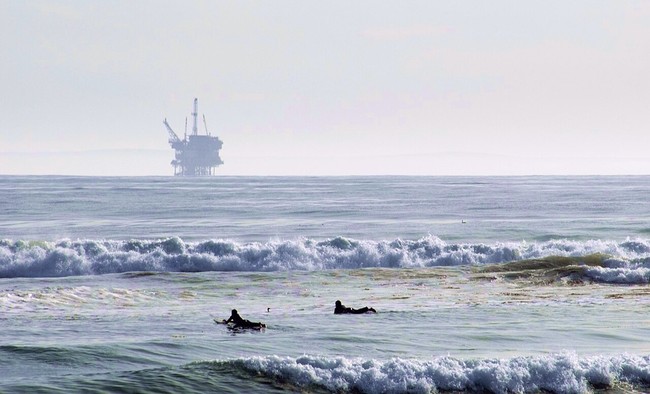
President Trump moved to restart a long-dormant offshore oil operation off California, invoking emergency authority to push crude back into pipelines, and the operation is now flowing tens of thousands of barrels a day amid legal fights and sharp political pushback from California leaders and activists.
The move sent California Governor Gavin Newsom and prominent environmental activists into a public uproar, framing the decision as a clash over state policy and federal power. The action relies on a Cold War–era law to force the restart of a shuttered offshore facility, and that decision has become a flashpoint in the debate over energy independence versus environmental oversight. Supporters argue this step proves the U.S. can supply more of its own energy if political obstacles are removed. Critics worry about safety, spills, and the precedent of using emergency powers for energy projects.
Despite lawsuits filed by state officials, the company operating the pipeline reports oil is moving again at significant rates. Company statements indicate the Santa Ynez Pipeline System resumed shipments, filling the line from offshore collection to an onshore station at a high daily throughput. That flow reverses more than a decade of idle status after a previous spill shut operations down. The practical effect is immediate: crude is being funneled toward local refineries that haven’t seen this oil in years.
Sable Offshore officially commenced oil sales through the Santa Ynez Pipeline System Sunday, marking the first time the network has moved crude oil since a major spill idled operations over a decade ago…
The company announced oil began flowing on March 29, with the pipeline successfully filled from Las Flores Canyon to Pentland Station at a rate exceeding 50,000 barrels per day. That is roughly 66,000 full tanks of gas.
Fox News host Laura Ingraham toured the facility and spoke with company leadership, capturing the back-and-forth that highlights the operational scale and local impact. The chief operating officer explained the daily volumes and noted how long local refineries had been without this crude. Observers on the political right point to this as evidence that domestic production can be ramped up quickly when federal policy enables it. On the left, the reaction has been immediate and vocal, with calls to halt production and renewed lawsuits aimed at stopping the flow.
In a direct quote during the visit, company leadership and Ingraham exchanged blunt remarks about the return of crude to local refineries. The company reiterated the volume figure and referenced the history of the pipeline’s closure. That exchange underlines the symbolic weight of restarting operations as much as the practical outcome. Supporters say this reduces dependence on foreign suppliers and buffers domestic consumers from global supply shocks.
Sable COO and President J. Caldwell Flores: “60,000 barrels a day of processed crude going down to El Segundo refinery that’s owned by Chevron down there.”
Laura Ingraham: “When’s the last time El Segundo refinery had that much oil running through it?”
Flores: “They have not had our crude in over 11 years.”
Meanwhile, critics like Jane Fonda and various environmental groups have made their opposition loud and clear, arguing the restart undermines climate goals and risks ecosystems along the coast. Activists frame the decision as a rollback of progress toward cleaner energy, and state officials have leaned into legal avenues to try to block the operation. That effort is ongoing, creating a legal standoff between federal emergency authority and state-level environmental enforcement.
The broader political argument centers on who gets to decide energy policy and how quickly the country can reclaim domestic production capacity. For those on the right, the priority is clear: tap American resources, lower energy costs, and reduce strategic dependence on unstable suppliers. For opponents, the same calculus raises concerns about long-term environmental harm and the need for more cautious transitions to alternative energy.
The timing also matters: global tensions, including conflict in the Middle East, have pushed energy prices higher and sharpened the debate about supply security. Restarting a domestic source offers a short-term cushion against volatility, and that pragmatic angle drives much of the administration’s pitch. Meanwhile, the legal and political battles continue, ensuring this will be a recurring story as production and litigation proceed.
Whatever the outcome in court, the episode highlights a choice facing policymakers and voters: prioritize immediate energy availability from domestic sources or stick to a stricter path toward reducing fossil fuel use even if it means greater exposure to global market swings. The Trump administration has signaled its preference clearly by taking executive action to get wells flowing again and by framing the move as part of a broader push to restore American energy independence.

Add comment