
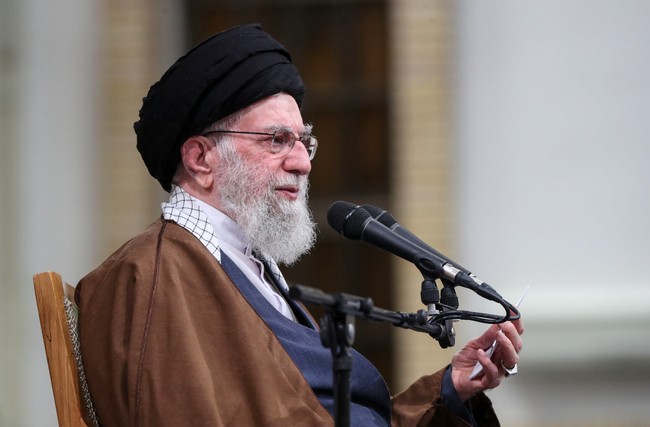
The story: reports say Iran’s Supreme Leader Ayatollah Ali Khamenei has reportedly withdrawn to an underground shelter amid fears of U.S. airstrikes, while the USS Abraham Lincoln carrier strike group moves toward the region. Tension between Tehran and Washington has spiked after public threats and moves by both sides, and insiders claim senior mullahs have shifted day-to-day duties to Khamenei’s son. This piece walks through what’s been reported, why it matters for U.S. strategy, and what outcomes conservatives view as preferable for fomenting real change in Iran.
Recent signals from Tehran suggest the clerical regime is nervous, and that matters. When a regime that thrives on projecting strength starts digging in, it reveals a fear of decisive force that a Republican foreign policy should not ignore. Reports that the 86-year-old supreme leader has moved to fortified underground quarters after warnings of imminent attack point to a leadership that feels vulnerable to American power.
The 86-year-old supreme leader has moved to a fortified shelter in Tehran connected to a series of elaborate underground tunnels after senior military officials warned of the increasing likelihood of an imminent US attack, Iran International reported, according to the Jerusalem Post.
Khamenei has left his youngest son Masoud Khamenei, 53, in charge of running the day-to-day management of the Islamic Republic, the Jerusalem Post reported.
Masoud Khamenei’s emergency duties include being the primary communication channel with the regime’s executive branch, according to the report.
Iran has deemed the likelihood of US airstrikes to be high after President Trump announced Friday that warships were headed to the Middle East as a warning to the ayatollah, following a continuing war of words between the two leaders in recent days.
American naval power is unmistakable on its approach, and conservatives see that as a useful lever. The Abraham Lincoln Carrier Strike Group carries firepower the mullahs simply cannot match on their own soil, and the visible deployment serves both as deterrent and as an option should Tehran choose to escalate. Republican policymakers and voters who prioritize strength welcome such moves as a firm reply to threats and as protection for U.S. interests and allies in the region.
Tehran’s responses have been predictably blusterous, declaring any attack on the leadership to be tantamount to an all-out war. That posture is theater meant to shore up the regime’s domestic control and intimidate foreign adversaries. Still, when bluster meets reality—when warships and strike groups approach—regimes that rely on fear and repression sometimes reveal cracks.
Trump boasted Friday that the US Navy was sending a massive “armada.”
The Abraham Lincoln Carrier Strike Group, which includes three destroyers, is currently motoring from the Indian Ocean to the Persian Gulf region of Iran, Stars and Stripes reported.
Publicly, Tehran has not backed down from heightened tensions with the US as Iranian President Masoud Pezeshkian threatened to treat any attack against the supreme leader by the US or Israel as “an all-out war against us.”
There is a strategic case for calibrated pressure rather than open-ended ground war. Conservatives generally oppose nation-building and long-term occupation, but support using decisive, proportional military options to degrade the regime’s ability to wage terror and repression. Airpower, targeted strikes against key military assets, and support for opposition forces fit a conservative framework that values U.S. strength while minimizing American blood and treasure.
The larger prize is not endless conflict but the removal of a regime that funds global terrorism and crushes its own people. A future Iran without theocratic rule would shift regional dynamics and deny networks like Hamas and Hezbollah a major backer. That is an outcome many on the right view as in America’s strategic and moral interest, even if it must be pursued indirectly and carefully.
Still, the limits of power must be clear: the Iranian people, not American troops, should be the ones to take the streets and reclaim their country. Republicans tend to favor enabling dissidents and applying pressure from abroad while avoiding unnecessary boots on the ground. In that spirit, use of carrier strike groups, sanctions, and diplomatic isolation are tools to amplify internal resistance without turning America into an occupying force.
Whatever unfolds, the sight of Ayatollah Khamenei reportedly sheltering underground is a reminder that regimes built on coercion can be shaken. For conservatives, that opens a policy window to press Tehran hard, protect U.S. interests, and back the cause of liberty in the region without repeating the mistakes of open-ended occupation.



Add comment