
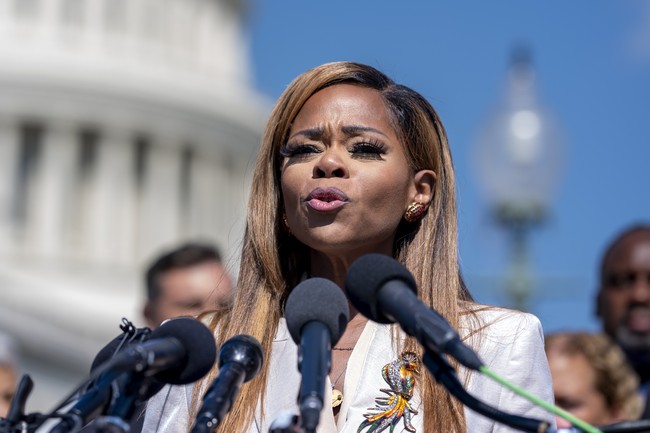
Sheila Cherfilus-McCormick resigned her seat in Congress effective Tuesday at 1:30 p.m. ET after the House Ethics Commission found her guilty on 25 of 27 violations tied to misused FEMA funds and campaign finance breaches; the resignation spares her an imminent expulsion vote and adds to a recent run of high-profile departures from both parties.
The Ethics Commission concluded Cherfilus-McCormick accepted more than $5 million in FEMA funds intended for a family business and then routed much of that money into her 2022 congressional campaign, leading to findings on 25 of 27 charges. Republicans and many conservative observers have argued this is part of a broader accountability moment in Congress where rule-breaking and ethical lapses are finally being met with consequences.
Cherfilus-McCormick publicly denounced the process, calling it unfair and framing the action as politically motivated, even invoking race and external distractions in her defense. Inside the Democratic caucus, leaders pressed her to assess whether she could survive an expulsion move, and those private conversations reportedly made clear that support was thin. The reality was stark: party leaders and rank-and-file members were weighing the political pain of an expulsion fight against the institutional cost of keeping a member under such a cloud.
Outside pressure did not come only from Democrats. Republican Rep. Ana Paulina Luna of Florida was vocal about the need for consequences, and that aggressive stance contributed to the mounting pressure on Cherfilus-McCormick. The possibility of a bipartisan consensus to remove her made the decision to step down more likely, since expulsion requires a high bar but also a willingness from both sides to enforce ethical norms. When a lawmaker’s behavior crosses certain lines, the institution itself becomes the trump card over party loyalty.
Before any formal expulsion vote could take place, Cherfilus-McCormick submitted a resignation letter to the House speaker that set a precise effective time and framed the exit as an act taken in the interest of her constituents. The letter said she had reflected and prayed on the matter and promised to aid a smooth transition for her district. Her resignation avoids the spectacle and formal rebuke of an expulsion proceeding, but it also leaves unanswered questions about accountability and restitution for the alleged misuse of federal aid.
I hereby resign my office from 119th Congress as Representative for Florida’s 20th Congressional District, effective Tuesday April 21, 2026: 1:30 p.m.
It has been the honor of my lifetime to serve the people of my district. I remain proud of the work we have accomplished on behalf of our communities.
After careful reflection and prayer, I have concluded that it is in the best interest of my constituents and the institution that I step aside at this time.
I remain committed to supporting a smooth transition and ensuring continuity of service for the district.
Despite the letter, Cherfilus-McCormick continued to contest the fairness of the process on her Congressional X account, reiterating objections about due process and the role of allegations in determining a lawmaker’s fate. That messaging aimed to frame her resignation as forced rather than voluntary, a narrative designed to keep political supporters sympathetic while stepping away from a formal censure. Yet for observers focused on rule of law and fiscal integrity, the Ethics findings were clear and damning.
Public reporting indicated House Democrats privately concluded she likely would have to go, with some suggesting top leaders encouraged her departure to avoid a painful floor vote. Insiders compared the move to past instances where party leadership quietly nudged members out to spare the conference a televised rupture. Those inside conversations underscored a growing willingness in both parties to resolve ethics crises through resignations rather than forceful expulsions, though that trend also leaves questions about whether quiet exits adequately deter future misconduct.
Her resignation follows a string of recent departures, including both Republican and Democratic members who left amid ethics or misconduct controversies, signaling an uptick in enforcement and a lower tolerance for behavior that undermines trust. Conservatives see this as a corrective moment where oversight and consequence are finally catching up to long-standing problems in Washington. The key test ahead is whether institutions translate these high-profile exits into consistent, enforceable standards that apply to all members.
For the people of Florida’s 20th District the immediate concern is continuity of representation and the logistics of filling the vacancy, but the wider takeaway for voters and lawmakers is about institutional credibility. When federal aid and campaign coffers intersect improperly, the system must respond decisively to restore public confidence. This episode highlights why clear ethics rules and accountability mechanisms matter to good governance and to the voters who expect their representatives to act with integrity.



Add comment