
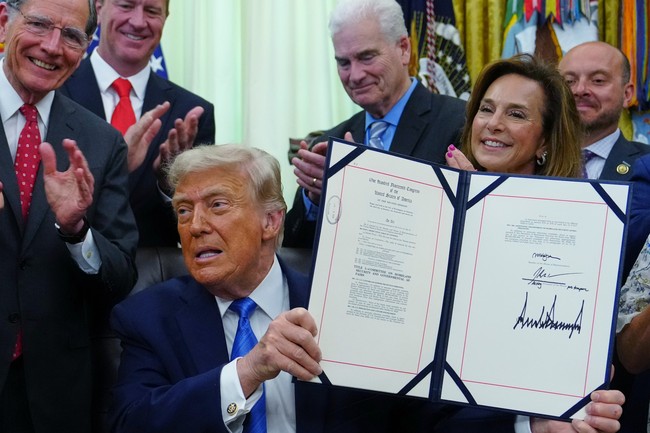
The fight over Homeland Security funding has ended with President Trump signing the $70 billion Secure America Act, fully funding ICE and Border Patrol through the end of his term and moving the administration past a months-long standoff that left agency employees unpaid and conservatives demanding stronger enforcement at the border.
What began as a partisan standoff over agency funding turned into a high-stakes showdown when House Democrats refused to back routine DHS appropriations in February. That refusal triggered a partial shutdown that stretched for weeks and put thousands of federal workers on the chopping block without pay. Conservatives argued the demands from Democrats were political theater that would have hamstrung ICE and Border Patrol in their core missions.
President Trump has now signed the Secure America Act into law, delivering what Republicans call a clear policy win for border security and enforcement. The bill passed the Senate and the House under reconciliation rules, avoiding the filibuster and allowing a simple majority to carry the package. For supporters, that procedural route was the right call to break a stalemate that threatened national security and basic operational readiness.
“This morning I’m thrilled to sign the Secure America Act to immediately and fully fund the Department of Homeland Security through the end of my term, so we won’t have to be talking about it anymore,” the president said in the Oval Office.
https://x.com/RapidResponse47/status/2064730097479811395
The Senate passed the $70 billion funding package on Friday, and the House approved it on Tuesday.
Democrats fought the funding for months, refusing to agree to the bill unless there were reforms to the organization after two American citizens — Renee Good and Alex Pretti — were killed by federal agents in Minneapolis earlier this year. But the measure was passed via reconciliation, which only requires a majority vote instead of 60 votes needed to overcome a filibuster.
The new law allocates multi-year lumps sums rather than typical single-year appropriations, giving ICE and Border Patrol funding through Sept. 30, 2029. That approach changes the budgeting landscape for Homeland Security operations, committing resources across multiple fiscal years. It also significantly increases funding levels for ICE compared with its historical annual budgets, a point that opponents hammered while supporters celebrated as necessary to rebuild capacity.
Under the reconciliation package, ICE sees a large infusion aimed at hiring, paying, and training more agents, along with specific funds for Homeland Security Investigations personnel. Republicans point out that previous legislation already boosted the agency, and this package cements a long-term investment to take on cartel networks and drug trafficking. Supporters say the money provides the tools to stop deadly fentanyl flows and dismantle smuggling operations that fuel the border crisis.
Democrats, however, continued to vote against the bill across the board, sticking to demands for reform and oversight that GOP leaders saw as unacceptable. That unified opposition allowed Republicans to frame the victory as a demonstration of priorities: security first, ideological concessions later. Conservative lawmakers argue that the terrain of debate has shifted; funding now exists to back tougher enforcement and targeted prosecutions.
Sen. Ted Cruz emphasized the GOP narrative of promises kept after the signing, casting the bill as follow-through on campaign pledges to secure the border and empower law enforcement. His remarks stressed the practical outcomes Republicans want to achieve with the new funding stream, including stopping trafficking, cutting off cartels, and enforcing immigration laws. That messaging resonated with the base and gave Republican leaders a clear example of legislative success to point to ahead of the next political cycle.
President Trump & Congressional Republicans promised to secure the border.
The Secure America Act fully funds ICE and Border Patrol through his term and gives them the tools to combat trafficking, stop deadly drugs, dismantle cartels, and enforce our laws.
Promises made, promises kept.
Meanwhile every single Democrat voted against the funding.
On the ground, this means federal agents will have budget certainty for staffing and operations for the remainder of the president’s term, which matters for planning long-term operations and joint task forces. Conservatives argue that stability in funding will translate to better interdiction and intelligence work along the border and within interior enforcement. That said, the debate over oversight, officer accountability, and the proper balance between enforcement and civil liberties is likely to continue.
For Republicans, the bill is a political and policy win that neutralizes a recurring Democrat tactic of using appropriations fights to extract concessions. The White House and GOP congressional leaders can now shift the discussion to implementation and results, with the expectation that agencies will demonstrate measurable progress against trafficking and cartels. The signing closes one chapter of the budget fight and sets the stage for enforcement decisions backed by multi-year resources.



Add comment