
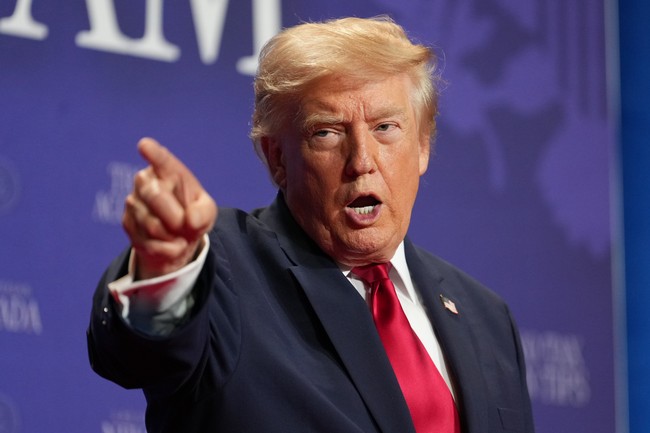
President Trump announced an immediate appeal to the U.S. Supreme Court after a federal appeals court affirmed a partial block on construction of a secure ballroom at the White House, and he reacted sharply to the ruling and the judges involved, calling the decision a national security threat and promising to seek swift judicial review.
The D.C. Circuit Court of Appeals upheld a preliminary injunction that halts construction of the proposed addition, and the court stayed its decision for 14 days to allow the administration time to seek review from the Supreme Court. The majority opinion sided with concerns that Congress, not the President, controls major structural changes to the White House, which left the administration scrambling to map its next legal move. The administration has made clear it will pursue that path without delay.
On Truth Social, the president singled out the judges in the majority and framed the ruling as politically motivated and dangerous to national security. He wrote: “Two Obama and Biden Appellate Court Judges just voted against the desperately needed Military Center, required for the National Security of Washington, D.C., and our Country, itself.” That post set the tone for the White House response and the immediate decision to escalate the fight to the Supreme Court.
Two Obama and Biden Appellate Court Judges just voted against the desperately needed Military Center, required for the National Security of Washington, D.C., and our Country, itself.
https://x.com/RapidResponse47/status/2085781768725016979
The president also highlighted a dissent authored by Judge Neomi Rao, quoting what he described as “key points” and relying on her view that the injunction exceeded proper judicial authority. The quoted dissent emphasized that the district court lacked jurisdiction because the Trust had no standing and argued that the balance of equities favors the government. That dissent became an important part of the administration’s narrative that the injunction was an overreach that ignored national security needs.
Highly Respected Judge, Neomi Rao, stated the following key points, among others, in a strongly worded dissent:
“This was a blatant abuse of discretion…To begin with, the district court had no jurisdiction because the Trust has no standing to stop construction at the White House…[T]he balance of equities overwhelmingly favors the government. The district court elevated the aesthetic displeasure of a single passerby over the government’s security interests in the ballroom and the security risks of leaving an open construction site at the President’s home and office…These errors in equitable judgment require vacating the injunction…The district court seized supervision of construction at the White House, and my colleagues affirm this judicial overreach…Because the injunction is beyond the proper province of the federal courts, construction should be allowed to continue.”
The appellate split was 2-1, with Judges Patricia Millet and Brad Garcia forming the majority and Judge Rao filing the lengthy dissent. Rao argued that deference to the Executive Branch on national security matters warranted allowing construction to proceed while litigation continues. The narrow vote and Rao’s detailed dissent give the administration a clear legal argument to press before the Supreme Court.
The White House contends the ballroom addition is part of a single, integrated security complex purpose-built to protect presidents and visiting dignitaries, and has described the project as built largely with private funding and delivered under budget and ahead of schedule. Trump said the decision “severely jeopardizes the lives and welfare of the people who work, and will be working, at the White House” and insisted the injunction threatens protective measures already under way. He framed the issue as more than a building dispute, calling it an urgent national security matter.
In a lengthy statement the president detailed components of the addition and argued they are essential to operational security, listing shelters, medical facilities, protective partitioning, missile-resistant materials, drone-proofing, and other hardened elements. He called the ruling “horrendous, politically motivated, and unlawful” and urged the nation to recognize the stakes involved for future administrations. The administration’s legal team is expected to stress those national security claims when presenting the case to the high court.
The Military and Secret Service are viewing this horrendous, politically motivated, and unlawful ruling as a National Security threat to our Nation in that the entire Complex is being built for the protection of our Country and, additionally, all future Presidents. The single, integrated project includes Bomb Shelters, State of the Art Hospital and Medical Facilities, Protective Partitioning, Top Secret Military Facilities, Structures and Equipment, Protective Missile Resistant Steel, Columns, Roofs, and Beams, Drone Proof Ceilings and Roofs, Military Grade Venting, and Bullet, Ballistic, and Blast Proof Glass. It is all tied together as one big, expensive, and very complex unit, which is vital for National Security and Military Operations of the United States of America!
Legal observers note that preliminary injunctions can be temporary but powerful tools that halt projects while courts sort standing, jurisdiction, and deference questions. The appeal will give the Supreme Court a chance to weigh in on whether courts should second-guess executive judgments tied to White House security and whether private parties can block such work. With the D.C. Circuit’s own stay providing a brief window, the administration will press quickly for certiorari and emergency relief.
This dispute raises broader questions about separation of powers, executive prerogatives on national security, and the role of lawsuits in deciding high-profile construction at the presidential residence. Expect the legal debate to focus on standing and the appropriate level of judicial deference to security judgments at the White House. The fight is moving up the chain, and the next chapter will be shaped by how the Supreme Court views those core issues.


Add comment