
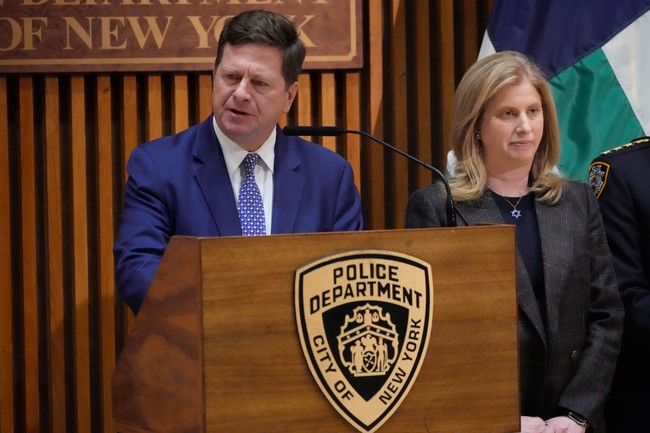
The Justice Department and New York officials announced charges in an alleged ISIS-inspired bombing attempt near Gracie Mansion, revealing that suspects brought volatile explosives to a protest, arrived in the city less than an hour before the attack, and were quickly arrested after devices were ignited; at least one device contained TATP, investigators say, and federal and local agencies credited swift police action for preventing greater harm.
Federal prosecutors filed charges against 18-year-old Emir Balat and 19-year-old Ibrahim Kayumi for their roles in the incident outside Gracie Mansion. Officials describe the plot as ISIS-inspired and say the defendants are accused of attempting to provide material support to a designated foreign terrorist organization.
NYPD Commissioner Jessica Tisch and other officials revealed that investigators recovered multiple improvised explosive devices linked to the men, and that at least one device contained triacetone triperoxide, often abbreviated as TATP. TATP has a reputation for being extremely unstable and has been used in numerous terrorist attacks overseas, which is why investigators treated the scene with maximum caution.
The criminal complaint includes statements attributed to the defendants that federal officials say indicate motivation tied to ISIS. According to reports, Kayumi responded to a question with, “ISIS,” and Balat allegedly made comments including, “This isn’t a religion that just stands when people talk about the blessed name of the prophet — we take action,” and said, “someone else will come and do it” if he did not act.
Authorities also say Balat wrote a message pledging allegiance to the Islamic State and adding, “Die in your rage, you kuffar!” Tisch explained the phrasing, noting that “Die in your rage” is a slogan used by ISIS, and “kuffar” is an Arabic term for non-believers. Those direct quotes are part of the criminal record authorities presented in public remarks.
Officials emphasized the short timeline from arrival to attack: investigators say the suspects drove from Pennsylvania, crossed the George Washington Bridge at about 11:36 a.m., and ignited and threw devices roughly 40 minutes later, around 12:15 p.m. Law enforcement sources say officers arrested the men almost immediately after the devices were thrown, which limited potential casualties.
Jay Clayton, the U.S. Attorney, noted the suspects face multiple federal charges and reminded listeners that allegations are not proof of guilt and that both defendants are presumed innocent until convicted. Still, Clayton called the plot “chilling,” particularly because investigators say the suspects hoped to eclipse the deadly toll of the 2013 Boston Marathon bombing.
Clayton told reporters he watched footage showing NYPD officers running toward the scene despite the risk the devices might explode, and he praised that commitment. “That is the kind of commitment that makes this city great,” he said, referencing the courage of first responders who rushed to protect civilians.
FBI assistant director James Barnacle Jr. described the recovered items as improvised explosive devices “designed to inflict serious injury and death.” He and other officials highlighted an elevated threat environment and credited interagency cooperation for the quick resolution, listing work by the FBI–NYPD Joint Terrorism Task Force and partners across federal and local law enforcement.
Investigators say they found handwritten notes in a vehicle linked to the suspects that referenced TATP and listed chemical ingredients, and bomb technicians later conducted controlled detonations of two recovered devices. Samples have been sent to the FBI lab for analysis to confirm composition and to build the forensic case.
Officials declined to say whether the suspects were self-radicalized or recruited by others, with Tisch noting investigators did not want to jeopardize an ongoing prosecution by revealing certain leads. She did confirm the men appeared to travel to New York in response to a planned protest near Gracie Mansion, underlining the danger that public gatherings can present when adversaries seek to exploit them.
Authorities also noted both suspects have travel histories in the Middle East, though they did not elaborate on destinations or purposes. Officials said search warrants were executed at residences connected to the suspects in Pennsylvania as the probe continues and agents follow additional leads.
Rebecca Weiner, NYPD deputy commissioner for intelligence and counterterrorism, said the case fits a pattern seen among ISIS-inspired extremists who radicalize online and often involve younger individuals. She warned that the Internet remains a potent incubator for violent ideologies that can motivate people to act quickly and with deadly intent.
Weiner underlined the destructive potential of the recovered materials, stressing that “Had these devices functioned as intended, they could have caused death and destruction.” Law enforcement leaders repeatedly credited quick detection, decisive police action, and coordinated federal support for preventing a far worse outcome.
Tisch noted the NYPD had been on heightened alert amid rising tensions overseas and continued protest activity in the city, and she said the department’s approach to policing demonstrations would not change. “Our job is to ensure New Yorkers can exercise their First Amendment rights safely,” she said, while maintaining that violence is not protected by constitutional guarantees.


Add comment