
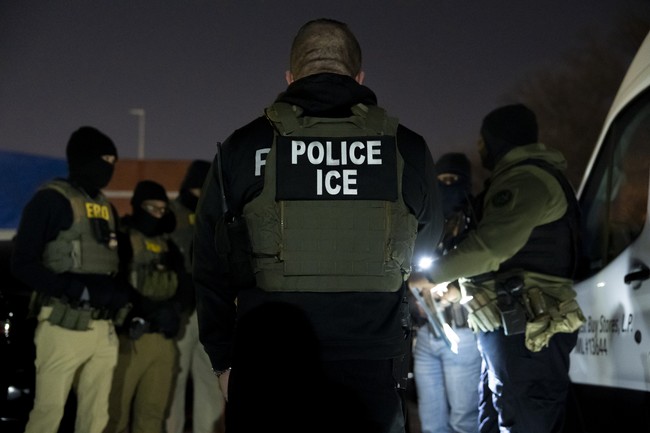
I’ll explain the federal judge’s decision blocking California’s mask ban for federal officers, outline why the ruling matters for enforcement and state-federal relations, quote the judge’s key findings exactly, note the practical fallout for ICE agents and state lawmakers, and point out how this fits into the broader fight over immigration enforcement in California.
California’s recently passed law aimed to stop federal immigration officers from wearing masks while performing duties inside the state, a move supporters said would increase transparency and critics warned would endanger officers and their families. The law was set to take effect January 1 but faced a quick legal challenge from the Trump administration claiming it was unconstitutional. Rather than letting the measure stand, a federal judge put the mask ban on hold and issued a ruling that raises constitutional problems for the state’s approach. That ruling shifts the conversation from a purely political stunt to a real legal obstacle for California’s plan.
On Monday, U.S. District Judge Christina Snyder ruled the law was problematic because it treated federal officers differently than state officers, a distinction the judge found discriminatory. The judge wrote that the exemption for state police meant the law “treats federal law enforcement differently than similarly situated state law enforcement officers.” That language is central: it frames the law not simply as regulation but as a measure that singles out federal agents, which creates constitutional exposure.
Judge Snyder also upheld a separate requirement that all officers wear badges or identification, applying that rule broadly to state and local personnel. While she blocked the mask ban, she left the ID requirement intact, so another piece of the legislative package survives the challenge. The mixed ruling means courts are willing to strike parts of the law that cross constitutional lines while allowing neutral identification rules that apply evenly across jurisdictions.
A new California law banning federal and local law enforcement officers from wearing masks was blocked Monday by a federal judge in a suit by the Trump administration. U.S. District Judge Christina Snyder said the law’s exemption for state police discriminated against immigration agents and other federal officers covered by the ban.
The law “treats federal law enforcement differently than similarly situated state law enforcement officers,” wrote Snyder, who is based in Los Angeles.
Snyder upheld another recently enacted state law requiring law enforcement officers to wear badges or other identification on their uniforms. That law applied to all officers, including state police.
Violations of either law could be prosecuted as crimes, punishable by jail sentences and fines, or punished by financial penalties under civil law. Both laws had been scheduled to take effect Jan. 1 but were put on hold during the legal challenges. The judge’s ruling apparently would allow legislators to reenact the mask ban without exempting state police, but it’s unclear whether Gov. Gavin Newsom would sign such a measure.
The ruling leaves the legislature a clear path if it wants the mask rule to survive: make it apply equally to state and federal officers or craft a statute that avoids singling out federal agents. That may sound technical, but it matters because the constitutional problem the judge highlighted is predictable and fixable on paper. Whether California lawmakers will actually rewrite the law to survive judicial scrutiny is a political question, not a legal impossibility.
For ICE agents and other federal officers, the decision is a short-term win. Many agents and their families have faced doxing and harassment as operations have become public, and anonymity can be a safety necessity during certain enforcement actions. Blocking a law that would have limited an officer’s ability to protect their identity responds directly to those safety concerns and keeps options open for federal personnel operating within California.
The political theater around the law reflected a broader strategy by state leaders to handicap federal immigration enforcement inside California. But the judge’s opinion makes clear that weaponizing state law against federal agents by crafting exemptions that favor state personnel will run into constitutional limits. That should give pause to any state trying to design laws aimed squarely at federal agencies without neutral application.
Legally, the case underscores the tension between state sovereignty and federal supremacy when it comes to immigration enforcement. States certainly can regulate public safety and officer identification in neutral ways, but they cannot single out federal actors for differential treatment without inviting legal defeat. Expect future drafts of this kind of legislation to try to appear facially neutral, or for litigation to continue until the Supreme Court weighs in.


Add comment