
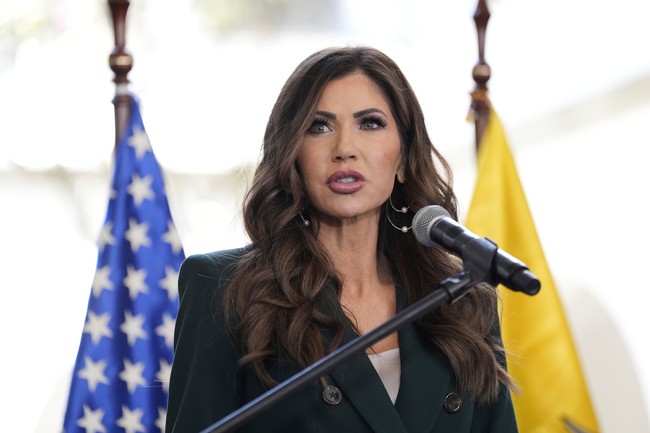
The 9th Circuit Court of Appeals temporarily blocked a lower court order that had undone Secretary of Homeland Security Kristi Noem’s 2025 terminations of Temporary Protected Status for Nepal, Honduras, and Nicaragua, signaling a significant appellate win for the Trump administration and a tightening of the legal path for challengers.
9th Circuit Hands Trump Administration a Big Win With TPS Ruling
The 9th Circuit granted a stay of the district court’s judgment that had vacated Noem’s decisions to terminate TPS for Nepal, Honduras, and Nicaragua, keeping the terminations on hold while the appeal proceeds. That move preserves the administration’s actions at least temporarily and shifts the battle to the appellate calendar, where the government has a clearer shot at reversal.
Multiple lawsuits over TPS decisions are active, and this particular case centered on whether Noem lawfully terminated protections for nationals of those three countries after she moved to end the designations in summer 2025. Judge Trina Thompson of the Northern District of California had concluded the terminations violated the Administrative Procedure Act and vacated them, creating the immediate legal conflict that spurred the government’s appeal.
The 9th Circuit panel explained why it was staying the district court’s order, emphasizing either a jurisdictional defect in the lower court’s ruling or the likelihood that the government will prevail on an APA challenge. The court wrote bluntly about the government’s chances:
We conclude that the government is likely to succeed on the merits of its appeal either by showing that the district court lacked jurisdiction or by prevailing on plaintiffs’ arbitrary-and-capricious APA challenge.
That passage amounts to a strong signal the appellate court views the district decision as vulnerable. One judge on the panel, Michael Hawkins, said he did not need to weigh in on the APA merits to support the stay, though he concurred with the result, while the other two judges on the panel—Consuello Callahan and Eric Miller—joined the order.
The panel drew a legal distinction the lower court had not: terminating a TPS designation and vacating one are different actions under the statute, the court said, and the law gives the DHS Secretary authority to terminate designations even if vacatur may be a different matter. That reading narrows the scope of challenges that hinge on prior case law about vacatur and offers the administration a footing to argue its actions fit within statutory authority.
The 9th Circuit also pointed to recent Supreme Court stays in related TPS cases as persuasive context, noting those higher court orders influenced how equitable discretion should be exercised in similar disputes. The appellate opinion quoted prior Supreme Court authority and recognized that while the high court’s stays contained no reasoning, they nonetheless served as relevant guideposts for equitable decision-making in the 9th Circuit’s own calculus.
We are not writing on a blank slate, however, because the Supreme Court has twice stayed district court orders blocking the Secretary’s vacatur of TPS for Venezuela. See Noem v. National TPS All., 146 S. Ct. 23 (2025); Noem v. National TPS All., 145 S. Ct. 2728 (2025). Those orders contained no reasoning, so they do not inform our analysis of the legal issues in this case, and the issues in any event are not identical. But the stay applications involved similar assertions of harm by both parties, and we have been admonished that the Court’s stay orders must inform “how [we] should exercise [our] equitable discretion in like cases.” Trump v. Boyle, 145 S. Ct. 2653, 2654 (2025). We therefore conclude that the equitable factors favor a stay.
Plaintiffs opposing the terminations retain options: they can seek rehearing en banc in the 9th Circuit and could try for Supreme Court review if the appeals court issues an adverse ruling on the merits. But the appellate stay and the Supreme Court’s prior stays in similar cases make a successful path forward tougher for challengers, at least in the near term.
The immediate practical effect is that the administration’s terminations remain in place pending appellate resolution, which means DHS policy toward nationals of Nepal, Honduras, and Nicaragua stays aligned with Noem’s 2025 decisions for now. The litigation will move forward on a compressed timetable, with legal teams from both sides gearing up to press their statutory and administrative-law arguments at the next level.
This ruling also underscores how procedural choices and distinctions between different types of agency actions can determine outcomes in immigration litigation, not just the broad policy questions. For conservative jurists and the administration, the decision reinforces the idea that heads of agencies have room to exercise statutory discretion on designations and terminations, subject to normal APA review.


Add comment