
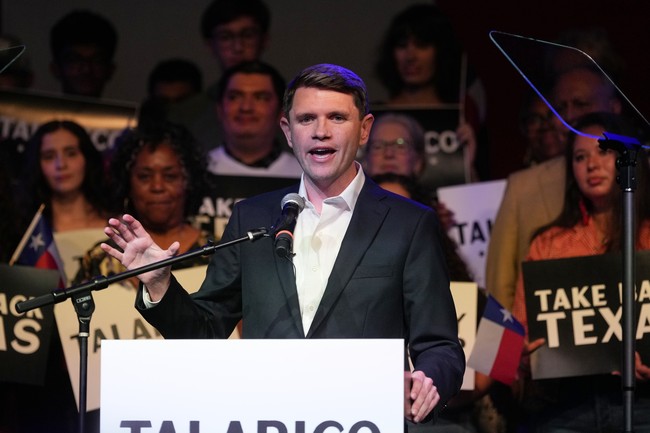
Texas Republicans are accusing Democrat Senate hopeful James Talarico of dodging responsibility after he missed a pivotal 2025 state House vote on a proposal known as Jocelyn’s Law that would have denied bail to violent illegal immigrants charged with felonies. The controversy centers on his absence for the final vote, prior votes on amendments, and his public rhetoric on immigration and policing, all while national Democrats rally around him ahead of a tight runoff. Critics say his record and rhetoric show misplaced priorities; his campaign says he is a law-and-order Democrat. This piece lays out the sequence of events, the key votes, the reactions from GOP leaders, and the national attention that followed.
Republican leaders in Texas have zeroed in on Talarico’s record as they push back against the Democratic narrative that he can flip a U.S. Senate seat. A Democrat has not held a Texas U.S. Senate seat in 32 years, and conservatives argue that voters deserve clarity about where a candidate stands on crime and border security. Talarico’s stump speeches stress compassion and community, but critics call his language about immigration and law enforcement vague and at times dismissive of enforcement priorities.
The flashpoint is Talarico’s absence during the final House vote on Jocelyn’s Law in 2025, a proposed constitutional amendment to deny bail to violent illegal immigrants charged with felonies. The bill failed to advance due to a lack of bipartisan support, and Republicans argue that Talarico’s nonattendance mattered. The measure was named for a slain 12-year-old, and that emotional backdrop intensified criticism from conservatives who framed the bill as a commonsense safety measure.
The facts of the case that propelled the bill into the spotlight are grim and unmistakable. Twelve-year-old Jocelyn Nungaray was kidnapped, raped, and murdered by two illegal aliens in June 2024, and that tragedy, along with other high-profile attacks, fueled national outrage over criminal illegal immigration. Republicans contend those events made Jocelyn’s Law urgent and that legislators who missed the final vote, including Talarico, avoided accountability when it mattered most.
Talarico did participate in earlier votes that drew scrutiny. Before missing the final tally, he voted against killing two amendments that would have exempted certain immigrants from the bill, including people on humanitarian parole, those with trafficking protections, and many with pending immigration processes. Critics seized on those amendment votes to argue that Talarico sided with protections that could shield violent offenders from stricter bail rules.
Republican operatives and spokespeople were blunt in their condemnation. “It is disgusting that James Talarico is letting his anti-American agenda show by siding with a violent illegal over a Texas family,” said Zach Kraft, a spokesperson for the Republican National Committee. Kraft added that Talarico’s stance “once again … proven his priority is criminals, not the safety of Texans.” Those lines underscore the GOP strategy of tying the candidate’s legislative record to voter concerns about crime and border security.
Gov. Greg Abbott also criticized Talarico, pointing to perceived contradictions between the candidate’s law-and-order rhetoric and his legislative behavior. Conservatives highlighted past votes Talarico cast against measures to restrict bail for violent sexual offenders and cited instances where he referred to undocumented immigrants as “my constituents,” framing that language as evidence of misplaced priorities. These attacks intensified as national Democrats rallied to boost Talarico’s profile.
On the national stage, former President Barack Obama made a public appearance alongside Talarico and other Democratic candidates in Austin, a move Republicans portrayed as out-of-touch elite backing for a candidate they argue is weak on enforcement. The appearance wasn’t a formal endorsement, but it elevated Talarico’s visibility and sharpened Republican attacks that portray his campaign as aligned with coastal Democrats rather than Texas priorities.
Talarico’s campaign pushed back on the criticism, arguing he supports prosecuting violent felons and has a record of voting for tougher bail laws and increased funding for police. JT Ennis, a campaign spokesperson, said, “James is a law and order Democrat who supports prosecuting violent felons, and has a proven track record voting for tighter bail laws for violent offenders and voting repeatedly to increase funding for Texas police.” That statement is central to the campaign’s counter-narrative.
The GOP response has kept pressure on the narrative by combining the emotional weight of the crimes that inspired Jocelyn’s Law with a close parsing of legislative votes. Republicans hope that juxtaposing Talarico’s absence with his earlier amendment votes and public rhetoric will resonate with voters worried about crime and the border. With the May 26 runoff between Ken Paxton and John Cornyn approaching, both parties are sharpening messages to win over a skeptical electorate.
The debate over Talarico’s record illustrates how single votes, absences, and public statements can reshape a campaign in a swing state. Supporters say he’s a Democrat who wants sensible policy and safety; critics say actions and absences tell the real story. As the campaign unfolds, the back-and-forth over Jocelyn’s Law will remain a focal point in Texas political discourse, fueling ads and talking points on both sides.
Republicans are keeping the spotlight on alleged inconsistencies and will continue pressing the issue; Democrats counter that national endorsements and local campaigning show momentum for a competitive challenge. The clash over priorities—law enforcement and border control versus a more restrained humanitarian approach—frames the broader fight for Texas voters heading into this pivotal contest.
Campaign messaging will likely keep returning to the same set of facts: the crimes that sparked the bill, the amendments and votes that preceded the final tally, and the public appearances that followed. Those elements are now woven into the story Republicans are telling about Talarico’s candidacy, and that storyline will be tested at the ballot box as the runoff approaches.


Add comment