
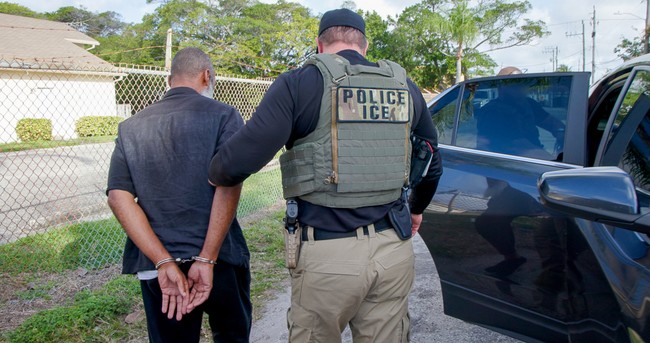
The Department of Homeland Security just recorded its biggest month ever for arrests, with Immigration and Customs Enforcement reporting 51,000 arrests in July, and this article walks through what that number means, where enforcement should go next, how workplace raids factor in, and what policy fixes could actually reduce illegal presence in the United States.
ICE reporting a single-month total of 51,000 arrests is a headline-making moment and not one to dismiss. That figure reportedly includes people detained for interfering with ICE operations as well as those taken into custody during targeted enforcement actions, which makes the raw number notable even before you dig into case details. For conservatives focused on restoring border integrity, record enforcement months are proof that federal agencies can act when directed to do so.
Still, the number alone doesn’t answer whether enforcement is hitting the right targets or making a dent in the much larger population of unauthorized residents. Even with aggressive activity, the best current estimates place the unauthorized population somewhere between 14 and 16 million people. That gap shows why monthly arrest records are important but insufficient without a broader strategy to remove incentives for illegal entry and continued unlawful residence.
U.S. Immigration and Customs Enforcement (ICE) arrested 51,000 individuals in July, according to sources familiar with the data.
The arrests are the largest in a single month in DHS history, according to data.
It comes as ICE is ramping up arrests at airports — with ICE arresting over 30 people at airports in July, agency data shows.
Those being detained in some cases do not have criminal records and have valid work authorization or parole documents, according to one immigration attorney that spoke with ABC News.
That blockquote contains some claims that deserve careful inspection, particularly the line about detainees sometimes having valid work authorization or parole documents. Claims from unnamed attorneys or reporters need scrutiny, especially when policymakers are deciding whether to scale up workplace enforcement or adjust parole and work-authorization rules. Conservatives should welcome transparency so the public can see exactly who is being detained and why.
One prominent conservative critic argues the enforcement numbers are still too modest relative to the scale of the problem and that the focus should shift to workplace enforcement as the central pillar of strategy. In the words presented in the original reporting: “The point is the numbers remain wildly disproportionately low to the scale of illegals let in by Biden and the promise of mass deportation,” Mike Howell, the president of the Trump-aligned Oversight Project, told ABC News. “The numbers will stay low until worksite enforcement is the central pillar of the strategy. I’m very worried about the amnesty lobby continuing to use inflated deportation statistics to push for a grand compromise and sell out. That’s why I’m suing DHS for real data and will keep doing it until I don’t have to.”
Worksite enforcement hits the true economic incentive for illegal migration: jobs. When employers know the cost of hiring undocumented workers rises and verification is enforced, the market shifts quickly. We’ve already seen operations where entire crews vanish after raids, and while that can hurt some businesses in the short term, it also shows how much of the unauthorized workforce is integrated into everyday commerce.
Congress can make those enforcement gains stick by changing the incentive structure nationwide. Freeze out government benefits and create strict penalties for knowingly hiring unauthorized workers, while preserving emergency medical care for humanitarian reasons. That mix of firm enforcement plus limited humanitarian allowances sends a clear message: living and working illegally in the United States carries real consequences.
Administrative actions alone won’t resolve the issue, because long-term outcomes depend on both the administration in the White House and the willingness of Congress to act. The next occupant of the Oval Office could expand or contract these efforts, so locking in statutory reforms that reduce incentives to stay illegally would be smarter than relying on the temporary flux of executive priorities. Conservatives should push for durable legal changes that outlast any single presidency.
Operational transparency is another critical piece. If ICE and DHS publish clear, comprehensive data about arrests, removals, and worksite enforcement outcomes, the public and lawmakers can have a fact-based debate instead of relying on anecdotes or anonymous sources. Transparency also undercuts the amnesty lobby’s ability to use selective statistics to argue for sweeping compromises that would reward illegal entry.
Record monthly arrests are a sign of increased enforcement intensity, but they are only a first step. Reducing the unauthorized population from double-digit millions requires sustained worksite enforcement, legislative changes to remove incentives, and clear public reporting so policy decisions rest on facts rather than spin. The arithmetic is simple: make it harder to live and work illegally, and the pressure to go home will grow.



Add comment