
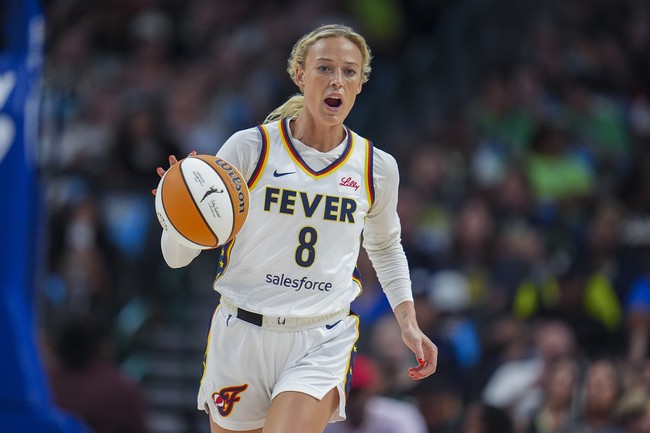
Sophie Cunningham Faces a Clothesline and a Coach’s Questionable Defense
The Indiana Fever’s recent stretch has put Sophie Cunningham at the center of a heated debate and a physical incident, while coach Stephanie White’s public responses have raised eyebrows about how the team handles player protection and accountability.
Sophie Cunningham has become a lightning rod after speaking about protecting girl athletes, and the attention has followed her onto the court. In the aftermath, critics and supporters alike have been watching how the team leadership responds to both the controversy and the gameplay. Coach Stephanie White was asked about the broader issue and gave an answer that many interpreted as evasive rather than supportive. That moment left some fans wondering where the coach’s loyalty and clarity were when her player needed a clear stance.
During a post-game exchange addressing biological men in women’s sports, White said, “I wouldn’t really say that I’m educated enough from a scientific standpoint. I don’t ever believe that exclusion is the answer.” That quote was widely shared and framed as a missed chance to back Cunningham publicly. The coach’s comment attempted to avoid taking a definitive position, which some read as sidestepping the player’s expressed concerns. The team atmosphere, already tense from off-court debate, only became more charged after that exchange.
Fever coach Stephanie White is asked her stance on males playing in women’s sports.
https://x.com/JackThompsonFOX/status/2083370966948643001
“I wouldn’t really say that I’m educated enough from a scientific standpoint. I don’t ever believe that exclusion is the answer.”
She then opens up on “frustration” over the debate being tied to the team lately, as they are playing their second game in a row with a rally celebrating Sophie Cunningham’s stance for protecting women’s sports.
The situation escalated on the court when DiJonai Carrington of the Chicago Sky clotheslined Cunningham, an action that led to an ejection and immediate controversy. Viewers and teammates alike reacted strongly to the physicality of the play and questioned intent and safety. When asked after the game, White described the play as a “hard foul” and said she did not believe Carrington “intentionally” went for Cunningham’s neck. That framing has been criticized for downplaying the severity of the contact and for not clearly condemning dangerous conduct.
“Yeah, I mean, look, it was a hard foul. I don’t think that DiJonai intentionally came out to get her across the neck like she did. But it did happen, and I thought it was the right call. But you know, one of the things about Nay is that she’s gonna play her butt off, man. She’s gonna compete. Nobody’s gonna go walking in for a layup. And so, I don’t oppose the hard foul. But I also don’t think that she intentionally went for the neck.”
Fans online have posted footage and comments questioning whether the contact could realistically be described as accidental. Those reactions fueled a broader conversation about how leagues and coaches handle physical safety and intent during high-stakes games. Some supporters argue Cunningham is resilient and will handle herself, but others insist the coach should make player safety and support unmistakably clear. The debate extends beyond a single play to expectations for leadership when players face both physical and cultural pressure.
When a player’s safety becomes a public conversation, the coach’s role includes calming tensions while also defending team members from undue harm or criticism. White’s remarks have been characterized by some as attempts at de-escalation, yet critics say the approach reads as reluctance to stand firmly behind Cunningham. The balance between tempering a volatile situation and showing unequivocal support is delicate, and observers feel White has missed opportunities to strike it.
On social media, people have discussed whether de-escalation can cross into tacit excuse-making, especially when a player is visibly affected by contact. Cunningham does not need a protector in every moment, but a coach’s words matter when the narrative shifts from a game to safety and respect. Clear leadership can shape how teammates, opponents, and fans interpret an incident and how similar situations are handled going forward.
The question now is whether the Fever organization and staff will clarify their stance moving forward and make sure players feel backed at all times. Cunningham remains a central figure in both the sports debate and the team dynamic, and how leadership responds will influence locker-room trust. For the moment, the incident and the subsequent comments have left many watching to see if accountability and player safety become louder priorities in practice and in public statements.



I’ll start by saying that I absolutely love Sophia Cunningham. I think she’s very professional, classy and smokin’ hot. So when I say that after watching the foul several times, I don’t think it was intentional, I’m just saying what I saw. Carrington went up to try and block the shot and she was in an awkward position coming up behind Sophia. I agree with the call as it was overly aggressive from where Carrington was, but I don’t think she intended to crash down on Sophia’s neck. Carrington should have just apologized and let it go, but instead she went to social media and claimed white privilege, which is total BS. I’m sick of these blacks and their whining about white’s. If anyone is babied and pampered, it’s the blacks.