
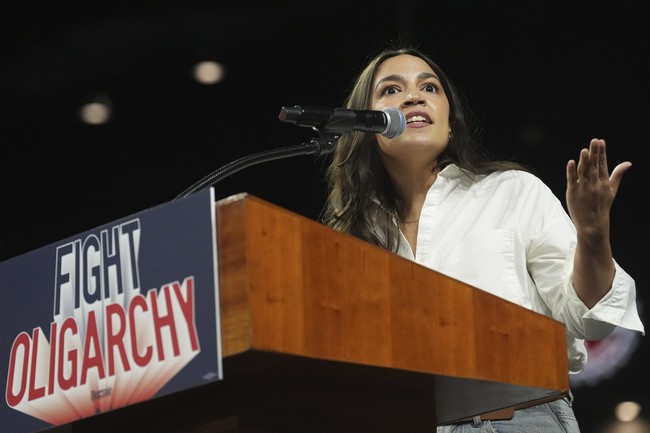
The Democratic Socialists of America are openly excited at the prospect of Alexandria Ocasio-Cortez running for president in 2028, and this piece examines why that idea appeals to the DSA, why it would be a strategic misstep for Democrats, and what the potential GOP response might be.
The leftward march inside the Democratic Party has been unmistakable, with activists and local officials pushing agendas that alienate many voters in competitive states. These shifts are often most visible in deep-blue districts where primary contests reward the most progressive candidates, but national elections play by very different rules. For Republicans, watching the party tilt further left feels like a gift, and there is relief at the thought that the Democrats might nominate someone with limited crossover appeal.
The DSA’s enthusiasm for AOC stems from her media presence, fundraising ability, and knack for energizing a base that prizes ideological purity. Within that movement, those traits are viewed as strengths because they mobilize volunteers and donors for down-ballot races in liberal enclaves. What works in a House primary or a New York district, though, does not necessarily translate to a national general election where swing voters and moderates decide the outcome.
Democratic Socialists of America (DSA) New York City co-Chair Gustavo Gordillo remarked on MS NOW Thursday that his organization would be “thrilled” if Rep. Alexandria Ocasio-Cortez, D-N.Y., decided to run for president in 2028.
In light of another DSA-backed candidate defeating an incumbent Democratic candidate in the Colorado primary elections, “MS NOW Reports” host Antonia Hylton asked Gordillo if his organization had begun any work on the 2028 presidential election.
“I think that we will be trying to influence the next presidential primary,” Gordillo answered. “And it’s still too soon to say how…to say who.”
Putting AOC at the top of the ticket would be a bold cultural signal for Democrats, but it would also hand Republicans a simple contrast to run on. The GOP can point to pragmatic governance, economic competence, and national security experience while framing AOC as an ideological figure who thrives on media moments rather than governing trade-offs. That narrative resonates with voters who worry about radical policy experiments and leadership style.
Critics argue AOC appeals to a certain demographic and media ecosystem, but lacks the coalition breadth necessary for a general election. Her strengths—sharp social media instincts, a knack for messaging, and a base willing to protest—don’t automatically convert into votes across the Midwest or among suburban parents. A presidential contest demands appeal to working-class and independent voters who prioritize pocketbook issues and stability over ideological purity.
Democrats face a choice: nominate for the base or nominate for the country. If they double down on ideological candidates who energize the far left, the GOP will have a predictable playbook to win back swing states. That dynamic explains why conservative strategists are quietly celebrating the DSA’s excitement; a nomination that stretches too far left could be the difference in the Electoral College.
There’s also the matter of experience and temperament. National leadership requires coalition-building, clear policy detail, and the ability to reassure hesitant voters. Opponents will focus on any gaps in practical governing experience and contrast those with Republican candidates who emphasize law and order, fiscal responsibility, and a strong national defense. For voters wary of uncertainty, those contrasts can be decisive.
He (Gustavo Gordillo) added, “You know, I think that many in the organization would be very thrilled if Alexandria Ocasio-Cortez ended up running, but ultimately that’s her decision, and we’ll be in conversation.”
Beyond the campaign trail, there are strategic calculations about down-ballot consequences. A radical nominee can galvanize turnout in some urban centers while suppressing it in competitive suburbs and rural areas. The result is often a net loss in states that decide presidential elections. Republicans see this as a potential path back to the White House, and they are preparing to make that case to swing voters.
Realistically, Democrats who want to remain competitive in 2028 will debate whether to prioritize electability over ideological loyalty. Some insiders may push for a centrist fallback or for figures who can bridge factions, while others will double down on progressive momentum. If the party chooses the latter, Republicans will be ready to exploit the divide and deliver a clear contrast to independent voters across the country.

It’s time to eliminate the DSA, with malice and no mercy shown, if you catch my drift.
ABSOLUTELY! They DO NOT belong in America! Communists in a softer package is what they are, and the time is long overdue to eliminate any and all such enemies within completely from these United States of America!