
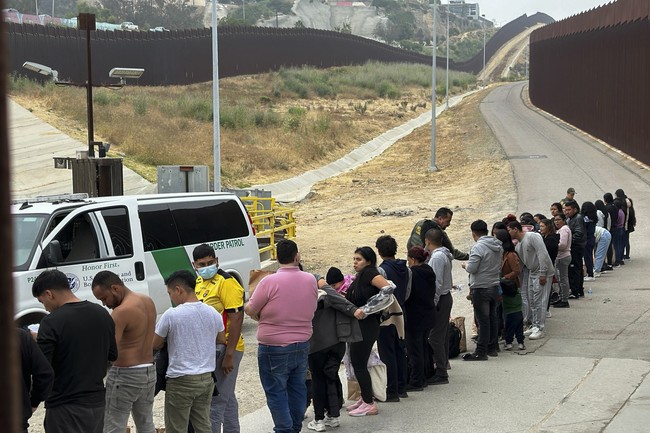
The 8th Circuit’s recent decision in Herrera Avila v. Bondi expands federal detention power, ruling that noncitizens who were never lawfully admitted can face mandatory detention without bond even when arrested inside the United States, and that shift echoes a similar 5th Circuit ruling and sets up a likely Supreme Court showdown.
The 8th Circuit issued a ruling this week that widens federal authority to hold migrants without bond, extending mandatory detention beyond encounters at the border into the interior of the country. The court framed the question around statutory language in the Immigration and Nationality Act and concluded that the detention rules apply to any alien present without lawful admission. That interpretation changes the practical distinction between border encounters and interior arrests.
At the center of the case is Joaquin Herrera Avila, who entered the United States unlawfully in 2006 and again in 2016 and was arrested during a 2025 traffic stop. DHS placed him in removal proceedings and detained him without bond. After an immigration judge denied a bond hearing, Avila sought relief through habeas, and a district court ordered release or a bond hearing, finding that the mandatory detention provision did not apply to his interior arrest.
The 8th Circuit reversed that result and held that 8 U.S.C. § 1225(b)(2)(A) mandates detention for any alien present in the United States who has not been admitted. The court focused on whether the statute’s phrases “applicant for admission” and an alien “seeking admission” are equivalent, concluding that they amount to the same category for mandatory detention purposes. That legal reading collapses the line many assumed existed between people encountered at ports of entry and those found inside the country.
The court’s opinion explicitly wrestled with statutory text and precedent, echoing the 5th Circuit’s decision in Buenrostro-Mendez v. Bondi, which reached the same broad outcome. Under both decisions, what determines mandatory detention is not where someone is stopped but whether they were ever lawfully admitted. For enforcement-minded policymakers, that is a straightforward, administrable rule that boosts federal leverage to detain nationals who entered unlawfully.
Opponents argue this approach sweeps too broadly and risks detaining people who are not actively trying to cross the border, but the court rejected that narrow reading. By reading § 1225 and related provisions together, the panel concluded the statute’s plain language supports detention whenever an alien is present without admission. That makes detention mandatory rather than discretionary in a wider range of cases, shifting the balance in removal proceedings.
If the phrases are equivalent, then, generally, any “alien present in the United States who has not been admitted” “shall be detained.” 2 Id. § 1225(a)(1), (b)(2)(A). On the other hand, if the phrases are not equivalent, then an alien is only subject to detention under§ 1225(b)(2)(A) if he or she is present in the country without being admitted and also engages in a separate act of “seeking admission,” whatever that may be.
The ruling portends significant operational consequences for DHS and ICE, giving them a broader statutory basis to deny bond and hold noncitizens during removal processes. Practically speaking, agencies that prioritize enforcement will view the decision as a useful tool for preventing released individuals from evading removal. Critics warn of civil liberties concerns and increased burdens on detention systems, but the opinion frames the matter as a statutory question, not a policy one.
The 7th Circuit has signaled skepticism about this sweeping interpretation in Castañon-Nava v. U.S. Department of Homeland Security, highlighting that circuits are not aligned on the scope of mandatory detention. That split makes it highly likely the Supreme Court will be asked to resolve whether interior arrests fall under § 1225(b)(2)(A). If the justices take the case, the outcome will determine whether the 8th and 5th Circuit approach becomes the national rule or remains a contested regional standard.
From a Republican perspective, this decision is a clear reinforcement of enforcement authority Congress wrote into law and a practical tool for controlling unlawful entries and interior immigration-related criminality. It supports an administration stance that prioritizes detention when statutory terms point to mandatory measures. Expect enforcement agencies to lean on the ruling while defense attorneys and civil interest groups press for review and relief in higher courts.



Add comment