
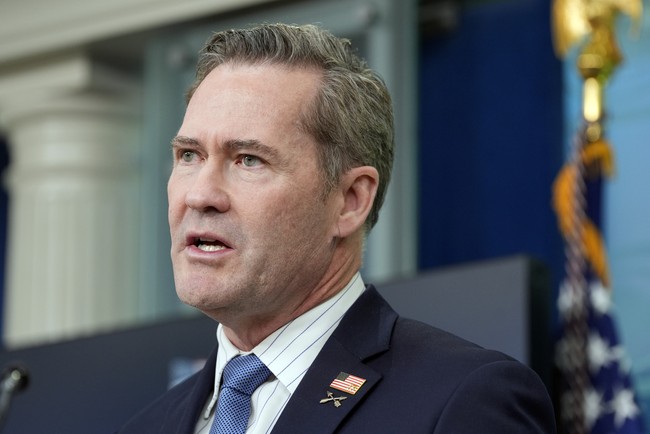
I’ll explain what Ambassador Mike Waltz said on Meet the Press about Operation Epic Fury, note the reported military effects, frame the long history of the Iranian threat, include the exact quoted remarks, preserve the embed, and keep the editorial perspective that this administration is taking decisive action.
United Nations Ambassador Mike Waltz joined NBC’s Meet the Press to assess the first week of Operation Epic Fury and to place the strikes in the broader context of decades of regional unrest. He described the operation’s initial results as significant and argued they reflect a necessary shift from talk to decisive action. The conversation focused on how military pressure is being applied to degrade Iran’s ability to threaten the region. His tone mixed professional military assessment with personal frustration at a problem he says has lasted generations.
Waltz highlighted concrete outcomes attributed to the operation, saying key Iranian capabilities have been targeted and harmed. He emphasized strikes on air force assets, air defenses, naval units, and production lines for drones and ballistic missiles. That list of targets maps directly onto the observable threat vectors that have been used against Israel, Gulf neighbors, and even supplied to other conflicts. For him, degrading those supply and launch capabilities is central to protecting Americans and allies.
Beyond the tactical picture, Waltz framed the campaign as addressing an enduring strategic threat. He noted that the current confrontation stretches back nearly half a century and placed the origin in actions by the Iranian regime in 1979. For Waltz, ending that long-running menace required a level of boldness past administrations did not bring. He credited the current president with taking decisive steps that, he argued, prior leaders failed to deliver.
ALSO SEE: Watch: U.S. Ambassador Says Gulf Leaders United Against Iran
Why We Fight Iran
“Well, I’ll tell you — the military objectives and achievements a week in are truly extraordinary, as the president has effectively laid out: Iran’s Air Force destroyed; Iran’s air defenses destroyed, and almost completely degraded; its navy sunk — over 40 ships sitting at the bottom of the ocean. And importantly, their ability to produce these ballistic missiles and these drones with which they’ve been terrorizing Israel, their neighbors in the Gulf, providing to Russia, and using against Ukraine, is also being severely degraded.
“So, the military, our great Secretary of War, Pete Hegseth, Secretary Rubio, and others, are laying out the case in terms of how we are going to protect the American people and eliminate this threat once and for all.
“Kristen, I can tell you, as a veteran, I can’t — it breaks my heart in so many ways that we have had to deal with this threat across the Middle East for 47 years. And I want to be clear: The Iranian regime started this war in 1979 under Jimmy Carter, and thank God for President Trump. He’s taking the bold, decisive action that so many of his predecessors have failed to do to end it, and end this threat to the American people and our allies once and for all.”
That block of remarks makes the central case in blunt terms: the campaign is being portrayed as a sweeping effort to dismantle Tehran’s operational reach. Critics will debate the scale and permanence of the damage, but the argument on the table is straightforward. If the stated effects hold, they would represent a major disruption of Iran’s regional posture and export of violence.
Waltz also tied the military message to political messaging, underscoring that restoring deterrence takes more than limited strikes. He framed the operation not as a brief episode but as the start of a campaign to eliminate a multi-decade threat. His language was explicit: this is meant to be an endgame move against capabilities that have threatened the United States and its partners. That framing matters because it sets expectations about follow-through and the administration’s priorities.
There is a human dimension to Waltz’s remarks too, particularly his reference to service and sacrifice. He spoke as a veteran and used that perspective to underline emotional and moral stakes. The implication is that allowing the threat to persist would be an offense to the memory of those who served and paid the price over decades. That kind of appeal aims to make the case for sustained pressure beyond immediate battlefield metrics.
The conversation also touched on allied unity and regional dynamics, suggesting Gulf partners are aligned with the need to blunt Iran’s reach. Waltz framed regional cooperation as part of the strategy to constrain Tehran’s influence. Diplomatic and military lines are being presented as complementary tools in this effort. For those focused on security, the combination of strikes and coalition-building is central to any long-term plan.
Editor’s Note: For decades, former presidents have been all talk and no action. Now, Donald Trump is eliminating the threat from Iran once and for all.
Help us report the truth about the Trump administration’s decisive actions to keep Americans safe and bring peace to the world. Join RedState VIP and use promo code FIGHT to get 60% off your VIP membership.


Add comment