
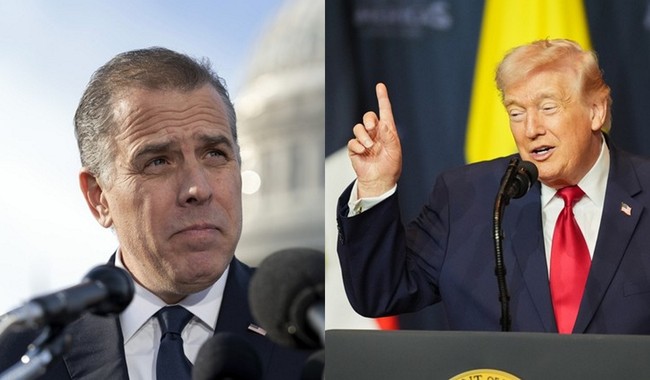
I’ll recap how President Trump skewered Hunter Biden and two vulnerable Democrats, note the key quotes he gave reporters, show how those jabs fit a broader political narrative, and place the public reactions and social media activity in context.
Donald Trump spoke from the Oval Office at an event promoting a major coal initiative and used the moment to land sharp punches at opponents. He answered Peter Doocy’s question about Hunter Biden running in 2028 with blunt, pointed humor that doubled as a political critique. The remarks were designed to highlight perceived double standards in Democratic politics and to frame character as a decisive issue. In doing so, Trump named two Democrats he mocked as emblematic of the party’s troubles.
When Peter Doocy asked about Hunter Biden’s potential viability in a 2028 Democratic primary, Trump didn’t play coy. He suggested that the Democratic Party’s lowered standards might allow a candidate with Hunter’s history to advance. The line aimed to force voters to consider whether the party values character or mere electability. That tension is central to the broader Republican critique of the opposition.
DOOCY: Hunter Biden. He’s on social media now, and he has suggested — maybe joking, I don’t know — that he could run for president in 2028. How would he do, Hunter Biden, in a 2028 Democratic primary?
Trump leaned into a comedic, brutal take that worked as both a joke and an attack. He referenced other Democrats running in 2026 as a measuring stick and used vivid language to make his point. The rhetoric was designed to provoke and to frame the Democrats as willing to overlook serious character issues for political gain. It was quick, memorable, and squarely political in its intent.
TRUMP: You would think that, you know, past is something to do with winning an election, and I would say his past is not the greatest.
[…]Um, I’m not gonna say bad [things].
I’m sure, you know, hey, if the guy from Maine can do well, I guess Hunter could do well, too, ’cause the guy from Maine is a basket case, and I would say worse than him is the one from Texas, that looks like Alfred E. Neuman.
I would say that if he can do, well, maybe Hunter can do well. I’m not sure, It would be pretty close as far as I’m concerned.
Trump’s “basket case” jab targeted Maine’s Democratic nominee, painting him as a scandal-plagued figure unfit for office. He paired that with a barbed visual about a Texas Democrat who, in Trump’s view, looks like a comic-book mascot rather than a serious public servant. The rhetorical goal was to reduce the opposition to caricature and to suggest that Democrats will back anyone who can win, regardless of character. That theme drives a lot of Republican messaging about standards and accountability.
Hunter Biden has been active on social platforms and tried a jokey, informal tone that invites parody and mockery. His social posts referenced mainstream media narratives and echoed partisan arguments, making him an easy target for the president’s derisive humor. For Republicans, the optics of a candidate with a troubled past flirting with a national run underline concerns about judgment and credibility. That makes the issue a persistent talking point ahead of 2026 and beyond.
Trump also weighed in on whether he detected cognitive decline when meeting Joe Biden in late 2024, delivering a measured yet pointed response. He said the president appeared the same as he had for years but hinted that something had changed after a public debate. The answer served two purposes: it pushed the narrative of concern about fitness for office while avoiding a crude personal attack. In classic Trump fashion, he left room for ambiguity while landing a rhetorical blow.
REPORTER: When you met with Joe Biden, President Joe Biden, right here in the Oval Office on November the 13th of 2024, could you detect any cognitive decline in President Biden at that time?
TRUMP: No, not really. I mean, he was the same guy I’ve been watching for a long time.
[…]
https://x.com/HunterBiden/status/2062271511650513357?ref_src=twsrc%5Etfw
He was fine as far as I was concerned. I don’t know, something happened to him during the debate. It could have been me.
Political theater like this does double duty: it entertains the base and it reframes the opposition in ways that stick. Comedy and ridicule become policy tools when they shape how voters perceive character and competence. For Republicans, highlighting flaws in rivals is a straightforward strategy to win skeptical middle voters and shore up turnout.
Observers on both sides will parse every line for deeper meaning, but the simpler takeaway is that Trump used the platform to spotlight what he sees as Democratic hypocrisy. He positioned Hunter Biden and two other Democrats as symbols of a party willing to overlook flaws for political expediency. That framing will likely echo through campaign ads and social feeds as the next election cycle unfolds.
The exchanges and quips reflected a broader battle over narrative control, one where sharp lines and memorable metaphors matter. Trump’s approach aimed to make opponents look unserious and unworthy while keeping his own message front and center. Expect this style of rapid-fire political comedy to remain a staple of the coming campaigns.
On the ground, Republican strategists will turn these moments into talking points about standards and accountability, while Democrats will try to pivot to policy and inevitability. Either way, the public got a clear demonstration of how rhetoric can redefine a contest before voters ever cast a ballot.

Add comment