
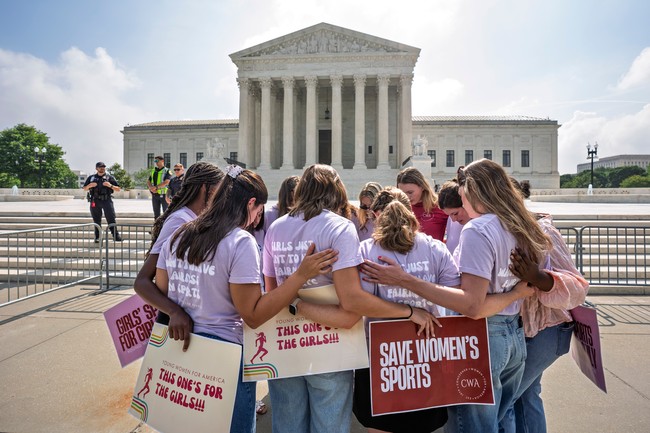
The Supreme Court’s decision in West Virginia v. B.P.J. upheld states’ authority to restrict girls’ and women’s sports to biological females, holding that Title IX and the Equal Protection Clause do not prevent states from creating sex-based athletic categories; the ruling affirms that Title IX contemplates biological differences and leaves legislatures, not judges, to weigh evolving science and policy on transgender participation.
The case reached the Court after twenty-seven states enacted laws limiting female sports to biological women, prompting challenges to the West Virginia and Idaho statutes. The challengers argued that Title IX and constitutional protections required allowing trans-identifying biological males to compete on girls’ teams. The Supreme Court disagreed and rejected that interpretation of federal law and the Constitution.
The majority opinion, written by Justice Brett Kavanaugh and joined by the Court’s conservative wing, framed Title IX as a statute enacted to guarantee access to athletic opportunities for girls and women. The opinion emphasized that Title IX and its implementing regulations historically understood “sex” to mean biological sex and that the law authorized separate teams for each sex. That statutory history informed the Court’s conclusion that states could rely on sex alone when structuring athletic competition.
The decision leaned on legislative and regulatory context, including the Javits Amendment and the 1975 regulations designed to preserve “equal athletic opportunity.” Those materials were cited to show Congress anticipated sex-segregated athletics in order to protect competitive fairness for females. The Court reasoned that Title IX expressly permitted states to create sex-based categories rather than forcing blended competition that could disadvantage biological females.
On the constitutional front, the Court held that the West Virginia and Idaho laws did not violate the Equal Protection Clause of the Fourteenth Amendment. The majority applied intermediate scrutiny to sex-based classifications, requiring that the classifications be substantially related to important governmental interests. The Court found that both safety and competitive fairness qualify as important interests that sex-based limits in sports can serve.
The majority relied on well-documented physiological differences between biological males and females in height, weight, strength, speed, and endurance to show that limiting women’s sports to biological females is substantially related to those interests. Plaintiffs pointed to a narrow subclass of transgender athletes, like the named plaintiff B.P.J., who had taken puberty blockers and cross-sex hormones and argued that those athletes might not present the same competitive concerns. The Court rejected the invitation to conduct individualized assessments or to require exemptions, stressing that intermediate scrutiny does not demand athlete-by-athlete hormonal testing.
Liberal dissenters, led by Justice Sotomayor, argued for more factual development in lower courts before foreclosing challenges, suggesting the Equal Protection Clause demands a closer look at whether exclusion of certain transgender athletes actually advances the state’s interests. The dissent favored a case-by-case inquiry where an athlete who never experienced male puberty could be shown not to threaten competitive fairness or safety. The majority, however, insisted legislatures are better positioned to make these empirical policy choices than courts are to micromanage athletic eligibility.
Justice Thomas filed a short concurrence stressing a distinction between immutable biological sex and gender dysphoria, which he described as a mutable characteristic. He argued that identity claims rooted in gender dysphoria do not automatically receive the constitutional protections reserved for immutable traits. That view underscores a conservative approach to equal protection analysis in these disputes.
The Court was careful to limit its holding to the question presented: whether Title IX and the Equal Protection Clause permit states to restrict women’s sports to biological females. The majority explicitly declined to decide whether Title IX would be violated if a state chose to allow biological males on girls’ teams. In other words, the ruling sets a statutory and constitutional floor permitting exclusion, but it does not declare a federal ceiling requiring exclusion everywhere.
That narrower framing leaves open litigation over permissive state policies that allow biological males to compete in girls’ sports, a debate already percolating through lower courts. Cases like Soule v. Connecticut Association of Schools and other challenges will test whether allowing such participation runs afoul of Title IX’s protections for biological females. The Supreme Court signaled that it may have more to say if those disputes reach it with a different question presented.
The ruling places primary responsibility on legislatures to assess medical research, competitive fairness, and safety concerns rather than on judges to conduct individualized hormonal assessments. The majority expressed skepticism that courts are well-suited to resolve the complex and evolving scientific questions about puberty blockers and hormone therapy. That deference gives states latitude to craft policies reflecting local judgments and athletic realities.
For advocates of preserving sex-separated women’s athletics, the decision is a significant validation of long-standing concerns about fairness and safety. The Court recognized the role Title IX played in creating opportunities for girls and emphasized that protecting those opportunities can justify sex-based classifications in sports. The ruling thus aligns statutory interpretation with biological realities and decades of athletic experience.
The litigation over the proper scope of Title IX and its application to transgender participation is far from over, and future cases will test the boundaries the Court intentionally left open. Lower courts will continue to grapple with how to apply intermediate scrutiny and where lines should fall between inclusion and protection of competitive fairness. As those disputes move forward, legislatures and courts will remain the arenas for sorting policy, science, and rights claims.
The decision will shape state policymaking and the landscape of high school and collegiate athletics for the foreseeable future, clarifying that federal law and the Constitution do not bar sex-based limits on women’s sports. It affirms the idea that preserving girls’ athletic spaces based on biological sex is legally permissible. That legal clarity will influence how schools, leagues, and lawmakers approach eligibility rules and the balance between inclusion and competitive integrity.



Add comment