
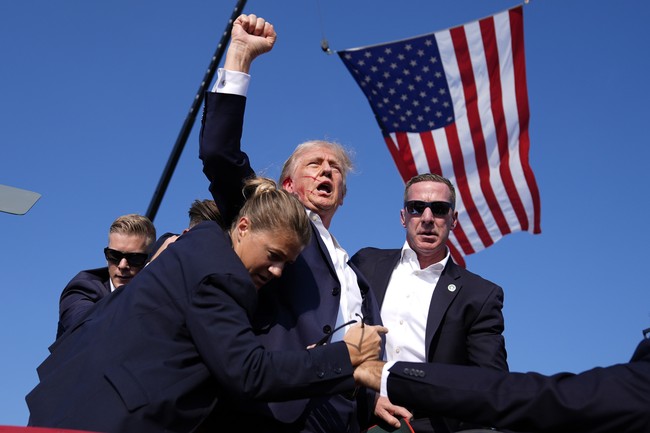
The Department of Homeland Security inspector general released a report that details multiple failures in the Secret Service response during the assassination attempt on Donald Trump in Butler, Pennsylvania, including a counter-drone operator who was searching online for the rooftop location as shots were fired, local law enforcement warnings that were not relayed in time, and planning breakdowns that left the shooter a clear line of sight 155 yards from the podium.
The DHS inspector general report says a Secret Service counter-drone operator was using an online search to find the roof location where Thomas Crooks was positioned at the very moment Crooks opened fire. Rather than immediately coordinating with officers who had identified the rooftop, the operator continued searching the internet while the gunman aimed. That delay became one of several critical failures highlighted by investigators.
Local law enforcement had reported spotting a suspicious person on the American Glass Research building roof at 6:09 p.m., two minutes before the first shots. Those warnings never reached the protective detail in time, leaving the team unaware of the armed man directly overlooking the venue. When Crooks fired eight shots at 6:11 p.m., agents and staff were already reacting to live gunfire rather than preventing it.
At the rally, the assailant struck the then-presidential candidate in the ear, causing significant bleeding, and a volunteer, Corey Comperatore, was killed while shielding his family. Two other men suffered serious wounds in the attack, and law enforcement eventually shot and killed the rooftop shooter. Multiple Secret Service agents were later suspended without pay as investigators examined the scene and agency response.
The report shows the counter-drone operator was still searching for the AGR complex when the first shots rang out, instead of confirming the tip directly with the officers who had called it in. Supervisors and planners also failed to act on simpler mitigation measures proposed at the scene. A site agent suggested using trucks already at the fairgrounds to block the line of sight from the AGR building to the stage, but that suggestion was rejected because it would have been “too close to [President Trump’s] press shot.”
The alternative placement that was agreed upon was never implemented, and follow-up never occurred after leadership said local law enforcement would handle the AGR complex. Those handoffs created gaps in responsibility and communication, leaving the shooter with an unobstructed 155-yard view of the podium. The IG report points to a cascade of missed opportunities to detect or deter the attack before shots were fired.
https://x.com/nypost/status/2072876426244632874
The lead agent at the event, identified in the report as Miyo Perez, was noted to have relatively limited experience, while supervisors who oversaw her planning did not face discipline and later advanced within the agency. Sean Curran, the agent who signed off on the site security plan and later became Director of the United States Secret Service, is named as the official responsible for approving the layout. The report criticizes both planning and oversight, saying the lack of policy and consistent process contributed to the failure to share intelligence and coordinate effectively.
“The Secret Service’s overall lack of policy and processes, coupled with limited intelligence sharing and poor collaboration and communication with protectee staff and state and local law enforcement, set the conditions that led to missing opportunities to prevent and detect the attempted assassination,” the report reveals.
Investigators found that supervisors did not ensure mitigation steps were carried out and did not confirm that local partners were assuming responsibility for the AGR site. That breakdown left the protective team operating under the false assumption that the threat was being handled, when in fact Crooks retained a clear line of fire. Those coordination failures compounded the initial mistake of relying on an online search at a critical moment.
After the shooting began, law enforcement on the ground engaged the rooftop shooter and ultimately neutralized the threat, but only after damage had already been done. The report frames the incident as a preventable tragedy made worse by a sequence of procedural lapses and poor communication. The human cost was sharp: lives were lost, others injured, and the president narrowly escaped a fatal outcome.
The IG review recommends stronger policy, clearer processes for intelligence sharing, and improved collaboration between Secret Service staff, protectee teams, and state and local law enforcement to prevent similar breakdowns. The document underscores that specific actions and decisions at the event collectively created the conditions for the attack to succeed in reaching the stage area. Reformers and agency officials now face pressure to implement changes that address each gap identified in the report.
Investigators and agency leaders will need to reconcile how routine procedures and split-second choices combined to produce such a dire result, and how to ensure faster information flow and decisive action in future protective operations. The report offers a stark reminder that planning oversights and communication failures can be fatal when a threat emerges in real time.
Add comment