
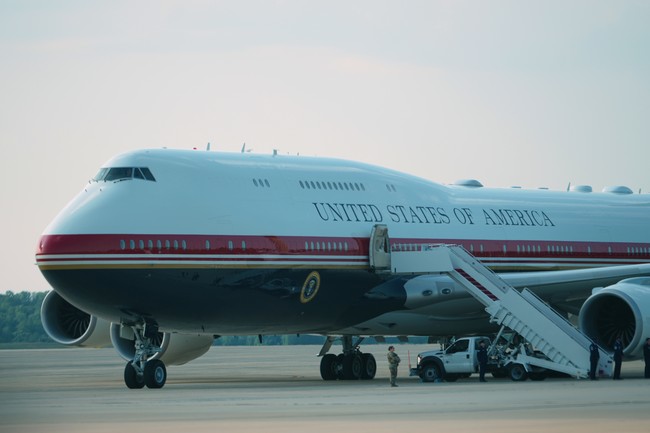
This piece argues that the interim Air Force One, a Qatar-sourced Boeing 747-8 valued at $400 million and modified for presidential use, is a fiscally sensible, mission-driven solution that preserves national security, leverages diplomacy, and avoids unnecessary taxpayer expense while the permanent VC-25B replacements face delays.
President Donald Trump’s recent flight aboard a newly modified Boeing 747-8 highlights a practical approach to presidential transportation that prioritizes capability and cost discipline. The plane, described as an interim Air Force One, was secured through diplomatic channels rather than bought outright, which changes how we should assess the expense and the optics. Critics in legacy outlets focused on appearances, but the operational realities tell a different story that deserves attention.
The aircraft reportedly came without a direct purchase price for American taxpayers, a fact that matters in a time of tight budgets. The U.S. military handled necessary retrofits to meet presidential security and communications standards, and those conversion efforts were performed in American defense facilities. That kept the work and the dollars tied to domestic high-tech manufacturing instead of sending procurement money overseas for a brand-new hull.
This bridge jet provides an available, capable platform while Boeing completes the long-delayed VC-25B program, which has struggled with development challenges common to large defense projects. Having a four-engine airframe like the 747-8 as a stopgap makes engineering sense for presidential missions because it balances range, payload, and redundancy. Presidential flights often carry extensive communications suites, large staffs, and substantial security contingencies, so the platform must be able to shoulder that load without compromising operational assurance.
https://x.com/PenguinSix/status/2072318237019086913
Range and engine redundancy matter for transoceanic legs and remote operations where safety margins cannot be second-guessed. Twin-engine commercial designs deliver fuel savings, but a commander-in-chief mission is not a routine commercial hop where small fuel efficiencies justify added risk. The engine-out capability and the larger payload capacity are pragmatic choices aligned with mission assurance, not extravagance.
Accepting and converting an allied nation’s aircraft into an interim presidential transport also reflects practical diplomacy and alliance management. Qatar, which hosts key U.S. facilities and plays a role in regional security, provided an asset that could be adapted quickly to meet U.S. requirements. Using a partner’s offer in this way turns diplomatic capital into operational capability without the time and expense of building a replacement from scratch.
From a fiscal standpoint, this approach conserves scarce defense dollars at a moment of competing priorities, including nuclear modernization and broader military readiness. Rather than sinking additional funds into a delayed procurement that faces schedule and cost risk, leveraging an immediately serviceable airframe reduces near-term budget pressure. The conversion work itself injected business to American defense firms and sustained domestic expertise in secure communications and aircraft modification.
Skeptics will dispute the optics and raise questions about transparency; those debates are fair and expected in a free society. Yet the central facts remain: the interim solution filled an immediate operational need, kept modification dollars onshore, and avoided a new-hull purchase that would have added cost and delay. That sequence of choices fits a mindset of fiscal prudence and operational realism rather than wasteful spending.
Engineering trade-offs in presidential aviation are not about showmanship so much as mission assurance. The 747-8’s four-engine configuration, significant payload capacity, and long range deliver the redundancy necessary to move the president safely across the globe. Given the stakes involved in carrying the commander in chief, prioritizing reliability and survivability is a sound judgment call, even when some commentators prefer to emphasize perceived symbolism over substance.
Using allied cooperation to bridge a capability gap also sends a clear signal about the value of partnerships that provide tangible benefits to U.S. operations. Diplomacy that yields concrete, immediate capability demonstrates how strategic relationships can be managed to advance national security without imposing fresh procurement burdens on taxpayers. In short, this interim Air Force One is a pragmatic, resource-conscious response to a complex procurement reality that keeps the nation’s leadership mobile and mission-ready.


Add comment