
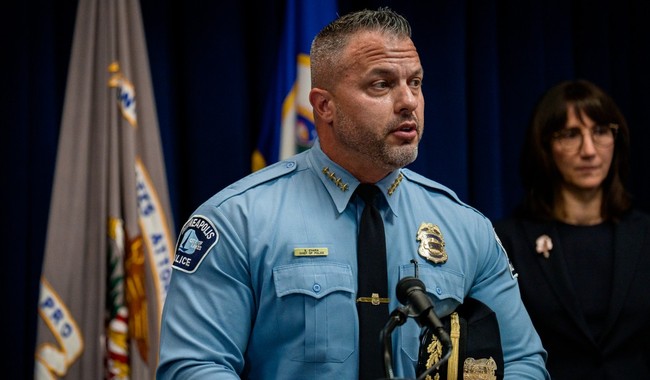
Minneapolis’ police chief told residents to call 911 if they see ICE agents conducting operations, a move that has stirred sharp criticism and political heat amid recent federal immigration actions tied to a large welfare fraud probe. The chief framed the guidance around public reports of masked individuals and potential kidnappings, while federal officials insisted targets are chosen for immigration status, not appearance. Reactions ranged from scorn from federal immigration figures to concerns about public safety and the city’s political priorities as officials react to heightened ICE activity.
Minneapolis Police Chief Brian O’Hara urged people to call 911 if they witness what looks like law enforcement activity but they are unsure who is involved. He said the department had received reports of masked people and fears that someone might be “kidnapping people,” and he described a duty for officers to step in when legitimacy is unclear. Speaking plainly, O’Hara encouraged citizens to provide as much information as possible to 911 so police could assess and respond.
Federal immigration operations reportedly increased after investigators uncovered a massive welfare fraud scheme, and that uptick brought ICE agents into neighborhoods where many Somali Americans live. DHS leadership pushed back on claims that agents target people because of race or ethnicity, reminding everyone that ICE focuses on immigration status. The debate immediately shifted from legal and procedural concerns to political accusations and local backlash.
Mayor Jacob Frey accused immigration authorities of “targeting Somali people” based on appearance, a claim that escalated tensions and invited national commentary. Department of Homeland Security Assistant Secretary Tricia McLaughlin emphasized that ICE’s focus is on people in the country illegally rather than on anyone because of how they look. Those clarifications did little to calm local leaders who framed the raids as an affront to community trust and safety.
Chief O’Hara’s remarks didn’t land well with everyone. Border Czar Tom Homan publicly criticized the chief and said he should “put his badge in the desk drawer,” a sharp rebuke from a national enforcement voice. That kind of response underscores how policing, immigration enforcement, and municipal politics collide, creating theater that distracts from restoring law and order. For many conservatives watching, it reinforced a view that local leadership is too willing to side with politics over public safety.
The chief’s appeal to call 911 if people are uncertain who is conducting an operation is framed as a public safety measure, but critics worry about the consequences for officers and the community. Officers intervening in federal operations could face confusion and risk, and civilians calling 911 in tense situations may escalate confrontations. From a Republican perspective, the priority should be clear: support lawful enforcement, protect neighborhoods, and hold public officials accountable when politics interfere with safety.
Minneapolis carries recent baggage from the 2020 unrest when looting and arson devastated parts of the city, and critics argue that decision makers since then have failed to prioritize enforcement. O’Hara was not the police chief at that time, yet the political leadership under Governor Tim Walz has drawn scrutiny for the state’s overall direction. Skeptics point to those events as evidence that a lax attitude toward law enforcement emboldens criminal behavior and erodes public confidence.
The local debate also exposes broader tensions about immigration and accountability. Some defenders emphasize due process and fear of profiling, while others demand strict enforcement and protection for citizens. Republicans tend to emphasize the need to secure borders, back law enforcement, and avoid allowing politically driven narratives to paralyze public safety efforts. That clash plays out loudly in Minneapolis as federal and local authorities navigate a fraught, highly visible operation.
Political theater and media coverage have amplified divisions, with elected officials trading accusations and national figures weighing in. In the middle are residents who want safe streets and transparent, consistent enforcement, not partisan posturing. The immediate question now is whether local leadership will defend city residents through steady policing and cooperation with federal partners, or whether political signaling will continue to undermine effective law enforcement.
The reaction to the chief’s guidance is a snapshot of a larger national disagreement: who gets to decide how enforcement happens, and whether cities will cooperate with federal agencies tasked with upholding immigration law. For many on the right, the answer is clear—public safety and the rule of law must come first, and political theatrics should not get in the way of enforcing immigration statutes. The dispute in Minneapolis is likely to remain a flashpoint as enforcement actions continue and politicians posture for advantage.
Back to O’Hara:
“We have experienced reports in this city … where people call to say that there’s folks that are masked, that they’re not sure if they’re law enforcement, that they may be kidnapping people. We have had those reports,” O’Hara said during a baffling news conference.
“The community should know that if you see something like that, that is legitimate, that you don’t know if someone is law enforcement, you should call 911, and you should provide as much information as possible,” he said, pledging that cops “absolutely have a duty to intervene” in such cases.
Border Czar Tom Homan had harsh words for O’Hara, saying he should “put his badge in the desk drawer”.

Add comment