
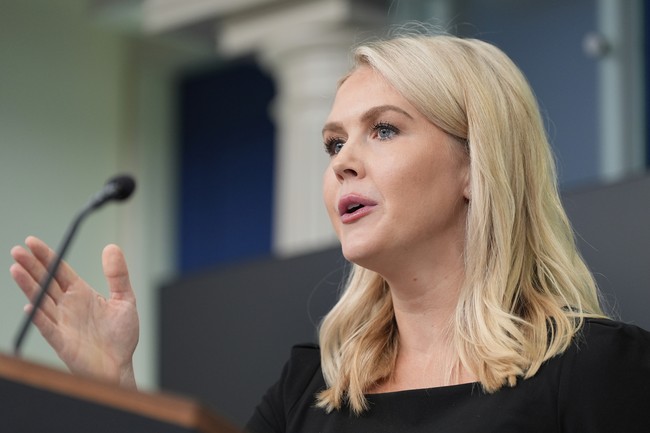
The CNN reporter Kaitlan Collins recounted an episode in Saudi Arabia where the White House press secretary Karoline Leavitt stepped in to ensure Collins could attend an event with the rest of the U.S. press pool, and that intervention undercuts narratives that the Trump administration is intent on crushing press freedom.
Democrats fling the term “fascist” at President Donald Trump so often it has lost meaning, yet stories like this show a different side of how his team operates abroad. The episode demonstrates a simple, practical protection of American reporters when foreign hosts push limits on press access. It’s not rhetorical posturing; it’s a concrete choice made in a tense moment.
President Trump talks to the media regularly and directly, a contrast with the previous administration’s more guarded approach to press encounters. That contrast matters because access and visibility shape how the public gauges both leaders and the press. The Biden team often appeared to control and restrict interactions, while the Trump team has shown a willingness to engage and defend reporters’ presence even when relations are strained.
Kaitlan Collins described being in Saudi Arabia with the White House pool and trying to ask a question at an event where local authorities “famously do not like the media there, to put it lightly.” When the Saudi royal guard reacted and indicated she would not be allowed to attend the next segment, the pool faced a choice about whether to press the issue. That kind of pushback in a foreign setting can be intimidating and could easily curtail U.S. reporters’ ability to cover events fully.
Some in the press pool hesitated, unsure of how to respond, and they turned to White House Press Secretary Karoline Leavitt for guidance. Leavitt’s decision was decisive and clear: Collins should be allowed to enter with the rest of the U.S. press. Her intervention prevented a standoff that could have escalated and set a precedent for letting foreign hosts dictate who represents the American media abroad.
Collins praised the intervention as crucial in communicating a commitment to press freedom while on foreign soil. She said, “And to her credit, she said, no, Kaitlin is coming in with the rest of the U.S. press. And we went in. And so it didn’t become this huge issue,” Collins said. “And so to her credit, she, without a doubt, was like, no, you’re coming in. Which I do think is important in that moment, especially when you’re the U.S. contingent abroad, and we don’t do things like they do in Saudi Arabia.”
The exchange reveals that, at least in this instance, the Trump administration prioritized American reporters’ rights in a setting where those rights are not a given. That action runs contrary to the simplistic claim that this administration seeks to silence the press at home or abroad. Standing up for a CNN reporter in a foreign country is tangible proof that protecting access can be a bipartisan principle in practice if not always in rhetoric.
Critics who call every critique of media coverage an attack on a free press blur the line between accountability and suppression. Calling out unfair reporting or demanding accuracy is part of a healthy media ecosystem; it does not equate to denying outlets the ability to operate. The Leavitt-Collins incident highlights this distinction: the administration objected to what it perceived as unfairness, yet still ensured the reporter could do her job in a hostile environment.
There is value in recognizing the complexities of these interactions rather than reducing them to slogans. Foreign hosts can and do try to limit U.S. reporters, and the choice to push back matters. When a U.S. representative says a member of the American press will be treated like the rest of the pool, that is an explicit defense of journalistic access that should be acknowledged on its merits.
Collins’ account may also offer perspective to those inside media institutions who take their freedoms for granted until they face restrictions elsewhere. Experiencing a foreign government’s disdain for press freedom can sharpen appreciation for constitutional protections at home, even if reporters and officials disagree domestically. That reality makes it harder to sustain absolutist claims that one side or the other wishes to abolish press freedom entirely.
Ultimately, the episode is a reminder that actions in specific moments define how principles are practiced, not just how they are proclaimed in partisan arguments. Standing up to a foreign host to protect an American reporter shows a willingness to defend access when it counts, and that fact complicates any easy narrative that paints the administration as uniformly hostile to the press.

Add comment