
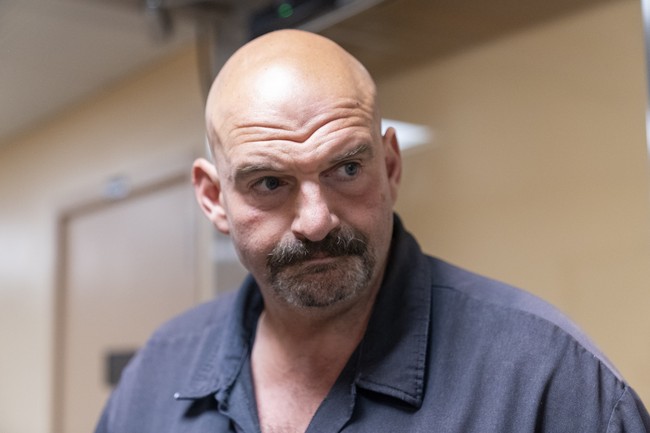
Senator John Fetterman told an interviewer he will not campaign against Republican Senator Dave McCormick if McCormick runs for reelection in 2030, a move that underscores an unusual bipartisan partnership between two Pennsylvania senators who have recently coordinated fundraising and public appearances.
Senator John Fetterman of Pennsylvania surprised some observers by saying, “Well, I would absolutely never move against my friend,” when asked if he would oppose his state colleague in a future campaign. He also described Dave McCormick as a “great guy,” while stopping short of promising an endorsement or active campaigning for him.
That declaration follows the two senators forming a joint fundraising committee, a step they took to pool donor support for both offices. The group, named Common Ground PA, is organized to accept contributions from donors who want to back the bipartisan duo and their work for Pennsylvania.
Fetterman and McCormick have highlighted a practical approach to representing a purple state where collaboration can matter as much as partisan loyalty. They jointly stepped in this summer to ensure Pennsylvania had a proper showcase at a national event after the state governor declined to set up a display, demonstrating a willingness to act beyond party lines.
https://x.com/DISivak/status/2087297166985556032?ref_src=twsrc%5Etfw
NEW: Fetterman pledges not to campaign against Republican Dave McCormick
“I would never, ever move against my friend,” Fetterman told me in an interview.
It’s not clear whether Fetterman will still be in politics in 2030, when McCormick’s seat opens up, but his promise is super unusual from a member of the opposite party and one of the clearest signs of his political alliance with McCormick yet.
His comments follow the two senators standing up a joint fundraising committee last month.
Their teamwork once included filling a gap left when the state failed to provide a Pennsylvania presence at a major fair on the National Mall. When visitors found an empty space where a Keystone State display should have been, the two senators and a group of private partners stepped in to represent Pennsylvania.
That incident has become a touchstone for their partnership, signaling a practical patriotism that places state interests ahead of partisan headlines. Observers note that while the two disagree on policy, they have repeatedly set aside those differences to prioritize visible support for their state.
Promises like Fetterman’s — to refrain from campaigning against a political friend across the aisle — are rare and draw attention because they differ from the usual electoral posture. It’s one thing to cooperate on legislation or events, and another to pledge political noninterference when a seat becomes competitive.
Even so, pledging not to oppose someone is not the same as pledging active support, and Fetterman left open the question of whether he would ever formally endorse McCormick. The long horizon to 2030 and Fetterman’s own reelection cycle add variables to what now looks like a symbolic but meaningful alliance.
Fetterman faces reelection in 2028, which raises a reciprocal question about how McCormick might act if the roles are reversed. Both senators have signaled an interest in building donor networks and public coalitions that can span party lines within Pennsylvania.
Their joint fundraising committee is meant to appeal to donors who value collaboration rather than a strict partisan agenda. By offering a vehicle for contributions that support both senators, Common Ground PA underscores a strategic bet that bipartisanship can be a fundraising asset in a politically mixed state.
Whatever the long-term political implications, the moment highlights a broader issue in contemporary politics: how elected officials balance partisan competition with practical cooperation. In Pennsylvania, at least for now, two high-profile senators are testing a model where working together is treated as a sensible option rather than a betrayal of party identity.
Add comment