
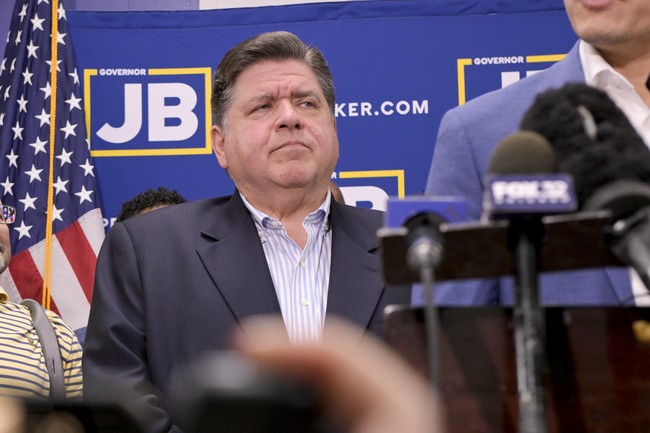
Illinois lawmakers are racing to change the state constitution’s redistricting rules days before the amendment deadline, pushing a measure that would reorder priorities for drawing legislative maps and elevate race-based considerations ahead of traditional criteria like compactness and contiguity.
Democratic leaders in Springfield have advanced a constitutional amendment that keeps equal population as the top requirement but moves other priorities, including language that directs mapmakers to consider “racial coalition or influence districts” earlier in the process. The timing of the filing — just before the deadline to move constitutional measures — has intensified scrutiny and created sharp partisan debate over motives and consequences. Republicans warn this is a power play meant to cement one party’s advantage, while Democrats say it protects minority representation if federal safeguards erode.
Republican lawmakers say the amendment undermines long-established state redistricting principles that date back to the 1970 constitution and removes guardrails designed to keep maps fair and competitive. They point to a lawsuit filed last year claiming current maps violate the state constitution’s compactness standard and its guarantee of free and equal elections, and they argue the proposed amendment responds to political damage rather than legal necessity. Opponents also criticized attempts to speed multiple measures through without the usual posting requirements, framing that as a move to limit transparency.
“Our Illinois constitution, since it was adopted in 1970, has had three elements as guiding principles for redistricting — that districts shall be compact, contiguous, and substantially equal in population,” said Rep. Ryan Spain, R-Peoria. “Some of those elements are routinely run over by Illinois Democrats, and now with the constitutional amendment introduced just days before the deadline… they double down.”
Republican leaders emphasize that the recent court dismissal of their case was on timing grounds rather than on the merits, noting the suit was filed nearly four years after the maps were adopted. They argue that allows Democrats to claim victory while moving to change the rules that could be used against them in future challenges. From their perspective, altering the constitutional order of priorities is not reform but a way to lock in partisan outcomes for a decade.
Democratic lawmakers, by contrast, frame the amendment as a defensive measure against a shifting federal legal landscape. They warn that the Supreme Court could pare back federal protections that have supported minority representation, and they say states must be ready to protect those communities at the state level. Speaker Chris Welch and other Democrats argue this approach is meant to safeguard representation rather than to empower partisan mapmakers, stressing that the proposal is not a mid-decade redraw like what has unfolded in Virginia.
“This Supreme Court is poised to dismantle these protections, and when it does, some states will quickly undertake new gerrymandering schemes aimed at stripping away Black, Latino, and other minority representation,” Welch said.
The amendment requires a three-fifths vote in the legislature before the May 3 deadline to advance to the ballot, where Illinois voters would then decide in November whether to adopt the change. If approved, the new priority order would govern the next round of legislative map drawing and could reshape political control across the state for years. Lawmakers on both sides are messaging this as a high-stakes fight over who writes the rules that determine political boundaries and influence electoral outcomes.
Republican lawmakers such as Rep. Amy Elik and Rep. Dan Ugaste have criticized the amendment as a blatant power grab, citing broken promises from the governor and accusing Democrats of trying to cement supermajorities. They argue Illinois residents deserve transparency, fair maps, and leaders who stick to their commitments. Democrats, meanwhile, insist the measure is a necessary precaution to preserve minority voting power if federal protections are overturned, positioning the amendment as a proactive shield rather than an offensive maneuver.
The debate in Springfield mirrors fights playing out elsewhere, including high-profile conflict in Virginia, but Illinois leaders emphasize the differences in approach and timing. Even so, the underlying battle is the same: control of mapmaking rules carries outsized influence over political power, voter representation, and legislative priorities for the coming decade. With the legislative clock ticking, the next steps hinge on whether lawmakers musters the votes to send the amendment to voters or whether the proposal stalls amid partisan objections and procedural fights.



Just wrote this comment elsewhere on this site that cuts to the chase of what and why this corruption is being implemented in these hellish evil Demoncrap States!
I’ve given much thought and prayer to all of these facts you bring out now and over time but I’ve come to the conclusion that things have been allowed to slide and sink into such a deep evil quagmire of ugliness and destruction because either the old “passing the buck” went full tilt into total all out greed or these people have literally sold their souls and are owned by Satan. So much changed in America all the way back in 1913 when the Federal Reserve was created by some of the most diabolical filthy rich elites, and that got coupled with a most diabolical anti-God and human ideology which was spawned and founded just previously by Karl Marx (who openly worshiped Satan and talked his own two daughters into committing suicide) he and Friedrich Engels, who both developed its core principles and published “The Communist Manifesto” in 1848 which was then able to flourish during the Industrial Revolution, as the stage was being set for the future of totalitarianism and the prophesied future arrival of the the Antichrist with the Globalist Beast System!
Look what communism has done to whatever countries its been manifested in as for example Communist China, or then spreading into Southeast Asia, as in “Cambodia when Pol Pot the leader of the Khmer Rouge from 1975 to 1979, when he was responsible for the deaths of approximately 1.5 to 2.8 million people, through executions, forced labor, and starvation. His regime aimed to create an agrarian socialist society, leading to one of the worst genocides in history.” As you know they called it the Killing Fields during the Viet Nam War Era and I say these subhuman devils we mention that now infest America, even our government; would not hesitate to bring those same techniques of total control here to our beloved former Constitutional Republic of the People the first chance they get to seize total control; which they’ve been pushing to do for decades now!
That Globalist shill Spanberger in Virginia is pushing that agenda for sure with changing or redistricting the voting landscape there as is also happening in many other states throughout, even as I’ve read in Texas from some reliable data I’ve come upon! How else but by an evil full blown greed and hate of what’s good or right can this be happening; and what’s very telling is how Spanberger came from within the ranks of the FBI!!! All I see in her is a witch from hell, and who is owned by the father of all lies! Soros is pure evil and should have been executed many decades ago but somehow remained untouchable; but now sorry to say that old almost silly adage at one time used jokingly; “money talks and bullshit walks” is now a reality for sure in America! You know how they say “everybody has a price” or for these power mongers its “name your price,” as they seem to buy just about anyone! It sure looks to me like the human race has arrived at this prophesied point mentioned in Scriptures that speaks to End Time!
Isaiah 5:19-21 to those who say, “Let Him hurry and hasten His work so that we may see it! Let the plan of the Holy One of Israel come so that we may know it! 20Woe to those who call evil good and good evil, who turn darkness to light and light to darkness, who replace bitter with sweet and sweet with bitter. 21Woe to those who are wise in their own eyes and clever in their own sight.”
And here isn’t this pointing out exactly what we are saying!
2 Timothy 3:1-4 “But understand this: In the last days terrible times will come. 2For men will be lovers of themselves, lovers of money, boastful, arrogant, abusive, disobedient to their parents, ungrateful, unholy, 3unloving, unforgiving, slanderous, without self-control, brutal, without love of good, 4traitorous, reckless, conceited, lovers of pleasure rather than lovers of God,…”