
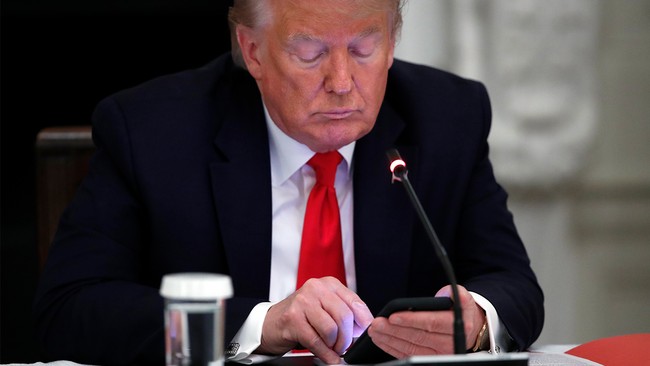
Checklist: Summarize Trump’s post and threat to Iran; explain the military and diplomatic context; reproduce key quoted statements exactly; describe implications for civilians and international law; note doubts about who speaks for Iran. This article focuses on the president’s warning that Iran must reopen the Strait of Hormuz or face strikes on critical infrastructure, and it preserves the quoted material as originally stated.
President Trump published a blunt public warning aimed at Iran, saying the United States is in intensive talks with what he called “A NEW, AND MORE REASONABLE, REGIME” and pressing for an immediate reopening of the Strait of Hormuz. His message hinges on a simple ultimatum: reach a deal and end or scale back military operations, or face targeted attacks on Iran’s infrastructure. The stakes are framed in stark, operational language, with specific facilities named as potential targets.
In his post, the president spelled out what would happen if negotiations failed or the strait did not return to normal commercial traffic, promising a campaign against Iran’s energy and water supply systems. That declaration singles out Electric Generating Plants, Oil Wells and Kharg Island, and even desalinization plants as assets the United States has deliberately avoided so far but would strike if necessary. Naming those particular facilities makes the threat unusually concrete and signals a willingness to inflict strategic damage rather than limited tactical blows.
[W]e will conclude our lovely “stay” in Iran by blowing up and completely obliterating all of their Electric Generating Plants, Oil Wells and Kharg Island (and possibly all desalinization plants!), which we have purposefully not yet “touched.”
That language raises immediate questions about the humanitarian and legal consequences of disabling water purification and power infrastructure, both of which are essential to civilian life. Disrupting desalinization plants could leave vast numbers of people without reliable drinking water, and taking out power plants would compound public health and safety risks. International law and commentary from legal experts often treat attacks on civilian infrastructure as fraught terrain, and critics will likely frame such strikes as crossing a serious line.
Trump framed the potential strikes as retribution for past Iranian acts, saying they would be “in retribution for our many soldiers, and others, that Iran has butchered and killed over the old Regime’s 47 year ‘Reign of Terror.'” Those words tie current operations to a decades-long narrative of Iranian hostility and position any U.S. military action as the culmination of a long response cycle. The rhetoric leaves little ambiguity about the emotional and political drivers behind the threat.
The United States of America is in serious discussions with A NEW, AND MORE REASONABLE, REGIME to end our Military Operations in Iran. Great progress has been made but, if for any reason a deal is not shortly reached, which it probably will be, and if the Hormuz Strait is not immediately “Open for Business,” we will conclude our lovely “stay” in Iran by blowing up and completely obliterating all of their Electric Generating Plants, Oil Wells and Kharg Island (and possibly all desalinization plants!), which we have purposefully not yet “touched.” This will be in retribution for our many soldiers, and others, that Iran has butchered and killed over the old Regime’s 47 year “Reign of Terror.” Thank you for your attention to this matter. President DONALD J. TRUMP
Observers note that the effectiveness of a threatened strike depends in part on whether Washington is actually negotiating with decision-makers who can change Tehran’s behavior. The president referenced a “more reasonable” cohort inside Iran, but names and clear authorities have not been publicly confirmed. That ambiguity complicates any diplomatic timeline and makes military pressure more unpredictable.
Strategically, forcing the Strait of Hormuz to reopen would be a major win for global commerce and energy markets, but doing so by threatening mass infrastructure destruction would carry major diplomatic fallout. Nations that rely on the strait for oil shipments would welcome resumed traffic, yet many allies and neutral states would balk at attacks that could produce heavy civilian suffering. The administration is betting that the clarity of its threat will produce bargaining leverage without triggering a wider escalation.
Legal and moral debates are already starting to swirl in international circles, where experts worry about the line between a legitimate military target and an attack that disproportionately harms civilians. Strikes on power grids and water systems are uniquely disruptive and can be seen as punitive measures that extend beyond conventional military objectives. Critics will argue such options risk violating norms and could provoke condemnation or legal challenge.
On the ground, the human cost of infrastructure attacks would be immediate and severe for ordinary Iranians, from hospitals losing power to households losing access to potable water. Even a limited campaign aimed at degrading energy production risks cascading failures that magnify suffering beyond any intended military effect. Those potential outcomes are central to the debate over whether such a hardline approach is wise or acceptable.
The administration presents this as a last-resort lever to end operations and protect American interests while reopening a vital shipping lane. Whether the threatened course of action becomes reality depends on how Tehran responds and on whether those the U.S. says it is talking to can deliver the necessary changes. For now, the message from the White House is unmistakable: reopen Hormuz and negotiate, or prepare to see infrastructure targeted in a way that would reshape the conflict’s footprint.


Add comment