
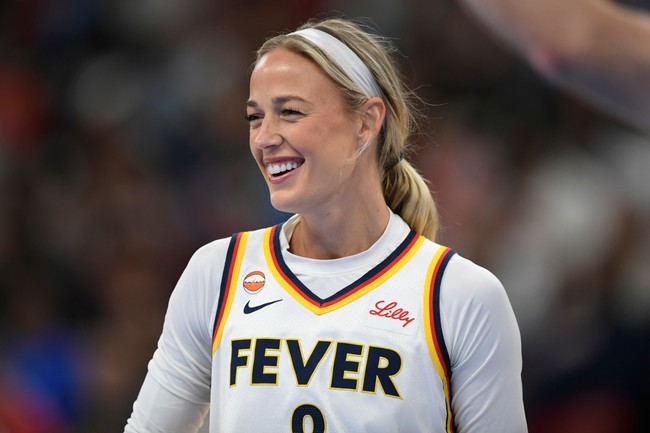
The controversy over men in women’s sports flared up again after Indiana Fever guard Sophie Cunningham spoke out, drawing public attention and high-profile support at a recent Fever-Wings game in Dallas; this piece covers her remarks, the league’s evasive stance, the crowd reaction, notable attendees, and the on-court result while keeping direct quotes intact and the original embed markers in place.
Sophie Cunningham used her platform to defend the integrity of women’s sports, saying she can both play and speak. She has kept a steady drumbeat of comments supporting the idea that biological men should not compete in women’s leagues, and that stance has prompted both praise and criticism. The WNBA’s public position has been vague, which only fed the controversy and drove more people to pay attention to what players are saying.
Cunningham pushed back on the notion that athletes should stay silent. “People are like, ‘You have a platform. Use it,’ and then once you use it, it’s like, ‘Go back to playing basketball’…I think I could do both,” she said. She made clear she intends to keep speaking on the subject while continuing her career on the court.
Her comments also touched on leadership in the league as the commissioner’s contract nears its end. “You do have to have a person in power who is bold, who is confident, who wants the best for the players and not maybe for themselves all the time. So I do feel like, as a whole, that could be a position that’s maybe open at the end of the year, but that’s not my call,” Cunningham told USA Today. That kind of remark suggests players want clarity and a leader willing to make tough choices for the good of the sport.
https://x.com/RedWavePress/status/2090431457835495865
Engelbert “People are trying to use the league to sow divisiveness.” The statement highlights the tense atmosphere, where league officials publicly decried division even as questions about fairness and definitions of womanhood persisted. That disconnect between rhetoric and the reality felt by players and fans has only stoked frustration in conservative circles and among many supporters of women’s sports.
A visible crowd showed up at the Fever vs. Dallas Wings game wearing XX-XY shirts to back the message that women’s sports should be reserved for biological females. The display followed a separate episode that had already energized supporters: a mother and daughter were reportedly told to cover similar shirts at another game, which fed into a wider sense that voices defending female athletes were being policed. That incident contributed to bigger turnout and louder support in Dallas.
In Dallas, the atmosphere included well-known conservative figures showing up in person. Among the people attending in support of women were Republican Senate candidate Texas Attorney General Ken Paxton and his daughter. Their presence underscored how this issue has moved from locker rooms into public political debates, and it made the event a flashpoint for national attention.
Cunningham spent time signing signs and memorabilia for fans who came to back her views and the broader message about protecting women’s sports. Those interactions made clear she has a grassroots base that wants athletes to take stands on culturally charged topics and expects leagues to enforce rules that make sense for fairness in competition. Fans treated her appearances as more than promotional stops; they saw them as moments of civic engagement.
The game itself ended in a close loss for the Fever, 85-91, a result that didn’t change the off-court conversation. Caitlin Clark was limited to a degree and showed visible frustration at a foul by Paige Bueckers, illustrating that competitive intensity remained high despite the surrounding media storm. On-court results mattered to fans, but the bigger story for many was the ongoing fight over what defines women’s athletics and who gets to decide.
The episode in Dallas is another chapter in a larger dispute about fairness, leadership, and the purpose of professional leagues. Players like Cunningham are pressing for clarity and action, while league officials have tried to tamp down public division even as the arguments escalate. The political spotlight will not dim quickly, and both supporters of preserving women’s sports and those calling for broader inclusion are preparing for a long fight over policy and public opinion.

Add comment