
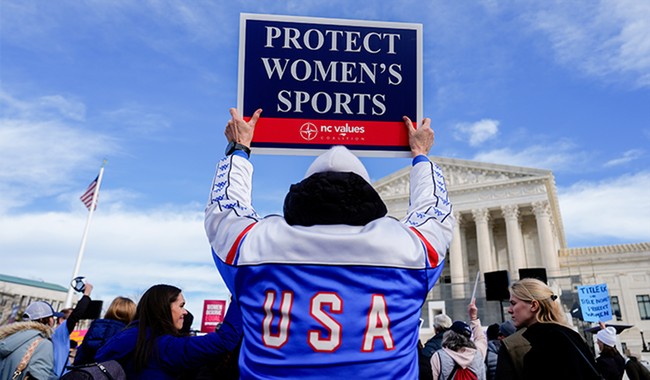
This article examines a recent poll showing broad voter support for restrictions on transgender female athletes competing in women’s sports, explains why Republicans see political advantage in the issue, and outlines how the data breaks down across party lines and independents while preserving key quoted findings exactly as reported.
This mid-term election year, Republicans have a clear, mobilizing issue: the practice of allowing “transgender girls/women”, by which the discussion frames boys and men, to compete in girls’ and women’s sports. Many GOP strategists view this as a straightforward case where biology, fairness, and voter sentiment intersect, and they are treating it as an effective wedge topic to use against Democrats. The public debate has grown sharp because the consequences play out visibly on the playing field, in locker rooms, and in school policy boards.
A new national poll is being cited as proof the Republican focus is working, showing a significant majority in favor of bans that keep biological males out of women’s sports. The headline figure from the survey has become shorthand for the argument: voters want fairness preserved in female athletics and are comfortable with state-level protections to that end. Campaign teams on the right see that number as a mandate to keep this subject in front of voters.
Here are the poll findings quoted exactly as reported: ” The majority of voters across the country support state bans on transgender athletes competing in girls’ and women’s sports, according to The Center Square Voters’ Voice Poll.” The next paragraph of the reported poll states the precise support level: “The Voters’ Voice Poll found that 68% of registered voters support allowing the Supreme Court to uphold state bans on transgender women competing in women’s sports.” Those lines are central to how the political argument is being framed this season.
It is worth noting, as some commentators have, that the phrasing about voters “allowing” the Supreme Court to act is a bit awkward; courts do not require popular permission. Still, the practical takeaway is clear: a strong majority of voters are uncomfortable with men posing as women competing in female athletics. That discomfort translates to political energy, particularly among parents, coaches, and community leaders who see the impact on girls and women in sports.
The poll results also showed clear partisan divides that conservatives find encouraging. As quoted in the original report: “Across partisan lines, a clear divide emerged between Republicans and Democrats. About 88% of Republican voters supported upholding state bans on transgender women competing in women’s sports whereas 49% of Democrat voters said the same.” Republicans interpret that gap as a structural advantage in persuading swing and disengaged voters about practical fairness concerns.
Independent voters were another key slice of the data. The polling noted: “Mike Noble, founder of Noble Predictive Insights, said the debate over transgender athletes is a ‘wedge issue’ where Republicans have an advantage. About 49% of independent voters supported transgender sports bans, with 65% of true independents agreeing on the issue.” That split gives GOP strategists room to press the point in districts where independents decide close races.
The report continued with more detail: ““Democrats seem really out of touch with those political folks in the middle of the aisle,” Noble said. “Republicans have been smart to keep going after this because this is a wedge issue for Democrats.”” Polling further found resistance among Democrats: “About 51% of Democrat voters said they would not support the U.S. Supreme Court upholding state bans on transgender women competing in women’s sports. Only about 35% of true independents said the same.” Those numbers are being used to argue that Democratic positions may cost them support among mainstream voters.
For Republican operatives, this is not just about raw policy preference but about political messaging and timing. The language of fairness, child protection, and preserving opportunities for biological girls fits into campaign themes that resonate at local and national levels. Messaging teams are preparing concise, repeatable lines grounded in the poll’s figures that can be deployed in ads, debates, and on social media.
On the substantive side, conservatives emphasize biological differences and competitive equity, citing scientific and practical examples of where trans-identifying males outperform biological females in certain sports contexts. That argument feeds into the political playbook: present the poll numbers, show clear examples, and offer state-level protections as a reasonable public policy response to voters’ concerns. The combination of data and tangible examples is meant to make the case both factual and emotional for voters heading into November.
As the issue continues to bubble in school boards and court dockets, expect Republicans to keep spotlighting the 68% figure and the partisan splits as evidence that this resonates beyond ideological circles. The debate will remain heated, but for now the numbers give one side a straightforward line to voters who prioritize fairness in women’s athletics.


Add comment