
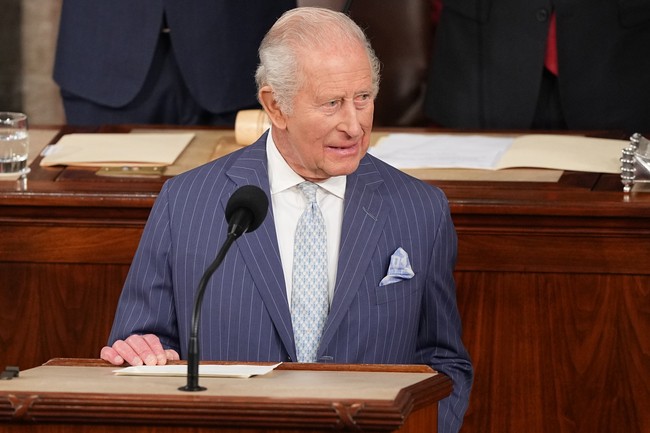
King Charles III made a forceful address to a joint session of Congress that framed the U.S.-U.K. relationship as a deliberate, strategic partnership. He tied history to present threats, condemned recent violence in Washington, and urged continued Western unity on defense and technology. The speech highlighted trade, joint military projects, and the need to choose this alliance anew in a more dangerous world.
King Charles III stood before Congress and made clear that the U.S.-U.K. alliance is not automatic but chosen, and that choice matters now more than ever. He used the 250th anniversary of the Declaration of Independence as a backdrop to emphasize both shared roots and contemporary responsibilities. The tone combined respect for history with a call to action on security and innovation.
“I would like to thank the American people for welcoming us to the United States to mark this semiquincentennial year of the Declaration of Independence,” Charles said. He framed the visit and the address around that milestone while moving quickly to current events. That juxtaposition set up a message that history informs present policy, not just memory.
He addressed the shooting near the White House Correspondents’ Dinner head-on, calling it “the incident not far from this great building that sought to harm the leadership of your nation and to foment wider fear and discord.” The remark landed in a chamber already sensitive to security risks, and he did not soften the language when speaking of the attack. This was a clear show of solidarity with American institutions under threat.
Charles followed by insisting that “whatever our differences, whatever disagreements we may have, we stand united in our commitment to uphold democracy.” That line was designed to cut through partisan noise and focus on the core premise of transatlantic cooperation. From a Republican viewpoint, reinforcing the primacy of institutions and shared values matters when confronting external threats.
He walked through a constitutional and legal lineage linking the two countries, noting centuries of mutual influence that predate the 250th anniversary. Charles referenced English common law, Magna Carta, and the Declaration of Rights of 1689 as part of the shared inheritance. He pointed out that Magna Carta has appeared in numerous U.S. Supreme Court cases to underline how entwined legal traditions still affect American jurisprudence.
Charles did not shy from the founding-era dispute that birthed American independence, stating: “The very principle on which your Congress was founded — no taxation without representation — was at once a fundamental disagreement between us, and at the same time, a shared democratic value which you inherited from us.” He then stressed the paradox that disagreement produced a durable partnership, noting, “Ours is a partnership born out of dispute, but no less strong for it.” That framing recognizes sovereign differences while insisting on cooperation where it counts.
The king turned to NATO, Ukraine, and the broader security picture, arguing that Western nations must hold the line against aggression. He tied that demand to the long-term commitments the U.K. has made, including its biggest defense spending rise since the Cold War. From a practical standpoint, the speech highlighted interoperability and shared platforms as the backbone of deterrence.
Charles pointed to concrete cooperation: joint production of F-35s, AUKUS submarine initiatives with Australia, and extensive troop exchanges and basing arrangements. He emphasized that Britain and America are collaborating across defense industries and operational footprints. This is the sort of alliance work Republicans often champion: clear capabilities, shared costs, and unified purpose.
He also addressed the economic side of the partnership, citing $430 billion in annual trade and $1.7 trillion in mutual investment as proof that security is paired with prosperity. Charles highlighted collaboration in advanced fields—nuclear fusion, quantum computing, AI, and drug discovery—as the next frontier for mutual advantage. Those sectors are where public policy, defense, and economic competitiveness intersect.
In closing, Charles urged both nations to “rededicate” themselves to a chosen alliance, warning that the world is “more volatile and more dangerous” than when Queen Elizabeth spoke to Congress in 1991. He argued that maintaining the alliance will take active commitment rather than assumption. The speech was a reminder that leadership matters, that alliances must be renewed, and that shared capability and will are essential to preserve Western interests.



Add comment