
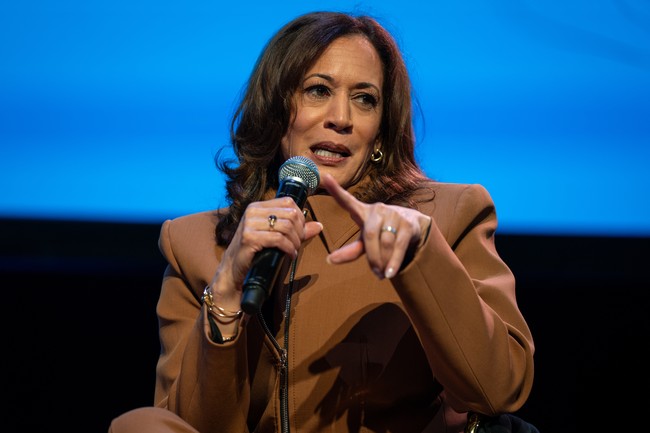
I’ll explain why Kamala Harris’ recent comments at the National Urban League conference matter for 2028, outline what she said about the Electoral College and the Supreme Court, compare her remarks to Pete Buttigieg’s, and note what this signals about Democratic strategy and optics going forward.
Kamala Harris spoke at the National Urban League Annual Conference in Tennessee and made remarks that deserve a close look from anyone thinking about 2028. One exchange stood out: when asked to name the “top three most effective” presidents, she omitted President Joe Biden. That slip drew immediate attention and raised questions about messaging and memory in Democratic ranks.
She did not stop there. Harris used the town hall portion of her appearance to push a set of structural changes to American government that aren’t new but are gaining louder voices inside her party. Specifically, she called for revisiting the Electoral College, expanding the Supreme Court to 13 justices, and considering statehood for Puerto Rico and the District of Columbia. Those suggestions matter because they touch the rules of how power gets distributed nationally.
“I know this is going to be controversial coming from me, in particular,” she said on Friday. “We need to revisit the Electoral College. We need to revisit the point of expanding the court to 13 justices like we have 13 district courts. We need to revisit, if they so want, statehood for Puerto Rico and D.C.”
That quote should be read literally. Saying “I know this is going to be controversial coming from me, in particular” is an odd preface if you had already pushed these ideas in prior venues or during soft interviews. It reads like damage control before the pitch, and it signals a shift from quiet policy exploration to full-throated advocacy. That’s the moment when insiders move ideas from thought experiments into campaign talking points.
Harris’s sudden embrace of structural fixes is not unique in Democratic circles this summer. Former Transportation Secretary Pete Buttigieg has been making strikingly similar arguments, arguing for term limits on Supreme Court appointments and openly backing a larger court. The overlap in talking points suggests a coordinated ideological push rather than isolated musings, which is why observers see a pattern and not random rhetoric.
Buttigieg’s line of argument has included calls to align the number of Supreme Court justices with the number of federal districts, and to consider reforms that would change how the court functions. Those proposals are effectively court packing by another name, and they are being framed as corrective measures for perceived partisan imbalance. Democrats pitching this as modernization are asking voters to accept a major rewrite of long-standing checks and balances.
There’s a political calculus behind these ideas: change the rules when the current system doesn’t produce your preferred outcomes. That makes sense in raw strategic terms, but it also opens Democrats to charges that they prefer process changes over delivering everyday improvements. Critics will argue that talking about altering foundational institutions looks like a substitute for practical policy that solves inflation, lowers crime, improves schools, and secures the border.
https://x.com/redsteeze/status/2054931163597439245
In the court of public opinion, optics matter. The party that talks loudly about overhauling foundational structures while some leaders live in pricey neighborhoods risks appearing out of touch. Reports that Harris bought an $8 million house in a largely white enclave were already fodder for critics, and layering constitutional change onto that image amplifies the political risk. Voters sensitive to elite double standards will use those contrasts to paint a narrative about priorities.
For 2028 watchers, the immediate worry isn’t necessarily the proposals themselves but what they reveal about Democratic priorities. If the party doubles down on institutional reform rather than bread-and-butter issues, it may hand Republicans a simple message: Democrats are focused on changing the rules, not improving daily life. That message can be potent in swing states and among independent voters who favor stability over experimentation.
Finally, the timing of these remarks matters. Offering controversial proposals midway through a political cycle is different from vetting them quietly with stakeholders. Public endorsements of sweeping changes now harden positions and give opponents clear targets. In short, Harris’s comments are a reminder that intra-party ideas have gone public, and those ideas will shape both the debate and the 2028 landscape.



Add comment