
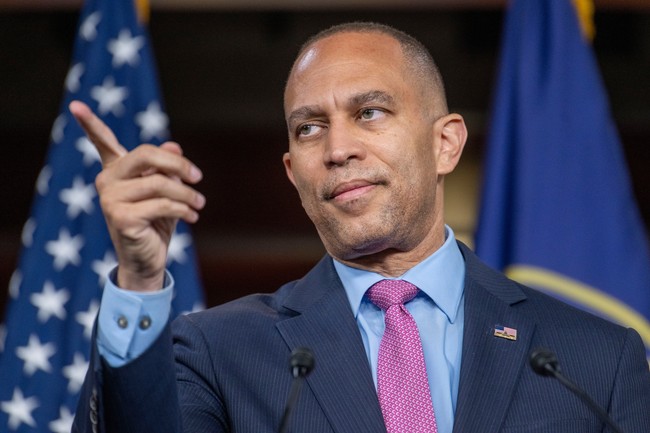
The Virginia redistricting fight has exposed a tense debate about courts and power, with Democrats reportedly weighing sweeping moves to reshape judicial makeup after a setback. This piece walks through the reported plan, reactions from House Minority Leader Hakeem Jeffries, and why the dispute over redistricting and court control matters for voters and the rule of law.
Jeffries’ New Statement About Courts Shows Just How Off the Rails Dems Are
Democrats are furious after the Virginia Supreme Court blocked a redistricting map that could have shifted as many as four congressional seats. That court decision stopped the map from being used, and some Democrats reportedly started discussing extreme responses to regain leverage. The tension is now not just about lines on a map but about whether political actors will try to remake the courts to secure favorable outcomes.
One report claims a meeting featuring House Minority Leader Hakeem Jeffries considered dramatic steps to change the judiciary in Virginia. The most extreme proposal described would shorten the mandatory retirement age for state Supreme Court justices “from 75 to 54,” a move that would force every sitting justice out and allow the majority to name replacements. If true, that plan would amount to a wholesale replacement of a court because it disagreed with a political outcome.
Perhaps the most extreme of the measures that, per The New York Times, were being considered during a meeting Saturday that included House Minority Leader Hakeem Jeffries (NY-08), was to have “Democrats in Richmond lower the mandatory retirement age for state Supreme Court justices… from 75 to 54,” a plan that, if seen through, would force out every justice currently sitting on the state Supreme Court. Afterwards, they conceivably would use their power to “then fill vacancies on the court with sympathetic Democratic lawyers.”
Even if those ideas remain only talk, the fact they were on the table shows how willing some are to use institutional changes for partisan gain. Courts exist to check majorities and protect legal stability, not to be repurposed as corrective tools when results are unfavorable. When a political party talks about lowering retirement ages or stacking courts, it crosses a line from strategy into institutional sabotage.
Jeffries was quoted as saying, “We are going to have to explore judicial ‘reform’ state by state and at the federal level…everything should be on the table as far as I’m concerned.” Those words raise alarms because they offer a sweeping approach to changing courts beyond the normal mechanisms of elections and legislation. “Everything on the table” invites uncertainty about what legal norms and protections might be altered to suit a political agenda.
Ask yourself how voters will respond when one party seeks to remake tribunals after a loss rather than accept the check that an independent judiciary provides. The notion of reforming courts to reach desired outcomes undermines confidence in the rule of law, and it sends a message that partisan advantage matters more than institutional integrity. That approach risks normalizing retaliation whenever a party dislikes a court ruling.
This debate is bigger than Virginia. Politicians across the country are watching, and what happens in one state can set a precedent in others. If elected officials begin to tinker with retirement ages, jurisdiction, or appointment rules purely to flip court majorities, the entire system of separated powers will feel the strain. The stakes are high because the courts resolve the disputes that keep democracy functioning when elected branches clash.
Voters and civic leaders should pay attention to these developments and push for protections that preserve judicial independence while keeping courts accountable through legitimate channels. A healthy system balances change with stability, preserving public trust so judges can apply the law without fear or favor. Protecting that balance means rejecting shortcuts that remake courts in the image of whoever holds political power at the moment.
Whether this episode ends as overheated rhetoric or turns into policy, it has already revealed a hunger for power that shakes the foundations of our institutions. The conversation about judicial reform must be rooted in respect for the law and constitutional limits, not in quick fixes aimed at reversing unfavorable results. When institutions are treated as instruments of partisan victory, the broader health of the republic is at risk.
Conversations about reshaping courts should be framed around clear, nonpartisan rules and guardrails that prevent episodic retaliation after one side loses a fight. Any legitimate reform discussion has to include protections for independence, transparent processes, and measures that resist sudden, sweeping swaps of judges. If not, the result will be a politics of court control rather than a justice system serving the public.



Jeffries another DEI black taco person democrats keep,trying to push a big mouth loser up the ladder to keep eyes off all the rest of them and there corruption when he falls from the top of the ladder. And he’s thinking he’s doing a great job by opening his big pie hole he’s going to go down hard. Where is all the money Taco man your going to prison and not one democrat is going to stand with you. This is why they let you of your lease.