
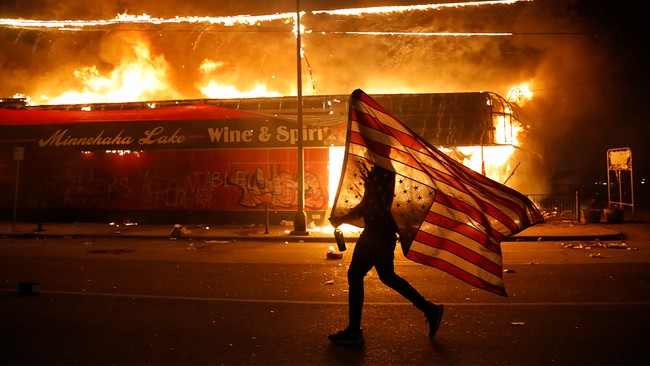
The federal government has launched a coordinated push to investigate nonprofit funding tied to violent left-wing groups, with the FBI and IRS Criminal Investigation forming a mission-control style task force to scour financial pipelines and prosecute actors who support Antifa-related violence.
Investigative Arm of IRS, FBI Reach Major Turning Point, Dig Into Nonprofits That Fund Antifa Actions
This effort answers long-standing complaints from many Americans that violent political mobs have been enabled by shadowy funding networks. The new initiative grew from a December 2025 memo by Attorney General Pam Bondi directing federal law enforcement to prioritize investigations into people and groups linked to Antifa and other extremist activity. CBS News reporters Sarah Lynch and Jennifer Jacobs first reported details of the multi-agency operation, and sources say the FBI will host a central command center with IRS agents temporarily embedded. That partnership is meant to pair law enforcement reach with forensic accounting to follow the money behind coordinated political violence.
Republicans view this as the federal government finally doing the job voters demanded when they returned President Trump to the White House. The goal is straightforward: disrupt financial support channels that enable violent protests, property destruction, and attacks on law enforcement. The effort reflects a shift from treating these events as purely local problems to recognizing national funding streams and coordination. It also reflects a political will to hold those who fund or materially support violence accountable under federal statutes wherever possible.
The Bondi memo spelled out the stakes and the administration’s rationale in stark terms, declaring the groups of interest and the harms they cause. “These domestic terrorists use violence or the threat of violence to advance political and social agendas, including opposition to law and immigration enforcement; extreme views in favor of mass migration and open borders; adherence to radical gender ideology, anti-Americanism, anti-capitalism, or anti-Christianity.” That language frames the investigation as a response to organized campaigns that use terror tactics to reshape politics and intimidate communities and officials.
Sources say the new task force will compile lists of groups that “may constitute domestic terrorism” per federal definitions and pursue cases even when domestic terrorism is not a stand-alone charge. “FBI and IRS agents are forming a new initiative to investigate nonprofit organizations over suspected possible links to domestic terrorism, sources briefed on the matter told CBS News.” Prosecutors typically use other criminal statutes and seek terrorism enhancements when appropriate, but following financial trails can create stronger, more sustainable cases against organizers and funders.
Officials emphasize legal limits and coordinated prosecution strategies. “The FBI was also ordered to develop a list of groups that are engaged in acts that ‘may constitute domestic terrorism,’ as defined by federal law.” That involves assessing whether acts are dangerous to human life, intended to intimidate or coerce civilians, influence government policy, or affect government conduct through mass destruction, assassination, or kidnapping. Investigators will therefore be looking for funding and logistics that enable such dangerous acts.
Another source described the practical setup: “The new ‘mission control command center’ that is probing nonprofits will be based at the FBI, with agents from IRS Criminal Investigation working on one-year temporary assignments, one of the sources added.” Temporary IRS assignments to the FBI should increase speed and technical capability for financial forensics, while the deputy attorney general’s office and U.S. attorney offices provide prosecutorial coordination. U.S. attorney offices have also been asked to name domestic terrorism coordinators to work with the task force on cases.
The Justice Department framed its role in a statement that reiterates standard law enforcement goals and civil liberties. “The Department of Justice is fully committed to preserving the rule of law, protecting law enforcement from coordinated attacks, ensuring everyone has the freedom to speak in the public square, participate freely in the electoral process, and practice their faith without fear of violence or harm, and bringing to justice the full range of criminal actors engaged in criminal conduct matching Congress’s definition of domestic terrorism.” That line is central to explaining why federal involvement is necessary when local authorities are overwhelmed or when funding is interstate.
IRS Criminal Investigation highlighted its role in tracking and exploiting financial evidence. “IRS Criminal Investigation (IRS-CI) is collaborating with federal law enforcement agencies, including the FBI, to investigate individuals and entities that may be funding domestic terrorism or political violence
“This coordinated effort allows agencies to leverage their respective strengths, including IRS-CI’s specialized expertise in financial investigations, to support enforcement actions and safeguard national security.”
There are precedents where federal prosecutors secured convictions tied to violent Antifa cells, showing how terrorism enhancements and financial investigations can lead to accountability. After a multi-defendant trial, the government won convictions that held attackers responsible for attempted murder, rioting, and providing material support to terrorists. Those outcomes illustrate how pursuing both violent actors and the resources that enable them can lead to meaningful sentences and deterrence.
FBI Director Kash Patel reinforced that approach in response to recent convictions: “Today justice prevailed. Terrorists who target our agents will face the full force of federal law. We will continue dismantling violent extremist networks and the funding pipelines that support them.” The political question now is whether the task force will sustain momentum, translate evidence into prosecutions, and deter future attacks by striking at the bankrolls that fuel organized violence.

Add comment