
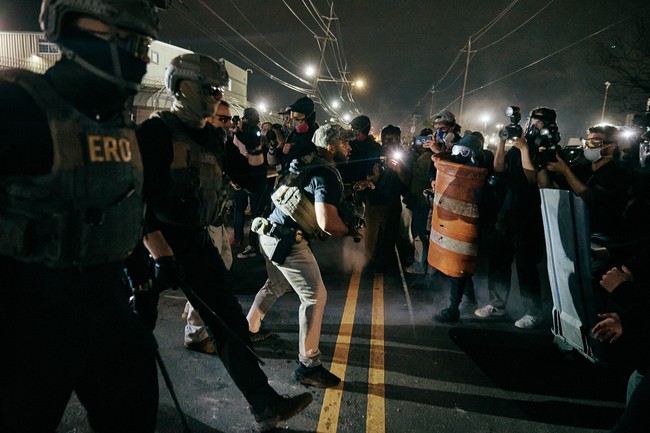
The Department of Justice has unmasked details about a 27-year-old Brooklyn man accused of loudly threatening to kill an ICE officer and his family during a protest outside a Newark detention center, and federal agents used facial recognition to identify and arrest him quickly; the case highlights concerns over violent rhetoric aimed at law enforcement and the consequences that follow when threats cross into criminal conduct.
Acting Attorney General Todd Blanche provided an update saying investigators moved fast after a video surfaced showing a demonstrator screaming violent threats at officers outside the Delaney Hall Detention Facility in Newark. The clip captured the suspect shouting, “I’ll kill your whole f***ing family! Your whole f***ing family is dead! Your children, your wife, all dead! I have your face, motherf***er! You’re dead! Dead!” and the Justice Department says that was only part of the evidence used to build the case.
The DOJ identified the defendant as 27-year-old Nicholas Matthew Scelfo, a Brooklyn resident, and charged him with influencing, impeding, and retaliating against a federal officer by threat. Authorities say Scelfo later admitted during an interview that he threatened to kill an officer and his family at the demonstration, and that he recognized himself in media coverage of the event.
FBI Director Kash Patel publicly explained how the bureau’s tools were applied, stating, “This individual allegedly threatened violence toward one of our federal law enforcement officers and their family — and by using facial recognition technology, within 24 hours this FBI got him.” He praised the rapid coordination between the acting AG and FBI teams in Newark and New York and warned that those who target officers will face consequences.
Homeland Security Investigations in Newark also weighed in, with Acting Special Agent in Charge Spiros Karabinas making clear that threats against officers and their families are not protected political speech. The Justice Department included a court filing that documents the explicit language used and notes other evidence beyond the social media video that tied Scelfo to the scene.
Federal law treats credible threats against officers as serious crimes, and the charge carries a maximum sentence of 10 years in prison and up to a $250,000 fine. That statutory penalty reflects the federal government’s interest in protecting law enforcement and ensuring that protests do not become cover for intimidation or violence against public servants.
The arrest underscores the growing challenge of balancing vigorous protest with public safety, especially when rhetoric escalates to explicit threats. From a law-and-order perspective, it is vital that officers who enforce immigration and other federal laws can do so without being menaced, intimidated, or targeted for violence by demonstrators.
Video evidence posted to social media was pivotal in this case, and the DOJ noted investigators had additional corroborating materials beyond the clip circulated online. The combination of digital footage, traditional investigative work, and biometric technology enabled authorities to move quickly from public exposure to a formal arrest.
Officials emphasized that the investigation moved deliberately but with speed once they had the suspect identified, and that law enforcement agencies coordinated to execute the arrest and gather the necessary evidence for federal prosecution. Statements from federal leaders framed the action as a straightforward application of justice rather than political posturing.
Republican-leaning commentators and law-and-order advocates have pointed to incidents like this as evidence that disorder can morph into criminal threats against officers, and they argue that strong federal action is the appropriate response. They see the case as reinforcing the principle that enforcing immigration law is legitimate and that those who threaten agents cross a legal line.
Critics of aggressive protest tactics say this case will serve as a warning to would-be agitators that inflammatory speech paired with targeted threats will trigger serious federal consequences. Supporters of law enforcement argue that this approach protects both officers and the rule of law while preserving the right to lawful protest.
The DOJ’s public account lays out a clear sequence: video evidence surfaced, investigators used facial recognition and other methods to identify the suspect, he was interviewed and admitted to the threats, and federal prosecutors moved to charge him. The message from officials was concise and resolute: threats against officers will be pursued and prosecuted.
https://x.com/HSINewark/status/2061525907391631716
Community leaders and law enforcement advocates will be watching closely as the case proceeds through the federal courts, and the outcome could influence how similar incidents are handled going forward. For now, the charged suspect faces federal counts with substantial potential penalties if convicted, marking a notable enforcement action in response to violent threats at a protest.
Here’s the video of the incident, for anyone who missed it:
Add comment