
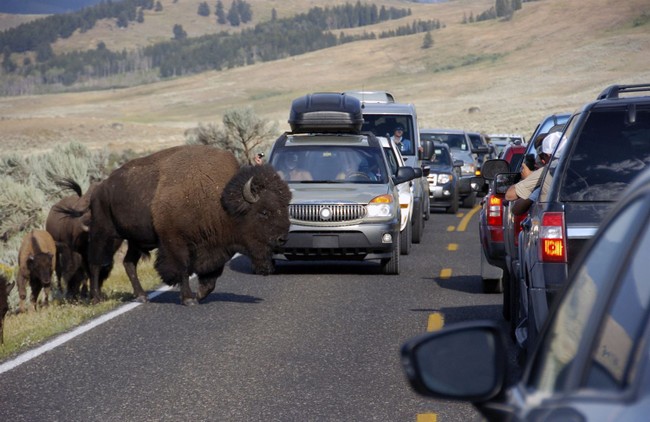
A Yellowstone visitor learned the hard way why you should give large wild animals plenty of space: a bison charged, the person fell, and a viral clip captured the whole thing. This piece looks at what went down, why people make risky choices around wildlife, and how common-sense behavior can prevent scary encounters in national parks.
Summer brings crowds to national parks, and with crowds come close calls with wildlife. Every year someone misjudges a distance and pays the price trying to photograph or approach a big animal. That pattern shows up across the country, from bears to moose to bison, and each incident reminds us that wild animals are unpredictable and powerful.
The recent Yellowstone episode fits that pattern. A tourist stepped too close to a bison, apparently thinking the animal would tolerate the attention. The bison reacted the way bison do when they feel threatened and charged to drive the person away, and the visitor ended up falling hard into the road while trying to escape.
The moment was recorded and shared widely because it is equal parts shocking and instructive. People keep making poor choices in wild places, and social feeds amplify the consequences. Viral clips like this one get millions of views because they mix danger, surprise, and a clear lesson about respecting animals and their space.
A woman learned the hard way that messing with nature is a very bad idea.
Viral videos of people testing fate with wild animals are right near the top of the list of the best content online.
Nature has plenty of uplifting moments, but it’s also full of people doing stuff so stupid that it’s honestly mind-boggling.
Part of the problem is mindset. Many visitors treat parks like photo studios instead of places where animals live without human instruction. People forget that national parks are managed for conservation and visitor safety, not for the convenience of selfies. When you step off a designated trail or close a gap in a viewing area, you reduce your margin for error dramatically.
Another factor is a lack of familiarity with animal behavior. Bison look slow and lumbering, but they can run faster than humans for short bursts and have the mass to cause serious injury. Predators and large herbivores respond to perceived threats instinctively, and their reactions are not negotiable. If an animal decides to defend itself or display dominance, distance is the only reliable buffer.
Park signage and ranger guidance exist for a reason, yet some visitors ignore both until something goes wrong. Education campaigns help, but they work only if people pay attention. Simple rules—stay on trails, keep at least the recommended distance, and never approach young animals—are effective precisely because they’re simple.
The popular Instagram page @touronsofnationalparks is known for spotlighting the foolishness of people in national parks.
The page recently posted a video that needs to be seen in order to be believed. A woman decided it was a wise idea to get close to a massive bison in Yellowstone National Park.
How do we think that worked out for her?
There are practical steps every visitor can take to avoid becoming a cautionary tale. Keep a respectful distance, learn the species you expect to encounter, and use binoculars or long lenses for close-up views. If you see warning behavior—such as a bison pawing the ground or a bear standing upright—back away slowly and give the animal space to move off.
When a close encounter does happen, knowing how to respond can reduce harm. Avoid sudden movements that might startle an animal further, and do not run if a large mammal charges; running can trigger pursuit. Instead, put a solid object between you and the animal if possible, and try to move to higher ground or into a vehicle or building without turning your back abruptly.
Wildlife encounters can be awe-inspiring when handled correctly, but they turn dangerous fast when people ignore boundaries. Respecting animals is about safety and humility: wildlife belongs in the wild, and visitors are temporary guests. Keeping that perspective will make parks safer for humans and wildlife alike.
In the Yellowstone case, the outcome could have been worse, but the footage serves as a blunt reminder. Treat large critters like the powerful animals they are, and keep a sensible distance. Watch the clip and take the lesson to heart: common sense beats a risky selfie every time.


Add comment