
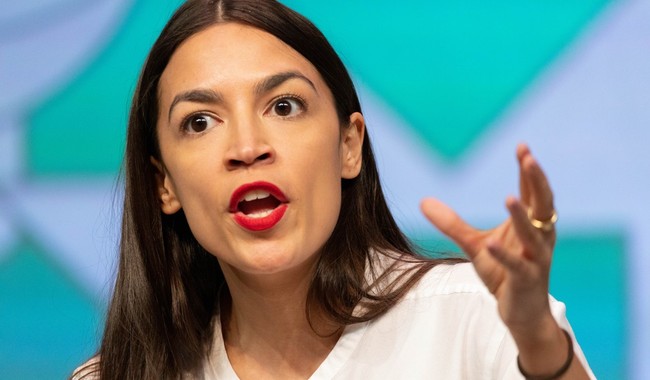
The piece examines the growing chatter about Alexandria Ocasio-Cortez contemplating a 2028 run for president, critiques her policy competence and foreign policy credibility from a Republican perspective, and considers the domestic consequences of a far-left presidency while preserving the original quoted interview exchange and embed placeholders.
Talk of AOC running for president taps into a larger worry on the right: that a radical candidate could capture a major party and reshape the country in ways conservatives find dangerous. She acknowledged she’s “thinking about a run for the big chair” during an ABC interview, and that alone has people on alert. From a Republican vantage point, the prospect is more than political theater; it symbolizes a real threat to free-market principles and national standing.
On policy, AOC projects an image at odds with traditional economic stewardship. She graduated with degrees labeled Economics and International Relations, yet she often promotes policies rooted in socialist thinking that many Republicans view as economically naive. Promises of sweeping giveaways and massive redistribution ignore incentives and growth, raising legitimate concerns about inflation, energy costs, and long-term fiscal stability.
Economists across schools disagree about theories and policy prescriptions, but the worry here is practical: voters tend to reward simple, lucrative promises even when those promises lack a credible plan to fund them. Socialists can be very effective at selling immediate relief, while the long-term bill lands on the middle class and future generations. Republicans argue that responsible governance requires balancing compassion with economic realism and that radical proposals risk bankrupting what remains of responsibly managed public finances.
KARL: So, I want to — we’re almost out of time, but get to your future. I’m sure you saw the poll in New Hampshire that had you as the leading candidate, leading choice for Democrats. First, are you going to run for president?
OCASIO-CORTEZ: I mean, I’m focused on winning the midterms. I’m running for Congress right now.
KARL: But, I mean, do you see this as something —
OCASIO-CORTEZ: You know —
KARL: I mean, I know you said you’re open to it.
OCASIO-CORTEZ: Yes, I —
KARL: Is it a realistic possibility for you?
OCASIO-CORTEZ: I haven’t — well, I haven’t ruled out the possibility. And I’m very humbled to the tremendous amount of support out there. I think that we have a responsibility to remain focused on the midterms and not on our individual aspirations or plans.
https://x.com/TVNewsNow/status/2086491622087205220
Here, :
On the world stage, competence and credibility matter. The right argues that unserious rhetoric and ideological posturing undermine deterrence and weaken alliances. A leader who appears unserious to strategic rivals hands advantage to authoritarian regimes, and Republicans believe that clarity, firmness, and respect for American strength are essential to preserving peace and national interests.
Foreign adversaries like Russia, China, North Korea, and Iran would exploit any sign of American incoherence. Republicans warn that a president lacking gravitas would invite tests of American resolve, emboldening bad actors and increasing global instability. This is not mere partisanship; it is a concrete argument about how perception influences behavior in international politics.
Domestically, the social fabric would be tested by extreme policy swings and cultural clashes. Republicans predict that a presidency focused on radical transformation would accelerate polarization, fuel the Great Sorting of Americans into ideological enclaves, and make compromise more difficult. The result, in Republican eyes, is a less governable country where economic pain and social strife are intensified.
Energy policy is a prime example. A turbocharged Green New Deal would, critics say, push prices higher and weaken energy independence, harming families and businesses. Republicans argue that pragmatic energy strategies grounded in affordability and reliability preserve living standards while allowing for measured environmental progress, not expensive, disruptive overhauls that risk economic harm.
Still, the practical politics of nominating and electing a president are messy and unpredictable. Republicans remember surprises that reshaped politics and understand that voters sometimes reward candidates who defy expectations. That history feeds vigilance: even unlikely scenarios demand attention and preparation from those who oppose radical change.
Despite the alarm, Republicans see opportunities in contrast. In debates over competence, national security, and economic stewardship, conservatives believe their emphasis on responsibility and strength resonates with many voters. The right expects to test those arguments in the marketplace of ideas and on the campaign trail, aiming to expose what they view as ideological hazards.
If AOC runs, Republicans will cast her platform as a warning: sweeping promises with shaky foundations, weak global posture, and policies that could fracture the nation economically and socially. The GOP will present an alternative centered on economic growth, secure borders, and a foreign policy that projects American power responsibly. The central question for voters will be which vision promises stability and prosperity versus sweeping experiments with uncertain outcomes.

Add comment