
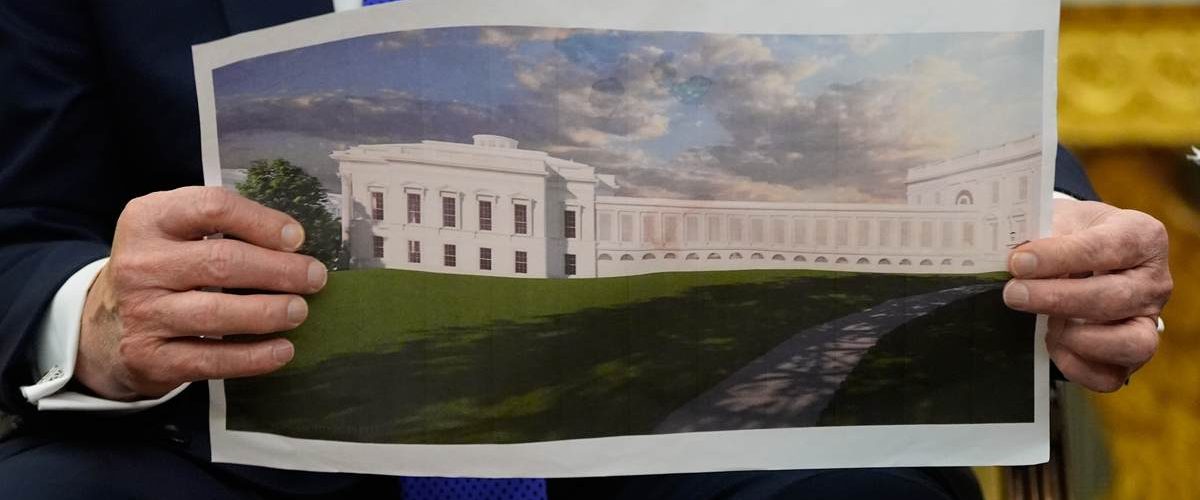
The Supreme Court has temporarily allowed construction of the White House East Wing ballroom to continue while it considers the case, but the decision is narrow and politically charged: the majority found the challengers likely lack standing while Chief Justice Roberts, joined by the Court’s liberal justices, warned that “That construction is likely unlawful.” The stay lets work proceed pending a petition for certiorari, but it does not resolve whether the project complies with congressional restrictions on building on federal public grounds. Key legal points include Article III standing, national security and operational arguments from the administration, and Roberts’ contention that existing appropriations do not authorize the scale of this project.
The Court granted the administration’s request to stay a lower-court injunction that had halted above-ground work on the East Wing project. Practically, that means crews can continue building the ballroom while the government asks the Supreme Court to take the case. The stay is a temporary procedural step, not a final ruling on legality.
The underlying dispute began when a preservation group challenged the project in federal court, and a D.C. judge issued a preliminary injunction blocking most above-ground construction. The D.C. Circuit initially allowed work to continue, then upheld the injunction, prompting the administration to seek emergency relief at the Supreme Court. The High Court replaced an earlier administrative stay with a stay issued by the full Court, pending the government’s petition for certiorari.
The majority’s explanation focused squarely on standing, rejecting the plaintiff’s claim that aesthetic and historical concerns create Article III injury. The Court said mere “offense, disagreement, or distaste” is not enough to sue, and it quoted that Article III standing “is not measured by the intensity of the litigant’s interest.” By that logic, allowing such suits would open the courthouse door to anyone displeased by a government project.
That legal framing gives the administration a provisional win: the challengers were held to lack the concrete, particularized injury required to maintain the suit. In Republican terms, this outcome respects limits on judicial power and guards against turning courts into arenas for generalized policy complaints. The decision preserves the separation of powers by emphasizing that not every dispute over public works belongs in litigation.
But Chief Justice Roberts’ dissent, joined by the Court’s liberal bloc, raises a substantial counterweight. Roberts warned that, apart from standing questions, “That construction is likely unlawful,” arguing Congress has forbidden construction on federal public grounds in D.C. without its express authorization. He contends that a modest $2.5 million maintenance appropriation does not become a blank check to demolish and rebuild large portions of a historic federal structure with hundreds of millions in outside donations.
Roberts’ analysis leans on statutory text and intent: the law requires congressional approval for new construction on President’s Park and similar federal public grounds. He says neither general Park Service management authority nor a routine maintenance appropriation supplies the express authority Congress must provide. That legal view points to a potential statutory violation that could doom the project if the Court reaches the merits and accepts his reasoning.
The administration countered by emphasizing national security and operational concerns tied to the integrated nature of the project. Senior officials filed declarations saying the ballroom and an underground facility form one construction package, with the ballroom’s height and mass tied to protecting the underground space. They warned that stopping above-ground work could jeopardize Secret Service missions, create intelligence vulnerabilities during prolonged construction, and risk structural problems if the project is paused midstream.
The majority found those equities persuasive enough, for now, to allow the work to continue while litigation proceeds. That calculus views immediate operational and safety concerns as weighty factors when balancing the harms of a construction stop against speculative aesthetic injury. For the administration, that balance buys time and momentum on an ambitious build tied to presidential operations and security planning.
So what happens next is straightforward in procedural terms: the government must file a petition for certiorari asking the Supreme Court to review the D.C. Circuit’s injunction. If the Court declines to hear the case, the stay dissolves and the injunction would resume effect unless the lower courts take other action. If the Court accepts review, the stay will remain in place through the Court’s ultimate decision, allowing construction to proceed for the duration of that review.
Meanwhile, the central substantive question remains unresolved: does the president, through agency action and a limited maintenance appropriation, have authority to build a large ballroom on President’s Park without explicit congressional approval? Roberts’ dissent frames that as a statutory question the Court may ultimately have to answer. Either way, the immediate result favors the administration’s ability to keep building while the legal fight continues.
For now, the political reality is clear: the stay gives the administration the breathing room to proceed, and it raises practical concerns about how much will be built before a definitive judicial ruling. The case will test the boundary between judicial gatekeeping on standing and the statutory limits Congress placed on construction of federal public grounds. That tension, not yet settled, is where the litigation will head next.


Add comment