
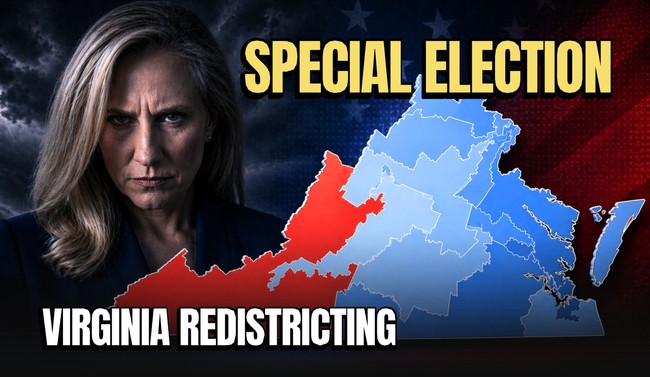
The Virginia referendum asked whether to return redistricting power to the Democrat-controlled General Assembly for a temporary congressional map ahead of the 2026 midterms, replacing the bipartisan commission set up by the 2020 amendment; the debate boiled down to whether a “temporary” fix that Democrats claim restores “fairness” is really a power grab that could cost Virginians representation and set a dangerous precedent for future mapmaking.
Election day in Virginia turned into a referendum on who gets to draw the lines that decide power. Voters were asked to weigh a constitutional change that would allow lawmakers to adopt a new congressional map for the upcoming elections, while Democrats promise the normal redistricting process will resume after the 2030 census. That “temporary” language is the hinge of the whole argument, and it has conservatives deeply suspicious.
The ballot question itself framed the change as a short-term remedy to ensure fair competition, saying legislators could adopt new districts “to restore fairness in the upcoming elections, while ensuring Virginia’s standard redistricting process resumes for all future redistricting after the 2030 census.” Many Republicans and voters read that wording and hear something different: a one-time exception that hands the keys to the party in power. This is less about neutral fairness than about who benefits from drawing lines now.
Democrats pushed the measure with high-profile endorsements and arguments that other states have already shifted their maps ahead of 2026, and Virginia should do the same to avoid being disadvantaged. Prominent figures publicly supported the plan, and the framing leaned on parity — if blue states redraw to gain seats after census shifts, Democrats said Virginia needed to act to protect its voters. To many conservatives, however, the timing and the temporary pretext do not inspire trust.
The trust question is at the core of the skepticism. To believe the Democrats’ promise that maps will be redrawn fairly in 2030, you must assume they will both hold the majority in the General Assembly by then and willingly surrender any extra advantage they gain from the interim map. For skeptics, that is a leap of faith the public has no obligation to make, especially when power is at stake and precedent matters.
Question: Should the Constitution of Virginia be amended to allow the General Assembly to temporarily adopt new congressional districts to restore fairness in the upcoming elections, while ensuring Virginia’s standard redistricting process resumes for all future redistricting after the 2030 census?
Republicans argued the referendum is not a neutral fix but a “blatant partisan power grab that nobody’s really ever seen anything like.” They warned that swapping an independent commission for direct legislative control invites partisan gerrymandering under the guise of short-term fairness. The practical outcome, critics say, could be a map stacked in one party’s favor for an entire decade once precedent is set.
“This referendum is a blatant partisan power grab that nobody’s really ever seen anything like it,” Trump said on a telerally call with Speaker Mike Johnson (R-La.) one day before the Virginia referendum.
“It’s the liberal extremist Gov. Abigail Spanberger, too bad, and the far-left Democrats in Richmond after Spanberger promised Virginia voters that she would never do this,” Trump said on the call. “And if it passes, Virginia Democrats will eliminate four out of five congressional seats, so you’re going to get just wiped out in terms of representation in Washington. That’s what it’s all about.”
“Please get out and vote and vote no. It’s very simple,” the president added. “Just vote no.”
That direct opposition from national Republican figures underscored how the fight over Virginia’s maps has become a proxy battle for control of Congress and the rules that shape elections nationwide. Republicans see this as more than a state issue; it’s about stopping a playbook that could be reused anywhere a majority wants to cement power. The rhetoric is sharp because the stakes are real: seats in Washington and the balance of influence on policy.
Supporters of the change counter that timing matters and that the adjustment is a sensible response to shifting seats and population changes that could unfairly penalize Virginia voters if the map remains unchanged. They claim “fairness” means matching national shifts so the state’s representation reflects where people live and how seats are reallocated. Yet that explanation leaves many unconvinced when the benefit appears to flow overwhelmingly to one party.
Beyond the high-profile quotes and promises, the referendum also tested how voters weigh institutional integrity against partisan advantage. The move to temporarily restore legislative control raises long-term concerns about how easily constitutional safeguards can be altered when one party sees an opening. For voters who care about impartial processes, a temporary exception that looks permanent once enacted is a hard sell.
As polls closed, commentators and political operatives from both sides were braced for tight results and legal fights to follow. The immediate outcome would determine the map for the near term, but the broader consequence could be whether states default to short-term fixes over independent systems designed to reduce partisan manipulation. The debate in Virginia felt like a warning shot about what happens when governing rules are changed in the middle of the game.



Add comment