
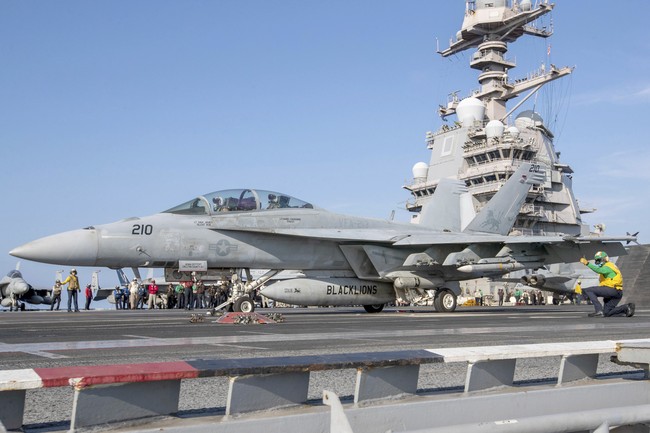
The U.S. appears to be preparing for a possible military showdown with Iran, with carrier strike groups moving into the region, Bahrain’s Fifth Fleet headquarters operating at mission-critical staffing, and public statements from leaders framing Tehran’s nuclear ambitions as unacceptable.
Ships including the USS Abraham Lincoln Carrier Strike Group are in the Arabian Sea and additional carrier groups are on the way, signaling a deliberate buildup of naval power close to Iran. Diplomatic conversations have reportedly stalled over Iran’s nuclear program, and U.S. officials are treating the window for a peaceful resolution as narrow.
The posture in the Gulf is unmistakably serious: one report says the U.S. Navy’s 5th Fleet headquarters in Bahrain has been reduced to mission-critical staffing, leaving fewer than 100 personnel at the facility. That kind of drawdown is not minor theater readiness; it’s the sort of move commanders make when risk of retaliatory or preemptive action rises.
The U.S. Navy’s 5th Fleet headquarters in Bahrain has been reduced to “mission critical” staffing ahead of potential U.S. strikes on Iran, multiple U.S. officials told Fox News.
There are now fewer than 100 personnel remaining at the facility. Ahead of Operation Midnight Hammer last June, when the U.S. struck Iranian nuclear sites, the 5th Fleet headquarters was evacuated in a similar manner.
The U.S. has been surging military assets to the Middle East in recent weeks as discussions have been ongoing between the U.S. and Iran over the future of Tehran’s nuclear program.
Fifth Fleet vessels have reportedly left port and are now at sea, a classic dispersion and maneuver pattern that makes them harder targets while positioning for contingency operations. Naval commanders do this to preserve options—defense, deterrence, and the ability to strike if ordered. Movement of major assets is also meant to send a clear signal to Tehran and to regional partners.
Public messaging has been blunt and consistent: leaders across the administration are saying Iran cannot be allowed to build a nuclear weapon. That posture combines military readiness with economic pressure aimed at constraining Tehran’s capacity and will to continue nuclear work. It’s a straightforward strategy: deny advance and increase the costs of aggression.
If talks collapse, officials have suggested a rapid shift toward kinetic measures could follow, with some commentators warning that hostilities might begin within days. When a government stages assets this way and reduces shore staffing, it is preparing for the full spectrum of operations, and that includes the possibility of strikes intended to degrade nuclear infrastructure.
President Trump framed the threat in stark terms during recent remarks, saying Iran is pursuing “sinister” ambitions and must not be allowed to acquire nuclear weapons. Political leaders often use forceful language in these moments, both to rally domestic support and to shape the calculations of rivals. The administration is pairing that rhetoric with practical actions meant to limit Iran’s access to technology, finances, and logistics.
“After Midnight Hammer, they were warned to make no future attempts to rebuild their weapons program and, in particular, nuclear weapons. Yet they continue starting it all over. We wiped it out, and they want to start all over again and are at this moment again pursuing their sinister ambitions,” Trump said Tuesday, referencing the U.S. strikes on Iranian nuclear facilities last summer.
Beyond ships and speech, Treasury actions and sanctions are part of the same campaign. Officials say targeting illicit oil sales, money laundering, and procurement networks is intended to choke off the regime’s ability to fund both weapons programs and proxy forces across the region. Economic tools can be powerful when used in concert with military deterrence.
“Iran exploits financial systems to sell illicit oil, launder the proceeds, procure components for its nuclear and conventional weapons programs, and support its terrorist proxies,” said Secretary of the Treasury Scott Bessent. “Under President Trump’s strong leadership, Treasury will continue to put maximum pressure on Iran to target the regime’s weapons capabilities and support for terrorism, which it has prioritized over the lives of the Iranian people.”
The signal being sent is clear: the administration views Iran’s nuclear pursuit as an existential red line that must be stopped, by diplomacy if possible and by force if necessary. That posture reflects a conservative approach to national security that favors strength and decisive action over prolonged accommodation. Allies and adversaries are taking note.
For now the situation remains fluid; naval movements, reduced staffing at command centers, and stepped-up sanctions together raise the likelihood of a rapid turn in policy should Tehran cross declared thresholds. Commanders and policymakers are positioning themselves to move quickly if the diplomatic track fails and the intelligence picture demands action.



Add comment