
I will explain the dispute over Arkansas Governor Sarah Huckabee Sanders’ decision to close state offices on December 26, show her response to a legal group’s demand, include her reasoning about religious expression and diversity, reproduce the original quoted letter exchange exactly, and keep the two embedded items in their original spots.
The holiday season brought a predictable clash over public displays of faith when a national secular group challenged a governor’s proclamation closing state offices the day after Christmas. The dispute centers on whether marking a government day off for a religious holiday crosses a constitutional line or simply honors a tradition many Americans observe. This debate taps into deeper tensions about public religion, pluralism, and how officials should balance secular governance with cultural and religious heritage.
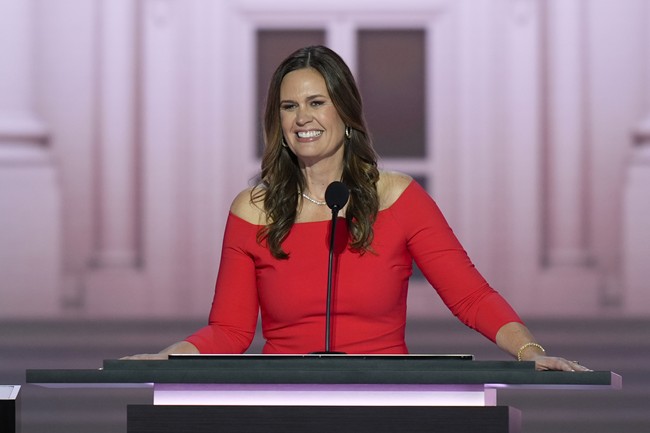
Governor Sarah Huckabee Sanders made a clear choice: she closed Arkansas state offices on December 26 and refused to reverse the decision. That move drew a letter from the Freedom From Religion Foundation asserting the proclamation was unconstitutional and demanding the closure be undone. Sanders pushed back firmly, arguing that Christmas is fundamentally the celebration of the birth of Jesus Christ and not merely a secular, end-of-year observance.
The governor’s response leaned on conviction rather than legal parsing, asserting that neutral communications on religion are impractical if not impossible. Sanders emphasized that true celebration of the holiday requires acknowledging its religious roots, not pretending those roots do not exist. Her stance reflects a common view among many conservatives: public acknowledgment of traditional faith practices does not exclude others but affirms history and cultural continuity.
After issuing a proclamation closing state offices for Christmas, Sanders received a letter from the Freedom From Religion Foundation (FFRF), a group focused on the separation of church and state, calling for her to reverse the move and claiming it was unconstitutional.
In a response letter, obtained by Fox News Digital, Sanders told FFRF she “will do no such thing.”
“You say that my communications as Governor must be neutral on matters of religion,” Sanders wrote. “I say that, even if I wanted to do that, it would be impossible. Christmas is not simply an ‘end-of-the-year holiday’ with ‘broadly observed secular cultural aspects,’ as your letter states. It’s not gifts, trees, and stockings that make this holiday special. Christmas is the celebration of the birth of Jesus Christ, and if we are to honor Him properly, we should tell His miraculous, world-changing story properly, too.”
Sanders pointed out an irony she experienced personally: she had just attended a Menorah lighting, yet the complaint accused her of alienating non-Christian constituents. She argued that people across Arkansas of many faiths already participate in civic religious expressions and that voicing one’s faith does not inherently exclude others. The governor suggested that open acknowledgement of Christianity can be part of a broader landscape where multiple faiths are recognized and respected.
Opponents of the proclamation framed the issue as a strict separation of church and state concern, arguing that government actions should avoid endorsing or privileging a particular religion. Supporters counter that recognizing a historically significant holiday is not an establishment of religion but an acknowledgment of cultural reality. That back-and-forth captures the essence of modern disputes over religious symbols and language in the public square.
The exchange also laid bare how legal arguments often collide with cultural and political ones. For legal groups, the text of the Constitution and precedent guide whether an action crosses into governmental endorsement. For elected officials and many voters, history, tradition, and communal norms shape expectations about public recognition of holidays. Both sides appeal to principles that matter deeply to their constituencies, which is why these fights seldom resolve quickly or quietly.
Practically speaking, the closing of state offices for December 26 has immediate effects for state employees and citizens who rely on government services. Some people welcomed the extra day to celebrate and gather with family, while others questioned the equity of a government recognizing a religious holiday in that way. These real-world consequences keep the debate tangible rather than purely theoretical.
The controversy also highlights how political alignment colors responses: actions that affirm traditional religious holidays often draw strong criticism from secular organizations and applause from religious constituencies. For officials like Sanders, taking a public stand on such issues sends a clear signal about governing priorities and the cultural values they intend to defend. The exchange between her office and the FFRF has become a touchstone in the ongoing conversation about faith, government, and public life.


Add comment