
The former mayor of Detroit, Mike Duggan, abruptly ended his independent campaign for Michigan governor after polling shifts and fundraising limits made his path to victory seem impossible. This article walks through the poll numbers that mattered, the timing of his exit, how the major players reacted, and what his departure means for the Republican field ahead of the August primary. It preserves the exact quotes released at the time and looks at the practical consequences for both parties in the months left before November. The tone is direct and grounded in the political reality Republicans now face on the ground in Michigan.
I used to shrug at rumors, but every so often one turns out to be right and this was one of those times. I heard the chatter that Duggan might be in trouble and treated it like noise until the numbers and the fundraising realities lined up. What changed was not a single event but a steady bleed in momentum and a national environment that shifted against his chances. For voters and operatives paying attention, the sudden announcement felt late rather than surprising.
In response to one potential three-way matchup, about 34% of voters surveyed said they supported Benson, the current secretary of state from Detroit, 29% said they backed Republican U.S. Rep. John James of Shelby Township, and 23% said they preferred Duggan, the former mayor of Detroit who’s running as an independent. About 14% were undecided.
The margin of error was plus or minus 4 percentage points.
The poll numbers showed Duggan trailing both a Democrat and a viable Republican in a three-way scenario, and that reality shrank the appeal of his independent bid. For someone running outside the two-party structure, you need more than name recognition; you need a clear funding stream and national backers to close the gap. Duggan never found that national donor base and struggled to convert his Detroit record into statewide traction. That grind exposed the limits of independent campaigns in competitive, high-stakes gubernatorial contests.
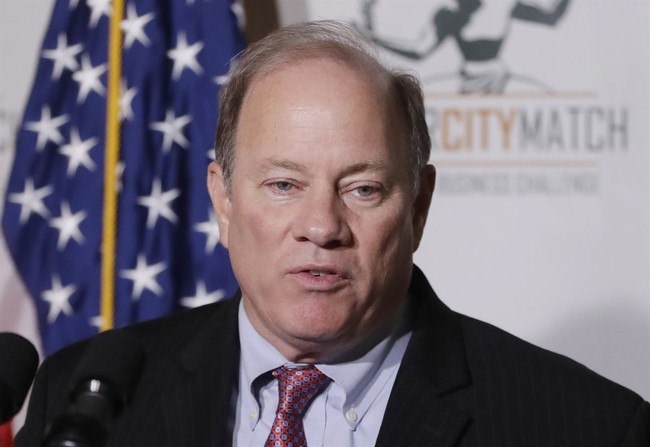
Former Detroit Mayor Mike Duggan ended his independent campaign for governor Thursday, resetting the race for Michigan’s highest political office.
“We don’t feel like there is a path forward. And I never ran to be a spoiler,” Duggan said Thursday afternoon at a press conference at Huntington Place.
Duggan said he no longer felt good about his chances of winning in November because of shifting “huge national headwinds” swinging in the favor of Democrats and struggles to establish a national fundraising base beyond Michigan supporters.
“What we’re doing today is facing reality,” Duggan said.
The timing of Duggan’s departure shifts the dynamics for both parties. For Democrats, it removes the risk of a split that could have handed the race to a Republican through vote division. For Republicans, it eliminates the potential strategic advantage of a weakened Democratic nominee and puts the pressure squarely back on their primary to produce a candidate who can compete statewide in November. That means fundraising, discipline, and sharpening a clear message for Michigan voters.
On the GOP side, candidates like John James, Mike Cox, and Perry Johnson now face a different calculus. Instead of preparing to run against a three-way map where Duggan siphoned Democratic votes, the eventual nominee must take a direct run at the likely Democratic standard-bearer. Republicans will need to marshal resources quickly, build a strong ground game, and present a unified pitch that addresses Michigan voters’ real concerns. Losing the independent wildcard makes the race cleaner, but also more uphill.
“At a time when politics can feel divided and cynical, we need more civility, more listening, and more people willing to work together to move our state forward,” Benson said. “I welcome Mayor Duggan’s ideas, his supporters, and everyone who believes Michigan’s future is bigger than division — and that it can be a place where anyone can afford to live, work, and thrive. We may not always agree on everything, but we share a commitment to building a stronger Michigan. And that work continues in this campaign.”
Benson’s quick, polished response was expected and aimed at consolidating the center-left voters who had been tempted by Duggan. From a Republican view, that rapid pivot underscores the challenge ahead: Democrats are organized and ready to absorb defections. Republicans must respond by outlining a positive, practical platform on jobs, public safety, and fiscal common sense that resonates across suburban and rural Michigan.
There is still room for optimism in the GOP camp, but lessons remain. Independent bids can alter races in unpredictable ways, and when they collapse, the fallout benefits the party that can act fastest. The coming weeks will test the Republican candidates’ ability to raise money, sharpen contrasts, and present a credible alternative capable of winning statewide. Michigan now looks like a straightforward two-way contest, and both sides will adjust accordingly.
Editor’s Note: The 2026 Midterms will determine the fate of President Trump’s America First agenda. Republicans must maintain control of both chambers of Congress.


Add comment